More Indians now drive on holidays, business trips and study abroad, and more visitors from other countries hire cars and motorcycles in India. Driving in another country means a different licence system, different laws and, in most countries, driving on the other side of the road. This article explains the International Driving Permit (IDP) and how to adapt safely.
India Drive Safe rule:
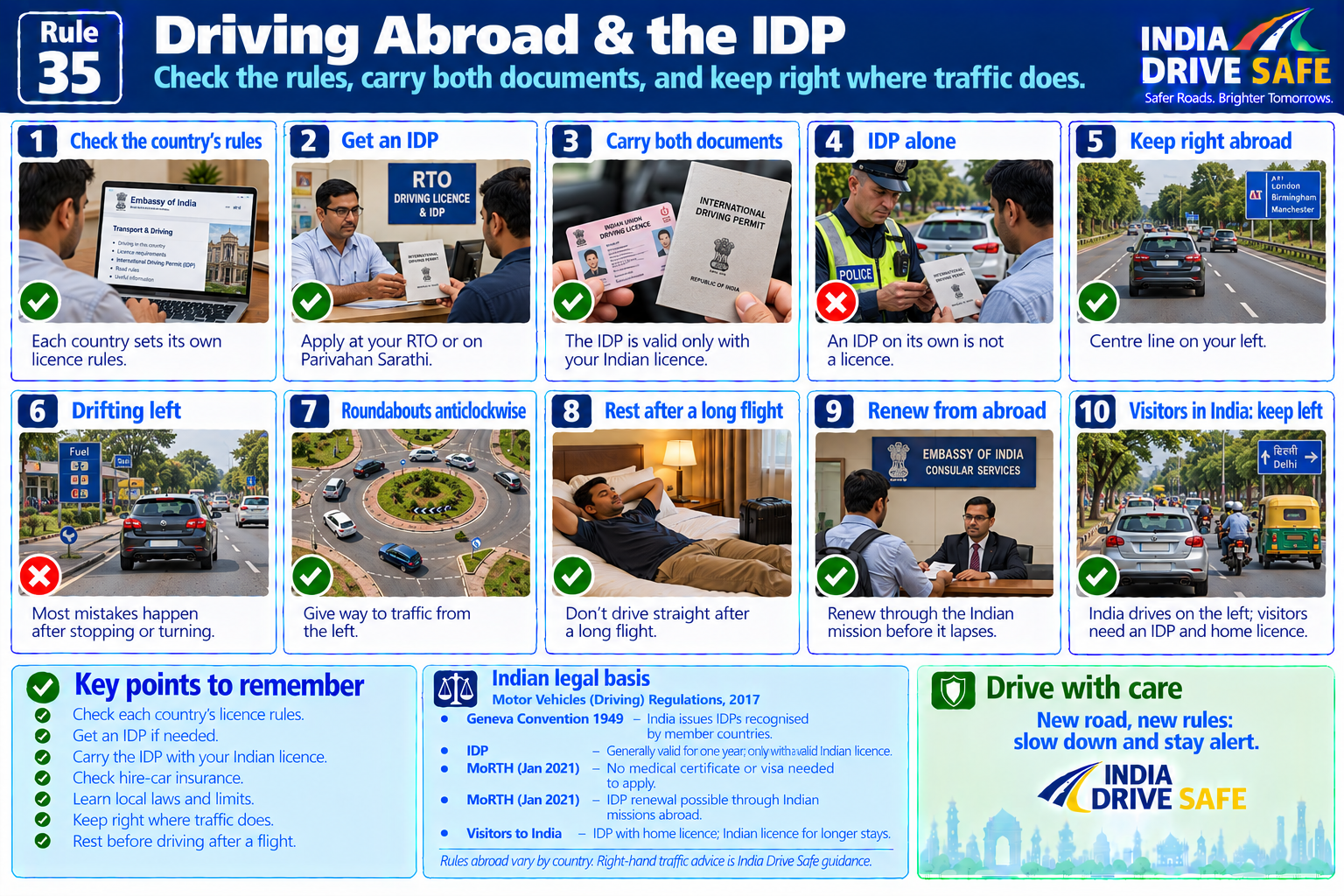
Before driving in another country, check what licence it accepts, get an International Driving Permit if needed, carry it with your Indian licence, and learn the local rules. If traffic keeps to the right there, take extra care at every turn, junction and roundabout.
Before driving in another country, check what licence it accepts, get an International Driving Permit if needed, carry it with your Indian licence, and learn the local rules. If traffic keeps to the right there, take extra care at every turn, junction and roundabout.
The International Driving Permit (IDP)
- What it is: an IDP is a translation of your Indian driving licence in a standard international format. India is a party to the 1949 Geneva Convention on Road Traffic, and countries that follow it recognise IDPs issued under it.
- It is not a licence on its own. Always carry your valid Indian driving licence with the IDP. The IDP covers only the vehicle classes on your Indian licence.
- Who can apply: a person holding a valid Indian driving licence, at the RTO where they live or online through the Parivahan Sarathi portal. You will need your licence, passport and photographs, and to pay the fee.
- Validity: an IDP is generally valid for one year from issue, and never beyond the validity of your Indian licence.
- 2021 changes: since 15 February 2021, a medical certificate and a visa are no longer needed to apply for an IDP in India, and Indians whose IDP expires while they are abroad can apply for renewal through Indian embassies and missions. The IDP format has also been made uniform across all States.
Check the rules of the country you are visiting
- some countries accept an Indian licence on its own for short visits, often with an English translation; others insist on an IDP; and some do not recognise IDPs issued under the 1949 Convention. Check the official transport or embassy website of the country before you travel;
- if you are moving abroad to live, most countries allow you to use your Indian licence or IDP only for a limited time, after which you need a local licence;
- car-hire companies may have their own rules, such as a minimum age or a minimum number of years since you passed your test; and
- check that your hire car's insurance covers you, and what you must pay if it is damaged.
Driving on the right
India drives on the left. Most countries drive on the right, and everything is reversed. The danger is greatest in the first few days, when you are tired after travel, and whenever you turn or pull out.
- keep right: the centre line should be on your left. Repeat "keep right" to yourself, especially after stopping, at car parks, fuel stations and one-way streets;
- turning left now crosses oncoming traffic, like a right turn in India. Wait for a safe gap;
- roundabouts go anticlockwise, and you give way to traffic coming from the left;
- overtaking is on the left;
- as a pedestrian, look left first when stepping off the kerb;
- in a left-hand-drive car, gears and controls are on the other side. Hire an automatic if you can, and sit in the car to learn the controls before you move off; and
- start on quiet roads, avoid driving straight after a long flight, and do not drive at night until you are comfortable (Rule 29).
Know the local laws
- alcohol limits differ; some countries allow no alcohol at all. The safest rule anywhere is not to drink at all before driving (Rule 14);
- speed limits are often enforced strictly by cameras, with heavy fines that can follow you through the hire company;
- pedestrians usually have strong priority at crossings, and drivers are expected to stop for them;
- horn use is often rare and seen as aggressive (Rule 27);
- child seats and seat belts are strictly required in most countries (Rules 16 and 28); and
- some countries require warning triangles, reflective vests, headlights in daytime, or winter tyres. Check before you go.
Visitors driving in India
- visitors from abroad generally need an IDP together with their home licence to drive in India, and these are usually accepted for up to one year. To drive for longer, apply for an Indian licence at the local RTO. Check the current requirements with the RTO or your hire company;
- India drives on the left, and the driver sits on the right (Rule 01). Take time to adjust;
- Indian traffic includes many two-wheelers, auto-rickshaws, cycles, pedestrians and animals sharing the road. Drive slowly, expect the unexpected, and keep a safe distance (Rules 03, 08 and 25);
- wear a helmet on every two-wheeler and a seat belt in every seat (Rules 15 and 28); and
- in an emergency, call 112 (Rule 12).
Common mistakes
Carrying only the IDP
Always carry your Indian licence with it.
Always carry your Indian licence with it.
Assuming an IDP works everywhere
Check each country's rules before you travel.
Check each country's rules before you travel.
Drifting to the left side abroad
Keep right; take extra care after every stop.
Keep right; take extra care after every stop.
Driving straight after a long flight
Rest first; tiredness and a new side of the road are a bad mix.
Rest first; tiredness and a new side of the road are a bad mix.
Using the horn as at home
In many countries it is seen as aggressive.
In many countries it is seen as aggressive.
Letting the IDP lapse while abroad
Renew through the Indian mission before it expires.
Renew through the Indian mission before it expires.
Before you travel
Check the country's licence rules → get an IDP if needed → carry it with your Indian licence → check hire insurance → learn local laws → keep right if traffic drives on the right.