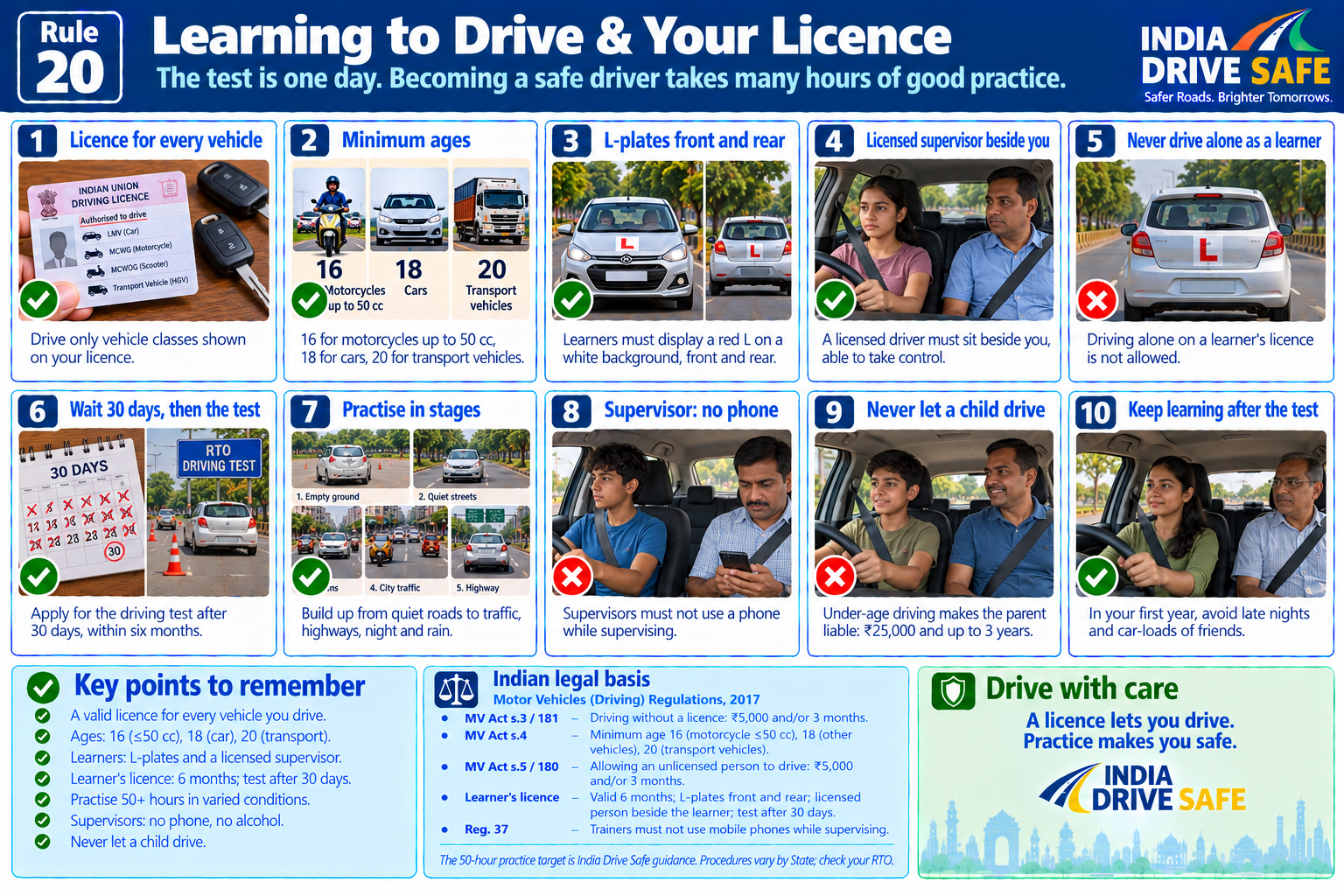
A driving licence proves that you passed a short test on one day. It does not prove that you can handle a monsoon night on a highway, a crowded market street or a truck overtaking on a blind bend. Those skills come from good teaching and many hours of supervised practice. This article explains what Indian law requires to get a licence, and how to become a genuinely safe driver along the way.
Never drive without a valid licence for that class of vehicle. As a learner, always display L-plates and drive only with a licensed supervisor beside you. Aim for many hours of varied, supervised practice, not just enough to pass the test.
What Indian law clearly requires
- A licence is compulsory (Section 3 of the Motor Vehicles Act, 1988): no one may drive a motor vehicle in a public place without an effective driving licence for that class of vehicle. Driving without one carries up to 3 months in prison, a fine of ₹5,000, or both (Section 181).
- Minimum ages (Section 4):
- 16 years: motorcycles with an engine capacity not exceeding 50 cc (a learner's licence for a gearless motorcycle under 18 needs written consent from a parent or guardian);
- 18 years: cars and other non-transport vehicles; and
- 20 years: transport (commercial) vehicles. A learner's licence for a transport vehicle generally requires having held a driving licence for at least one year.
- Owners are responsible (Sections 5 and 180): an owner who lets an unlicensed or under-age person drive faces up to 3 months in prison, a ₹5,000 fine, or both. If the driver is a child, Section 199A also applies: the parent or owner faces ₹25,000 and up to 3 years in prison (Rule 14).
- Driving while disqualified (Section 182): up to 3 months in prison, a ₹10,000 fine, or both.
- Insurance (Section 196): driving an uninsured vehicle carries up to 3 months in prison and/or a ₹2,000 fine for a first offence.
The learner's licence
- apply to your licensing authority (RTO), usually online through the Parivahan Sarathi portal, and pass a computer-based test on road rules and signs. Some States set a pass mark of 60%;
- a learner's licence is valid for six months;
- you may apply for the driving test after 30 days from the date the learner's licence is issued, and before it expires;
- while learning, a person holding a valid driving licence for that vehicle must sit beside you, able to take control or stop the vehicle; and
- display a red "L" on a white background on the front and rear of the vehicle. The background must be at least 18 cm square, and the L at least 10 cm high, 2 cm thick and 9 cm wide at the base.
Rules on carrying passengers while learning, especially on motorcycles, can vary. India Drive Safe recommends that learners carry no passengers other than their supervisor.
The driving test and accredited training centres
- the practical test is normally taken at the RTO's test track or on public roads with an inspector;
- since 1 July 2021, the Central Motor Vehicles Rules (Rules 31B–31J) allow Accredited Driver Training Centres, with simulators and a dedicated test track. A person who passes the course and test at an accredited centre is exempt from the driving test at the RTO; and
- the Ministry has clarified that ordinary driving schools are not the same as accredited centres. Check the accreditation before you enrol if you want the test exemption.
Your licence and documents
- your licence lists the classes of vehicle you may drive, for example a motorcycle without gear, a motorcycle with gear, a light motor vehicle (car) or a transport vehicle. Drive only the classes shown;
- check the expiry date and renew in time; and
- you may carry your licence, registration, insurance and pollution certificate in electronic form through DigiLocker or mParivahan (Regulation 38, as amended in 2020).
Learning to drive well
Indian law does not set a minimum number of practice hours. Other countries do: in New South Wales, learners under 25 must log at least 120 hours of supervised driving, including 20 hours at night, before their test. India Drive Safe recommends at least 50 hours of supervised practice, spread over weeks, covering:
- Quiet roads and open spaces: controls, steering, clutch and brakes, moving off and stopping smoothly.
- Residential streets: observation and mirrors (Rule 02), road position (Rule 01), pedestrians and two-wheelers (Rule 08).
- Junctions and traffic lights: Rules 05, 06, 07 and 19.
- Busier city traffic: lane changes and merging (Rule 18), speed and distance (Rule 03), overtaking (Rule 04).
- Parking and reversing: Rule 10.
- Highways, once confident: Rule 09 and Rule 17.
- Night, rain and hills, with an experienced supervisor: Rule 11.
This driving guide is arranged in the same order, so a learner can read one rule, then practise it.
For supervisors, parents and instructors
- stay calm and patient; shouting makes learners freeze;
- plan each session: choose the route and the skill to practise beforehand;
- never use your phone while supervising. Regulation 37 prohibits trainers from using mobile phones while supervising a learner;
- be fit to take control: no alcohol, and no supervising when you are tired; and
- model good habits yourself. Learners copy what they see.
The first year after the test
New drivers have the highest crash risk. India Drive Safe recommends that for the first year you:
- avoid late-night driving and long highway trips alone;
- limit passengers, especially groups of friends, who distract new drivers;
- keep the phone out of reach and drink no alcohol at all before driving (Rule 14); and
- keep practising difficult conditions with an experienced driver beside you.
Two-wheeler learners
Most Indians learn to ride informally. Take a proper riding course if one is available, practise in a safe open space first, and always wear an ISI-marked helmet with the strap fastened (Rule 15).
Common mistakes
A licensed supervisor must be beside you, and L-plates displayed.
Under-age driving makes the parent criminally liable (Sections 180 and 199A).
The test is the start. Aim for 50+ varied hours.
A car licence does not cover a geared motorcycle or a transport vehicle.
Regulation 37 prohibits it. The supervisor must be ready to take control.
You get a licence without the skills, and the road will test you anyway.