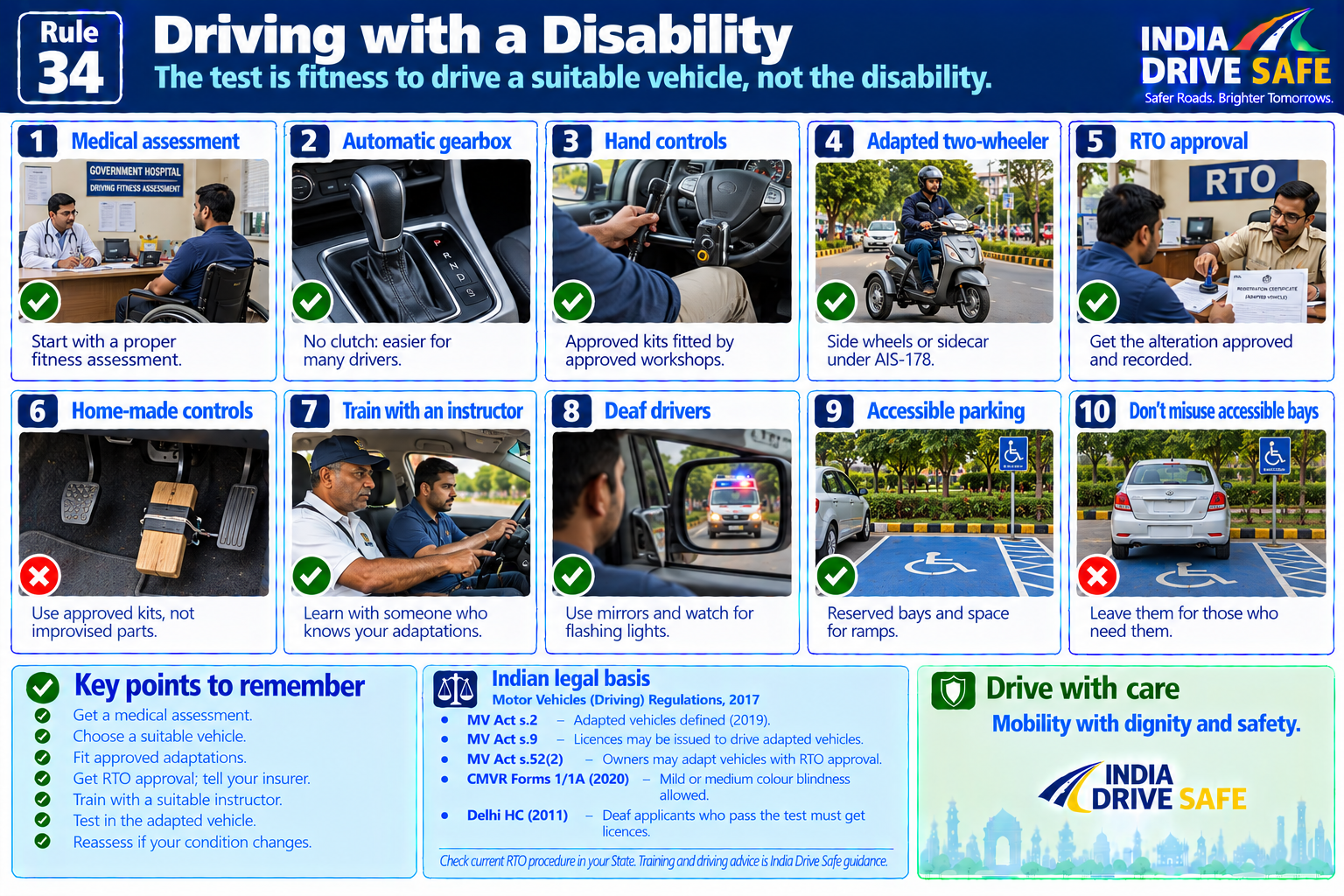
Many people with disabilities drive safely every day, often with a vehicle adapted to their needs. Indian law now recognises adapted vehicles, and courts and the Government have opened driving licences to people who were once excluded, such as deaf people and people with mild colour blindness. The test is whether a person can drive a particular vehicle safely, not the disability itself. This article explains the rules and the steps.
India Drive Safe rule:
If you have a disability, get a proper medical assessment, choose a vehicle and adaptations that suit you, learn with a trained instructor, and take the test in that vehicle. Your licence then lets you drive the adapted vehicle safely and legally.
If you have a disability, get a proper medical assessment, choose a vehicle and adaptations that suit you, learn with a trained instructor, and take the test in that vehicle. Your licence then lets you drive the adapted vehicle safely and legally.
What Indian law says
- Adapted vehicles are recognised: since the 2019 amendments, the Motor Vehicles Act, 1988 defines an adapted vehicle as one specially built, or altered under Section 52(2), for use by a person with a physical defect or disability, and used solely by or for that person (Section 2).
- Licences for adapted vehicles: a licensing authority may issue a driving licence for an adapted vehicle if it is satisfied that the applicant is fit to drive it (Section 9).
- Altering your own vehicle: any owner may alter a vehicle into an adapted vehicle, with the subsequent approval of the registering authority (RTO) and under conditions set by the Central Government (Section 52(2)). The change must be recorded in the registration certificate.
- Standards: technical requirements for adapted two-wheelers, three-wheelers and tricycles are set in the Automotive Industry Standard AIS-178 (2024 edition), including approved kits, fitting workshops, testing and RTO registration.
- Medical fitness: every applicant declares their fitness in Form 1; a medical certificate in Form 1A is needed in some cases, including for transport vehicles and for older applicants (Central Motor Vehicles Rules, Rule 5). Be honest: false declarations can lead to the licence being cancelled.
- Colour blindness: since an amendment to Forms 1 and 1A in June 2020 (G.S.R. 401(E)), people with mild or medium colour blindness can obtain a driving licence; restrictions apply only to severe colour blindness.
- Deaf and hard-of-hearing drivers: in 2011 the Delhi High Court directed that deaf people who meet the other criteria must be allowed to take the test and, if they pass, be granted a licence (National Association of the Deaf v. Union of India). Hearing aids may be used where they help.
- If your condition changes: a licensing authority can require a medical test and suspend or revoke a licence if a disease or disability makes a person unfit to drive. Driving while knowingly unfit is an offence (Sections 16 and 186; Rule 29). If your health or vision changes, get reassessed.
Getting started: step by step
- Medical assessment. Ask a government doctor or a rehabilitation centre for an assessment of your fitness to drive and of the adaptations you need.
- Choose the vehicle. An automatic gearbox removes the clutch and gear changes, which helps many drivers with leg or hand impairments. Two-wheelers can be fitted with side wheels or a sidecar.
- Fit the adaptations through an approved supplier or workshop: hand controls for accelerator and brake, a steering knob, left-foot accelerator, pedal extensions, swivel seats, ramps or wheelchair docking, as needed.
- Register the change. Apply to the RTO for approval and for the vehicle to be recorded as an adapted vehicle in the registration certificate. Inform your insurer too.
- Learner's licence and training. Get a learner's licence for the adapted vehicle and practise with an instructor who understands your adaptations (Rule 20).
- The test. Take the driving test in the adapted vehicle. The licence is then issued for driving the adapted vehicle.
Driving safely with a disability
- practise in a quiet place until using the adapted controls is automatic, especially emergency braking;
- set the seat, mirrors and steering for your posture before every drive (Rule 28), and add extra mirrors if turning your head is difficult;
- deaf drivers: rely more on mirrors and look out for flashing lights from emergency vehicles (Rule 12). Consider a sticker or card in the vehicle explaining that you are deaf, to help in a police check or emergency;
- plan routes, breaks and accessible stops, because fatigue may come sooner (Rule 29);
- carry a charged phone and emergency contact details. If you break down, switch on hazard lights and call for help rather than getting out into traffic; and
- keep your medical documents and the RTO approval of the adaptations with your vehicle papers (Rule 21).
Parking and access
- many public buildings, malls and municipal car parks have reserved accessible parking bays under national accessibility guidelines. Some cities' traffic police issue disability parking stickers; ask locally; and
- other drivers must never use accessible bays without entitlement. Leave the extra space beside them clear for wheelchairs and ramps.
For other road users
- a vehicle may be driven by someone using hand controls or who cannot hear your horn. Be patient, give space, and do not crowd or tailgate;
- do not park in accessible bays or block kerb ramps (Rule 10); and
- drivers must take special care of people with disabilities on the road (Regulation 5(4); Rule 08).
Common mistakes
Adapting a vehicle without RTO approval
Get it approved and recorded, and tell your insurer.
Get it approved and recorded, and tell your insurer.
Assuming a disability means no licence
The test is fitness to drive a suitable vehicle.
The test is fitness to drive a suitable vehicle.
Hiding a medical condition
Declare it honestly; get reassessed if it changes.
Declare it honestly; get reassessed if it changes.
Learning without a suitable instructor
Train with someone who knows your adaptations.
Train with someone who knows your adaptations.
Using accessible bays without need
Leave them for those who need them.
Leave them for those who need them.
Unapproved home-made controls
Use approved kits and workshops.
Use approved kits and workshops.
Remember
Medical assessment → suitable vehicle → approved adaptations → RTO approval and insurer told → trained instructor → test in the adapted vehicle → reassess if your condition changes.