From the Western Ghats to the Himalaya and the hills of the North-East, India has thousands of kilometres of steep, narrow, winding roads. They need different skills from the plains: controlling speed downhill without overheating the brakes, starting on a slope, judging hairpin bends, and giving way correctly where vehicles cannot pass. Rule 11 gives the basics; this rule goes further.
India Drive Safe rule:
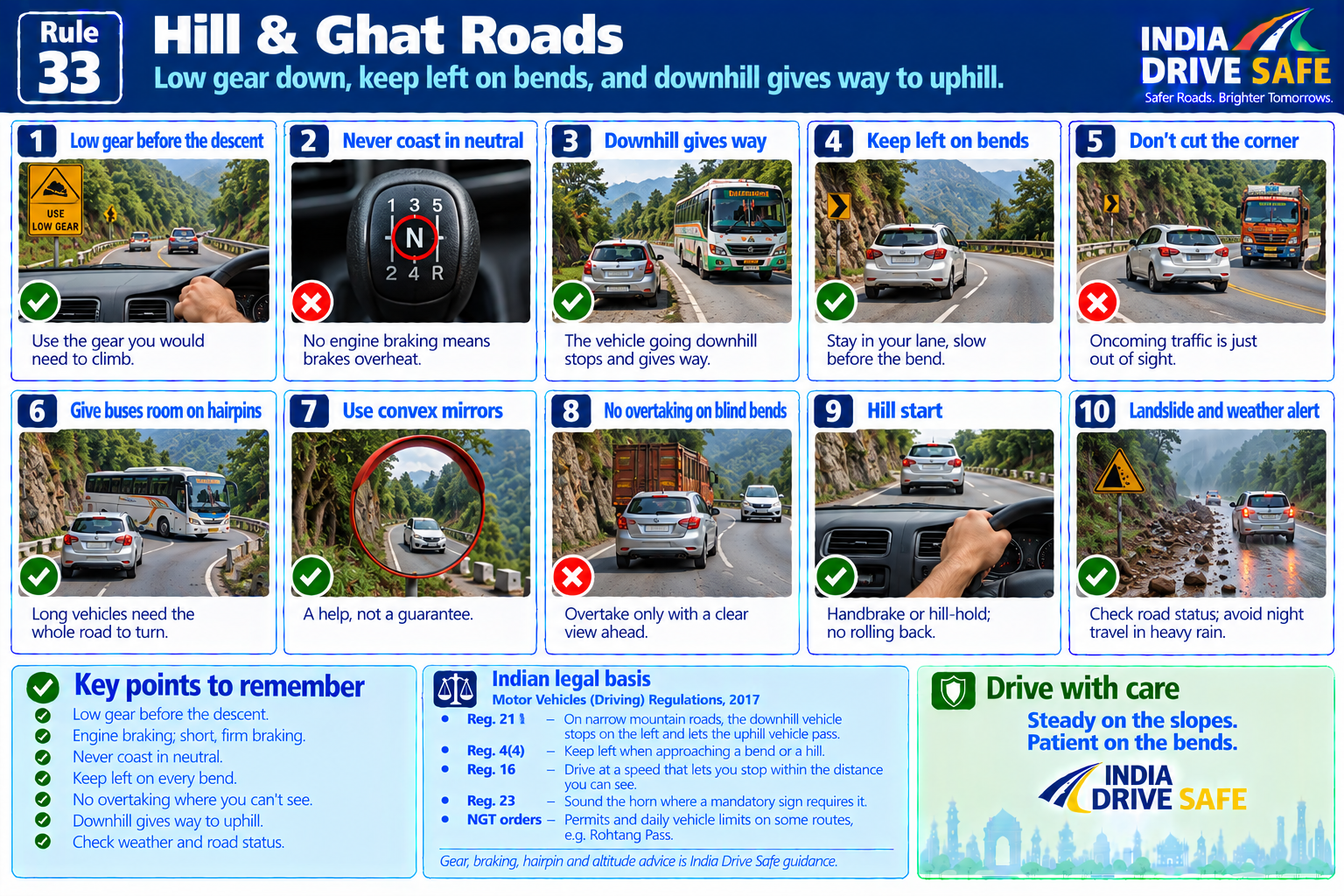
On hills, use the same low gear going down that you would need going up, and let the engine hold your speed. Keep left on every bend, never overtake where you cannot see, and where the road is too narrow to pass, the vehicle going downhill stops and gives way.
On hills, use the same low gear going down that you would need going up, and let the engine hold your speed. Keep left on every bend, never overtake where you cannot see, and where the road is too narrow to pass, the vehicle going downhill stops and gives way.
What Indian law says
- Uphill priority: on a mountain road or steep road too narrow for vehicles to pass freely, the driver going downhill must stop on the left and let the vehicle going uphill pass first (Regulation 21 of the Motor Vehicles (Driving) Regulations, 2017).
- Keep left on bends and hills: keep to the left when approaching a bend or a hill, or wherever the view ahead is restricted (Regulation 4(4)).
- Speed: drive at a speed at which you can stop safely within the distance you can see (Regulation 16).
- Horn: sound the horn where a mandatory sign requires it, as on many blind ghat bends (Regulation 23; Rule 27).
- Parking: do not stop or park on or near a bend (Regulation 22).
- Permits and limits: some mountain routes limit the number of vehicles or need a permit. For example, under National Green Tribunal orders, vehicles going beyond Gulaba towards the Rohtang Pass need an online permit, and the number allowed each day is capped. Check the rules and road status before you travel.
Going downhill: let the engine do the work
- select a low gear before the descent, generally the gear you would use to climb that slope. In an automatic, use the low (L, 2 or manual) mode or paddles;
- let engine braking hold your speed, and use the brakes firmly but briefly to slow down further, rather than resting your foot on the pedal all the way down;
- never coast in neutral or with the clutch pressed. You lose engine braking, and the brakes must do all the work;
- if the brakes start to smell, feel soft, or the vehicle does not slow as it should, the brakes are overheating (brake fade). Change down a gear, slow down, and stop in a safe place to let them cool;
- never pour water on hot brakes or drums, which can crack them; and
- heavy vehicles are slowest downhill. Keep well back from trucks and buses on descents in case their brakes fail.
If your brakes fail downhill
- switch on hazard lights and use the horn to warn others;
- pump the brake pedal; it may regain some pressure;
- change down through the gears one at a time, and apply the handbrake gradually, not suddenly;
- use an escape ramp or arrester bed if there is one; and
- if you must, steer to rub the vehicle against the hillside or a barrier on the uphill side, not towards the valley.
Going uphill
- change down early, before the engine struggles, and keep a steady speed;
- keep a longer gap behind heavy vehicles, which may slow down sharply or roll back slightly when they stop;
- starting on a slope: hold the vehicle on the handbrake (or use hill-start assist), find the clutch's biting point, add a little more power, then release the handbrake as the vehicle pulls. Do not let it roll back into the vehicle behind; and
- watch the temperature gauge. If the engine overheats, stop safely and let it cool with the engine idling or off, as the manual says. Do not open a hot radiator cap.
Bends and hairpins
- slow down before the bend, not in it, and stay in your lane, well to the left. Do not cut corners;
- on hairpins, long buses and trucks need the whole road to turn. If you see one coming, stop well back on your side and let it complete the turn;
- use the convex mirrors fitted on many blind bends to look for oncoming traffic, but treat them only as a help; and
- at night, headlights sweeping round a bend can warn of oncoming vehicles. By day, a short horn where signs require it does the same.
Overtaking and passing on hills
- overtake only on a straight stretch where you can see far enough ahead to complete the move safely (Rule 04). Never overtake on a bend, a crest or near a hairpin;
- if you are driving slowly with a queue behind you, pull into a safe lay-by and let them pass; and
- where the road is too narrow to pass, the downhill vehicle gives way (Regulation 21). If you are going uphill and the downhill driver has nowhere to stop, use a passing place yourself if it is safer, and communicate clearly.
Landslides, rain, snow and altitude
- in the monsoon, check road and weather warnings before travelling. Avoid ghat roads at night during heavy rain, and do not stop under unstable slopes or beside fresh rockfalls;
- watch for loose gravel, mud, water flowing across the road and fallen rocks, especially after bends;
- on snow and ice, drive very gently: no sudden steering, braking or acceleration. Use snow chains where advised, and beware of ice on shaded bends early in the morning;
- at high altitude, both you and the engine have less oxygen. Climb gradually, rest, drink water, and do not drive if you have a severe headache, dizziness or breathlessness; and
- carry warm clothes, water, food, a torch and a fully charged phone, and fill fuel before long mountain stretches.
Common mistakes
Coasting downhill in neutral
No engine braking. Stay in a low gear.
No engine braking. Stay in a low gear.
Riding the brakes all the way down
Brakes overheat and fade. Use engine braking.
Brakes overheat and fade. Use engine braking.
Cutting the corner on a hairpin
Keep left; oncoming traffic is just out of sight.
Keep left; oncoming traffic is just out of sight.
Overtaking on a blind bend
Only on straight stretches with a clear view.
Only on straight stretches with a clear view.
Downhill driver refusing to give way
Regulation 21 gives priority to the vehicle climbing.
Regulation 21 gives priority to the vehicle climbing.
Stopping on a bend for photos
Use a safe lay-by or viewpoint instead.
Use a safe lay-by or viewpoint instead.
Remember
Low gear before the descent → engine braking, short firm braking → no coasting → keep left on bends → no overtaking blind → downhill gives way to uphill → check weather and road status first.