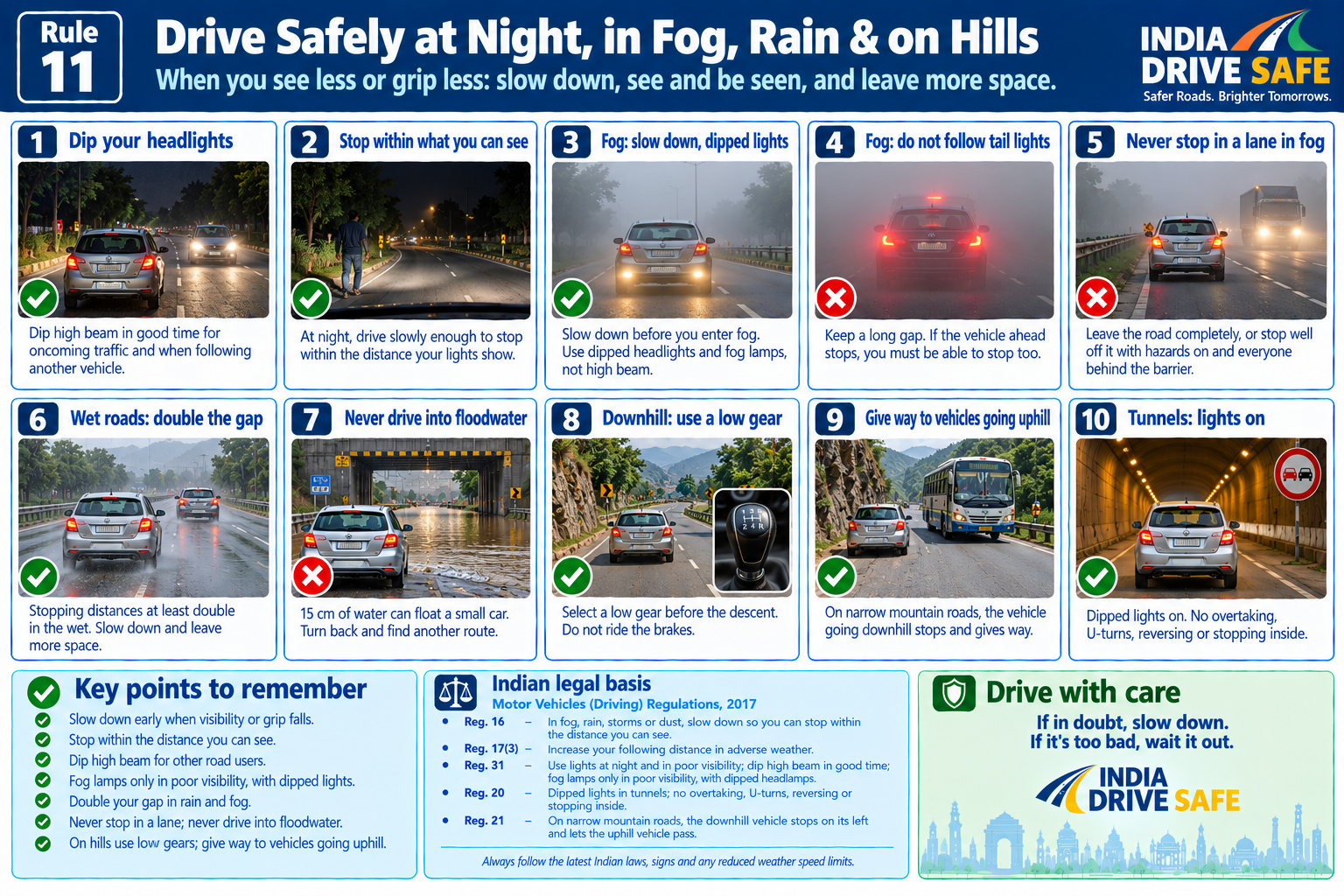
The same road can be easy in daylight and deadly at night, in dense winter fog, in the first monsoon shower, in a dust storm or on a steep ghat road. In difficult conditions you see less, others see you less, and your tyres have less grip. The answer is always the same: slow down, see and be seen, and leave more space.
When visibility or grip falls, reduce your speed until you can stop within the distance you can see to be clear, and at least double your following gap.
What Indian law clearly requires
- Regulation 16(1)–(2): drive at a speed that keeps the vehicle under control, taking account of the road, traffic, visibility and weather. In fog, rain, storms or desert winds, slow down enough to stop within the range of your forward vision.
- Regulation 17(3): in rain, storms and other adverse weather, increase your following distance further.
- Regulation 31: use your lights from nightfall to dawn and whenever visibility is poor. Keep all lights working and clean. Do not drive on parking lights alone. Do not use high beam on well-lit roads, and dip it in good time for oncoming traffic and when following another vehicle. Use fog lamps only when fog, dust, storm or rain considerably reduces visibility, and only together with dipped headlights. Two-wheeler riders must use dipped headlights in daytime too.
- Regulation 20: switch on dipped headlights before entering a tunnel. Do not overtake, U-turn or reverse inside a tunnel, and do not stop there unless it is absolutely unavoidable.
- Regulation 21: on a mountain road too narrow for vehicles to pass freely, the vehicle going downhill must stop on its left and let the vehicle going uphill pass first.
- Regulation 23: use the horn only when you apprehend danger or where a sign requires it, as on many blind ghat bends.
Night driving
At night you see only what your headlights show. Pedestrians in dark clothing, unlit cycles, tractor trolleys, animals and broken-down trucks appear suddenly.
- drive at a speed that lets you stop within the distance lit by your headlights;
- use high beam on dark, empty roads, but dip it in good time for oncoming vehicles and when you are following another vehicle (Regulation 31);
- if an oncoming vehicle dazzles you, slow down and look towards the left edge of the road, not into the lights;
- keep your windscreen, mirrors and headlights clean, inside and out, as dirt multiplies glare;
- watch for unlit vehicles parked on the left and people walking on the road edge; and
- remember that the hours after midnight are when drivers are most tired and when drink-driving is most common.
Fog
Dense winter fog across north India causes multi-vehicle pile-ups every year, often on expressways where drivers keep their normal speed until it is too late.
- Slow down before you enter fog, not after. Check your mirrors first.
- Switch on dipped headlights. High beam reflects off fog and makes it harder to see.
- Use fog lamps only while visibility is seriously reduced, always with dipped headlights, and switch them off when the fog clears (Regulation 31).
- Drive slowly enough to stop within the distance you can see (Regulation 16(2)). If you can see only 30 metres, that may mean 20–30 km/h.
- Leave a much bigger gap (Regulation 17(3)). Do not "hang on" to the tail lights in front: they give a false sense of security, and if that vehicle stops you will hit it.
- Use the left edge line and reflective road studs as your guide.
- Use wipers and demisters, and open a window slightly so you can hear traffic you cannot see.
- Brake gently and early, so that your brake lights warn drivers behind.
Hazard lights are for when you are stopped or are warning of a hazard ahead. Driving along with hazards flashing in fog hides your indicator signals, so use dipped headlights and fog lamps instead. Obey any reduced fog-season speed limits, such as the limits set on UP expressways for the 2026–27 fog season (see Rule 09).
Rain and wet roads
- stopping distances are at least double on wet roads, so slow down and increase your gap;
- the first rain after a dry spell is the most slippery, because it mixes with oil, rubber and dust on the road surface;
- switch on dipped headlights so others can see you, and keep your wipers in good condition;
- if the steering suddenly feels light, your tyres may be riding on water (aquaplaning). Ease off the accelerator, hold the steering straight and do not brake hard until grip returns; and
- watch for potholes hidden under water, open drains and slippery painted markings.
Flooded roads and underpasses
Every monsoon, people drown in vehicles that drove into flooded underpasses or causeways. Water depth is very hard to judge, and moving water is far stronger than it looks.
- as little as 15 cm of water can start to float a small car, and 30 cm can move a mid-sized car (Victoria State Emergency Service);
- never drive into a flooded underpass, causeway or road if you cannot see the road surface or know the depth. Turn back and find another route;
- if you must cross shallow, still water, drive slowly and steadily in a low gear, then test your brakes gently afterwards; and
- if water starts entering the vehicle or the engine stalls in rising water, do not try to restart it. Unfasten seat belts, open the windows or doors early while the electrics still work, and get out to higher ground.
Dust storms and smoke
Regulation 16(2) applies to dust storms and desert winds as well as fog. Slow down, switch on dipped headlights and increase your gap. Strong crosswinds can push two-wheelers, high-sided trucks and buses sideways, so give them extra room. If you cannot see, leave the road at a safe place rather than stopping in a lane.
Hills and ghat roads
- Going down: select a low gear before the descent and let the engine help hold your speed. Riding the brakes all the way down can overheat them until they fail.
- Going up: keep a steady speed in a suitable gear; do not try to overtake on blind bends or crests.
- Narrow roads: if two vehicles cannot pass, the vehicle going downhill stops on its left and gives way to the vehicle climbing (Regulation 21).
- Blind bends: keep left, slow down, and use a short horn where a sign requires it or where danger is likely (Regulation 23).
- watch for landslides, fallen rocks, loose gravel and water flowing across the road, especially in the monsoon; and
- never park or stop on a bend.
Tunnels
- Switch on dipped headlights before you enter, and remove sunglasses.
- Keep your lane and a safe gap. Do not overtake, make a U-turn or reverse inside (Regulation 20).
- Do not stop unless it is absolutely unavoidable. If you must, switch on hazard lights and place warning triangles about 20 metres in front of and behind the vehicle (Regulation 20).
- Expect your eyes to need a moment to adjust when you leave the tunnel into bright light.
Bright sun and heat
- low sun at sunrise and sunset can blind you completely; use the sun visor, keep the windscreen clean and slow down or stop if you cannot see;
- heat raises tyre pressure and engine temperature; check tyres and coolant before long summer journeys; and
- a hot, stuffy cabin makes drivers drowsy; keep it ventilated and take regular breaks.
Prepare before you go
- check weather and fog warnings before a journey, and delay it if conditions are dangerous;
- make sure all lights, wipers, demisters, tyres and brakes work properly;
- clean all windows, mirrors and lights; and
- carry a reflective warning triangle, a torch and a reflective jacket.
Common mistakes
It reflects back and reduces visibility. Use dipped headlights and fog lamps.
If that vehicle stops, you will hit it. Keep a long gap.
15 cm of water can float a small car. Turn back.
A dazzled driver cannot see you or anyone else. Dip in good time.
Use a low gear and let the engine hold your speed.
They dazzle other drivers. Switch them off when visibility improves.