Emergencies happen suddenly: an ambulance behind you in heavy traffic, a breakdown on a fast road, or a crash in front of you. What you do in the next few minutes can save a life, or put more lives at risk. Knowing the steps in advance means you can act calmly.
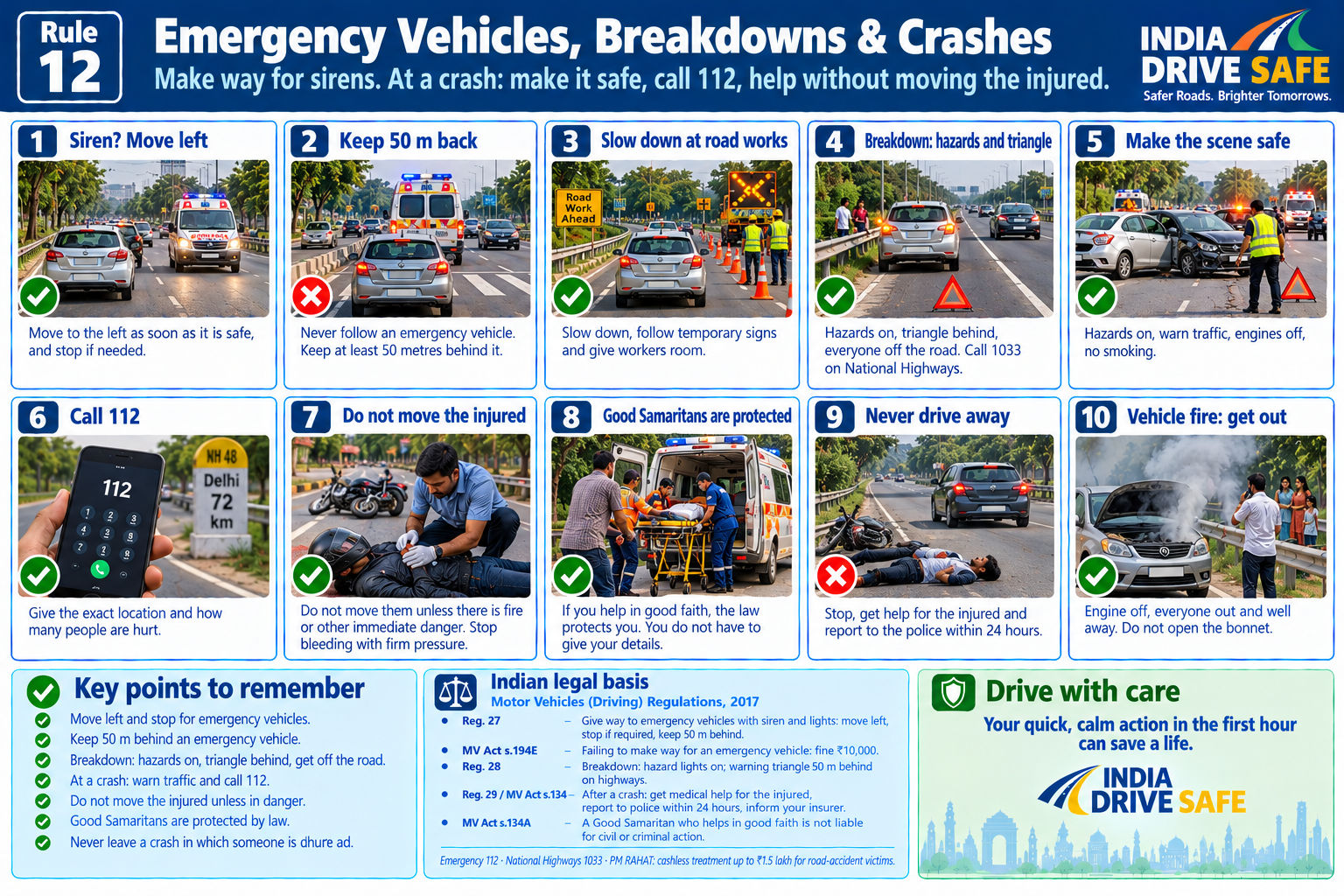
Make way for emergency vehicles at once. If you are involved in or witness a crash: make the scene safe, call 112, help the injured without moving them unnecessarily, and never drive away from a crash in which someone is hurt.
Emergency vehicles: make way
Regulation 27 of the Motor Vehicles (Driving) Regulations, 2017 gives a fire engine, ambulance or police vehicle with its siren and flashing lights on the right of way over all other vehicles. When one is approaching, overtaking or entering your path, you must, unless a police officer directs otherwise:
- move to the left, as close to the kerb or road edge as practicable, as quickly as you safely can;
- stop if necessary, and stay stopped until it has passed; and
- keep at least 50 metres behind an emergency vehicle that has its siren or lights on. Never follow it to get through traffic.
Failing to draw aside for a fire engine, ambulance or other designated emergency vehicle is an offence under Section 194E of the Motor Vehicles Act, 1988, punishable with a fine of ₹10,000, up to six months' imprisonment, or both.
How to make way safely
- look and listen early; turn your music down so you can hear sirens;
- check your mirrors and signal before moving left, and watch for two-wheelers on your left;
- do not brake suddenly in front of the emergency vehicle;
- at a red light, stay calm; move only if you can do so safely and without entering the junction into cross-traffic; and
- after it has passed, check for a second emergency vehicle before moving off.
Emergency drivers may, with great care, cross red lights, exceed speed limits and drive in either direction on one-way streets (Regulation 27(3)). Expect them to appear from unexpected directions.
Road works and stopped service vehicles
Road and utility maintenance vehicles may stop on the roadway with hazard lights and a warning device at least 50 metres behind them (Regulation 27(7)). Slow down when you see work-zone signs, cones or flashing lights, follow the temporary signs and lane changes, and give workers plenty of room.
If your vehicle breaks down
Switch on your hazard lights immediately. Get the vehicle off the road if you can. On highways and fast roads, place a reflective warning triangle 50 metres behind it (Regulation 28). Get everyone out on the side away from traffic and wait well away from the road. On National Highways call 1033 for help. See Rule 09 for the full highway breakdown routine.
Arriving at a crash: make the scene safe
- Stop safely where you do not block the road or put yourself in danger, and switch on your hazard lights.
- Warn other traffic: place a warning triangle well back from the scene. Wear a reflective jacket if you have one.
- Reduce fire risk: ask drivers to switch off engines, and ask everyone not to smoke.
- Move uninjured people away from the road, behind a barrier if there is one.
- Call 112, the all-India emergency number, for police, ambulance and fire. Give the exact location: road name, kilometre stone, landmark or your phone's map location, and how many people are hurt.
Helping the injured
- do not move injured people unless they are in immediate danger, for example from fire or traffic. Moving them can make neck and spine injuries worse;
- do not remove a motorcyclist's helmet unless it is essential to keep them breathing;
- check whether they are conscious and breathing. Talk to them and keep them calm and warm;
- stop heavy bleeding by pressing firmly on the wound with a clean cloth;
- do not give injured people anything to eat or drink; and
- stay with them until help arrives.
The first hour after a serious injury, often called the golden hour, is when quick hospital treatment does the most good. A basic first-aid course is one of the most valuable things any driver can do.
You are protected when you help: Good Samaritan law
Section 134A of the Motor Vehicles Act, 1988 protects a Good Samaritan: anyone who, in good faith and without expecting reward, gives emergency help at the scene of a road accident or takes the victim to hospital. A Good Samaritan is not liable in any civil or criminal action for the victim's injury or death, unless the injury or death was caused by their own negligence in giving that help.
Under the Good Samaritan guidelines and rules:
- you cannot be forced to give your name or personal details to the police or hospital;
- you may leave once you have informed the police or brought the victim to hospital; and
- if you agree to be a witness, your statement should be taken at a convenient time and place, and can be recorded by video.
The Government's Rah-Veer scheme, launched in 2025, has rewarded people who take a seriously injured victim to hospital within the golden hour with ₹25,000 and a certificate. Check the scheme's current status with your State transport department.
Free treatment for accident victims
Under the PM RAHAT scheme, announced on 14 February 2026, every eligible road-accident victim can receive cashless treatment of up to ₹1.5 lakh at a designated hospital for up to seven days after the accident, on any category of road. Calling 112 from the scene directs the victim to the nearest designated hospital and an ambulance. Hospitals are reimbursed from the Motor Vehicle Accident Fund, so treatment within the scheme's limit is cashless for the victim.
Victims of hit-and-run crashes, where the vehicle is never traced, can also claim compensation from the Government: ₹2 lakh for death and ₹50,000 for grievous injury (Section 161 of the Motor Vehicles Act and the 2022 hit-and-run compensation scheme).
If you are involved in a crash
Section 134 of the Motor Vehicles Act, 1988 and Regulation 29 set out your duties.
If anyone is injured
- Stop. Never drive away from a crash in which someone is hurt.
- Check yourself and your passengers for injuries.
- Take reasonable steps to get medical help for anyone injured, including taking them to hospital, unless a mob or other circumstance beyond your control makes it impossible, or the injured person refuses (Section 134(a)). Call 112.
- Give the police any information they ask for. If no police officer is present, report the crash at the nearest police station as soon as possible and in any case within 24 hours (Section 134(b)).
- Inform your insurance company in writing with the policy details, date, time and place, details of anyone injured and your driving-licence details (Section 134(c)).
Doctors and hospitals must treat an injured person immediately, without waiting for police or other formalities (Section 134).
Minor crashes with no injuries (Regulation 29)
- stay calm and do not argue or provoke anyone;
- photograph the vehicles, their registration plates and the scene;
- move the vehicles off the road so they do not block traffic;
- switch on hazard lights and place warning triangles;
- exchange names, addresses, phone numbers, insurance and driving-licence details; and
- if you cannot agree, call the police and stay until they arrive and allow you to leave.
Major crashes
If the vehicles cannot be moved, stay at the scene until the police arrive, unless injuries prevent it, and co-operate with the investigation (Regulation 29).
If your vehicle catches fire
- stop as soon as it is safe, switch off the engine and get everyone out immediately;
- move well away from the vehicle and keep others back;
- do not open the bonnet, as the extra air feeds the fire; and
- call 112 and warn approaching traffic.
Keep in your vehicle
- a reflective warning triangle and a reflective jacket;
- a first-aid kit and a torch;
- emergency numbers: 112 (all emergencies) and 1033 (National Highways); and
- copies of your registration, insurance and licence, or the electronic versions on DigiLocker or mParivahan, which are valid under the 2020 amendment to Regulation 38.
Common mistakes
Keep at least 50 metres back. Its path is not your shortcut.
Check your mirror, signal and move left. Stop if needed.
Do not move them unless there is fire or another immediate danger.
Good Samaritans are protected by law. Your call to 112 may save a life.
Stop, get help for the injured and report to the police within 24 hours.
Onlookers block ambulances and cause second crashes. Help or move on.