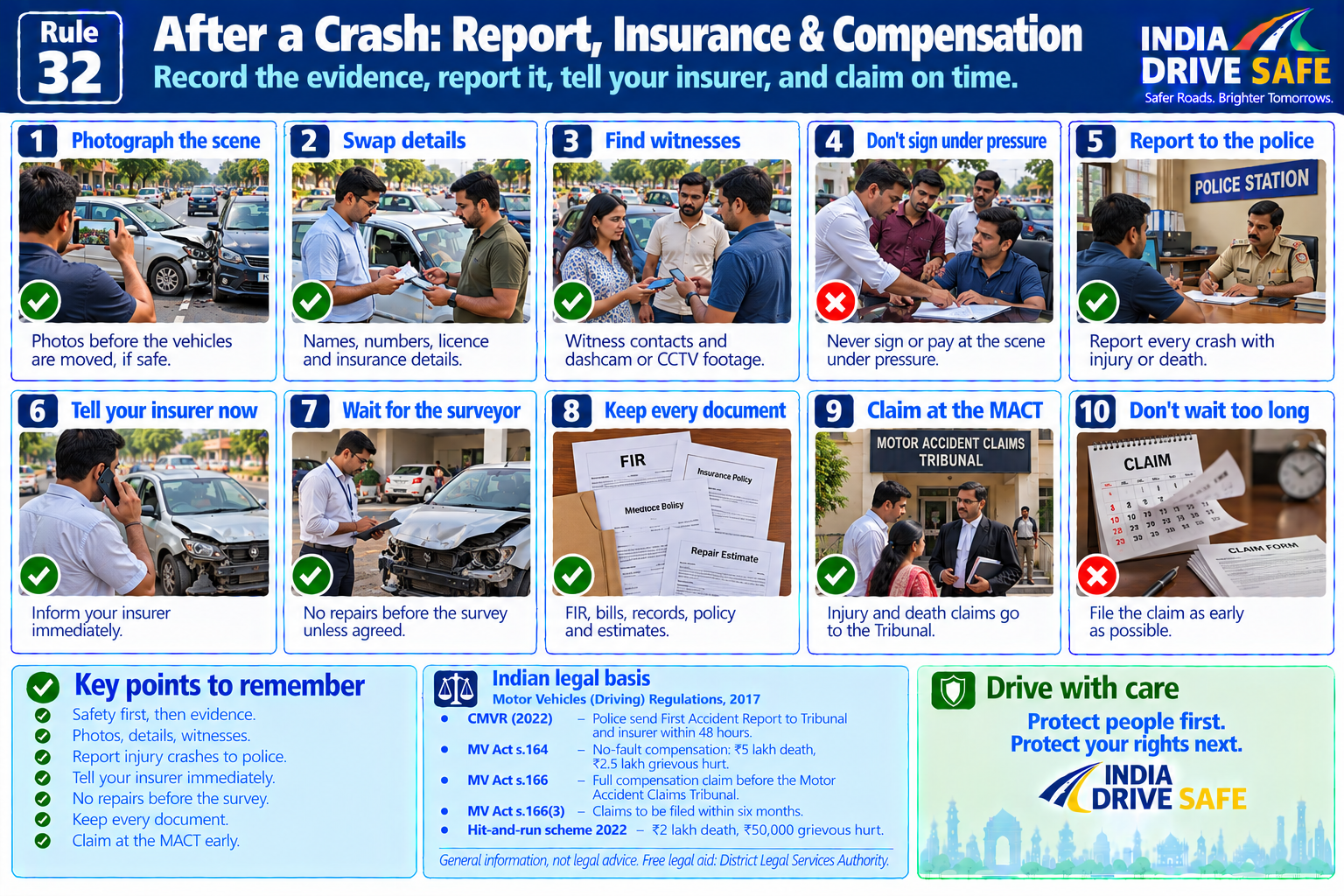
Rule 12 explains what to do at the scene of a crash: make it safe, help the injured, call 112 and never drive away. This article covers what comes next: the police report, your own insurance claim, and how injured people and families of those killed can claim compensation. Knowing the steps early protects your rights and avoids months of delay.
After any crash: collect evidence, report it to the police when anyone is hurt or there is serious damage, tell your insurer straight away, keep copies of every document, and if someone is injured or killed, file a claim before the Motor Accident Claims Tribunal as early as possible.
Step 1: Record what happened
Once everyone is safe and help is on the way (Rule 12), and only if it is safe to do so:
- take photographs and video of the vehicles' positions, damage, number plates, road markings, signals, skid marks and the wider scene, before the vehicles are moved where possible;
- note the details of every vehicle and driver involved: registration numbers, names, phone numbers, addresses, driving licence numbers and insurance details;
- get the names and phone numbers of witnesses, and save any dashcam or CCTV footage quickly before it is overwritten;
- write down the time, place and weather, and what happened, while you remember it clearly; and
- do not sign any paper or make any payment at the scene under pressure. Do not argue about blame; leave that to the police and insurers.
Step 2: The police report
- if anyone is injured or killed, the driver must report the crash to the police (Section 134 of the Motor Vehicles Act, 1988; Rule 12). The police register the case and investigate;
- since 1 April 2022, the Central Motor Vehicles Rules (Rules 150A onwards, added by the Fifth Amendment Rules, 2022) require the investigating officer to send a First Accident Report to the Claims Tribunal and the insurer within 48 hours, and later a Detailed Accident Report. The police must also inform victims of their rights under the claims procedure;
- for minor crashes with no injuries, the drivers may settle between themselves (Regulation 29; Rule 12), but you may still need a police report for an insurance claim, for example for major damage or theft. Check your policy;
- keep a copy of the FIR or police report, the report number and the investigating officer's contact details.
Step 3: Your own insurance claim
- inform your insurer immediately, by the helpline, app or website, even if you have not decided whether to claim. Late reporting can lead to a claim being rejected;
- follow the insurer's instructions on survey and inspection. Do not start repairs before the surveyor has seen the vehicle, unless the insurer agrees;
- keep ready: the policy, registration certificate, driving licence of the person driving, police report (if any), photographs, repair estimate and bills;
- third-party insurance, which is compulsory (Section 146), covers your legal liability to others for death, injury and property damage. Damage to your own vehicle is covered only if you have an own-damage or comprehensive policy;
- a claim may be refused if, for example, the driver had no valid licence or was drunk, so driving legally protects your cover as well as your safety; and
- if you disagree with the insurer's decision, use its grievance process first, then the Insurance Ombudsman or a consumer commission.
Step 4: Compensation for injury or death
People injured in a crash, and the families of those killed, have a legal right to compensation, usually paid by the insurer of the vehicle at fault.
Where to claim
- claims are made to the Motor Accident Claims Tribunal (MACT) in the area where the crash happened, where the claimant lives or works, or where the defendant lives (Section 166). Many claimants use a lawyer; free legal aid is available through District Legal Services Authorities;
- the Tribunal can also treat the police accident report as a claim application;
- Section 166(3), added in 2019, says a claim must be filed within six months of the accident. The Supreme Court has directed Tribunals and High Courts not to reject claims only because they were filed late while it considers the issue. Do not rely on this: file as early as you can; and
- the insurer may offer a settlement (Section 149). You can accept it or continue with the claim. Many claims are also settled in Lok Adalats.
Two kinds of compensation
- Fixed, no-fault compensation (Section 164): ₹5 lakh for death and ₹2.5 lakh for grievous hurt, without having to prove anyone was at fault; or
- full compensation based on fault (Section 166), which takes into account income lost, medical costs, pain and suffering, and the needs of dependants. This can be much higher, but the claimant must show that the driver of the other vehicle was negligent.
Accepting fixed compensation under Section 164 can end the right to claim more under Section 166. Get legal advice before choosing.
Hit-and-run and treatment
If the vehicle is never traced, the Government pays fixed compensation under the 2022 hit-and-run scheme, and cashless treatment is available for accident victims (Rule 12). The police and the district Claims Enquiry Officer can explain how to apply.
Documents to keep
- FIR or police report and its number.
- Photographs, videos and witness details.
- Insurance policy, registration certificate and driving licence.
- Medical records, bills, discharge summaries and disability certificates.
- Proof of income (salary slips, tax returns) and, in case of death, the death certificate, post-mortem report and proof of relationship.
- Repair estimates, bills and the surveyor's report.
Common mistakes
Evidence decides claims. Take photos as soon as it is safe.
Report immediately, even if you may not claim.
Do not sign or pay under pressure.
The law sets six months. File as early as you can.
The insurer may refuse to pay. Wait for the surveyor.
Keep every bill and record; compensation depends on them.
Remember
This article is general information, not legal advice. For a specific claim, consult a lawyer or your District Legal Services Authority.