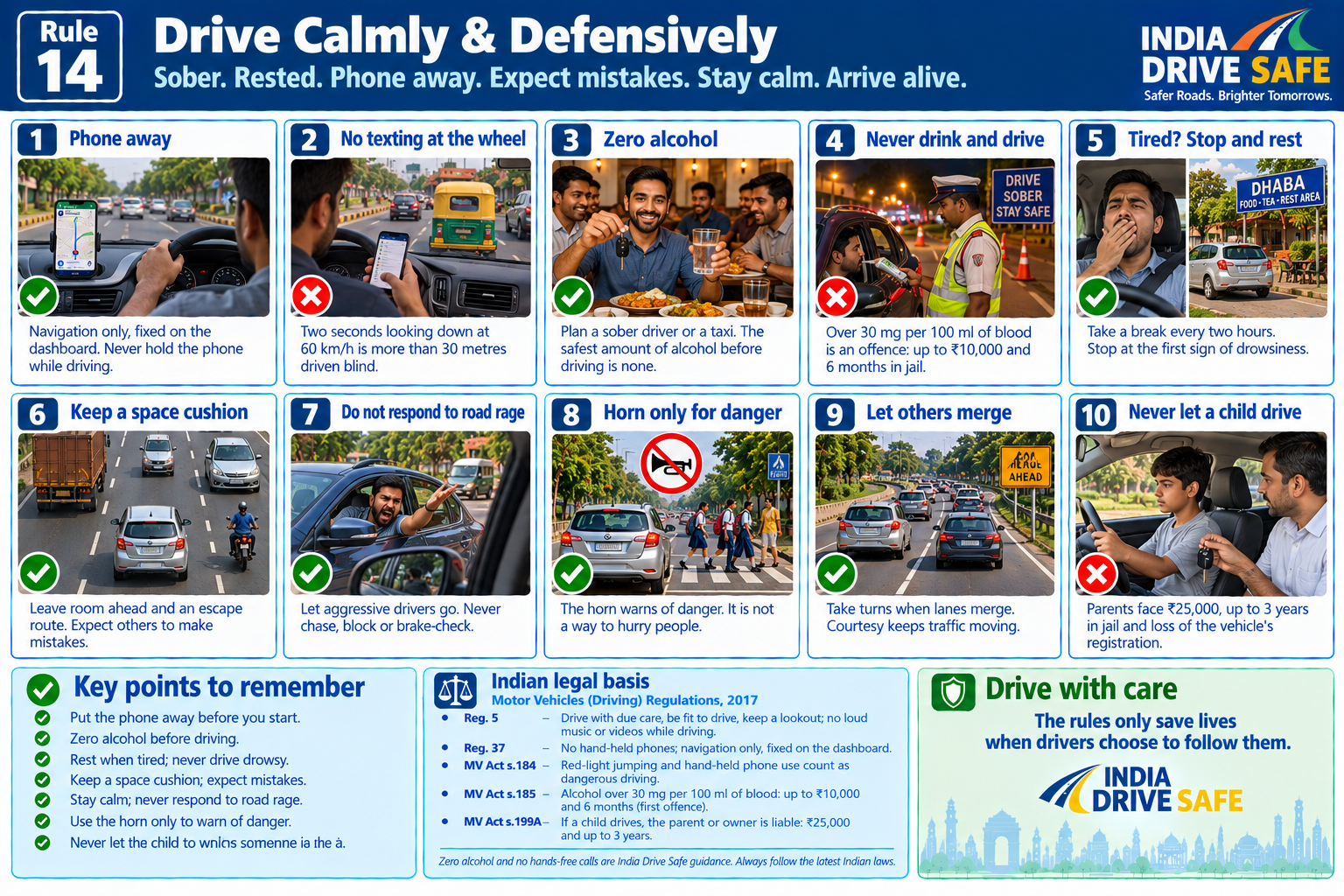
Knowing the rules is only half of safe driving. The other half is attitude: staying alert, patient and sober, expecting others to make mistakes, and choosing safety over winning a few seconds. Most crashes involve a human error, such as a glance at a phone, a moment of anger, a drink too many or a driver too tired to react. Good attitude prevents those errors.
Drive sober, rested and undistracted. Expect other road users to make mistakes, leave yourself space to deal with them, and never let anger decide how you drive.
What Indian law clearly requires
- Regulation 3: do not drive in a way that endangers or inconveniences other road users.
- Regulation 5: drive with due care and caution at all times; be physically and mentally fit to drive; keep a good lookout and do not let yourself be distracted; do not play loud music; do not watch videos while driving (route navigation is allowed if it does not distract you); and obey the laws on alcohol, drugs and smoking.
- Regulation 37: do not use a hand-held mobile phone or other communication device while driving. Since the 2020 amendment, a device may be used only for route navigation, and only if it is fixed on the dashboard.
- Regulation 23: use the horn only when you apprehend danger, never continuously, and never in silence zones.
- Section 184 of the Motor Vehicles Act, 1988 (dangerous driving): jumping a red light, ignoring a STOP sign, using a hand-held communication device while driving, overtaking unlawfully and driving against the flow of traffic are all treated as dangerous driving. A first offence can bring 6 months to 1 year in prison, a fine of ₹1,000–5,000, or both.
- Section 185 (drunk or drugged driving): it is an offence to drive with more than 30 mg of alcohol per 100 ml of blood, or while under the influence of a drug that stops you controlling the vehicle properly. A first offence can bring up to 6 months in prison and a fine of up to ₹10,000; a repeat offence up to 2 years and ₹15,000.
- Section 199A (offences by juveniles): if a child under 18 commits a driving offence, the parent or vehicle owner is presumed guilty. They face a fine of ₹25,000 and up to 3 years in prison, the vehicle's registration is cancelled for 12 months, and the child cannot get a licence until age 25.
Drive defensively
Defensive driving means driving so that you can survive other people's mistakes, not only your own.
- Look far ahead, not just at the vehicle in front, so problems reach you early.
- Keep a space cushion: a long gap in front (Rule 03) and room to the side wherever possible.
- Always have an escape route. Avoid sitting beside trucks or boxed in where you cannot move if something goes wrong.
- Assume others have not seen you. Expect the bus to pull out, the auto to stop without warning and the pedestrian to step off the kerb.
- Be predictable: keep your lane, signal early and avoid sudden changes of speed or direction.
- Cover the brake near junctions, schools, markets and parked vehicles.
Put the phone away
Looking at a phone for two seconds at 60 km/h means driving more than 30 metres blind. Even hands-free calls take your mind off the road.
- switch on "Do Not Disturb while driving" or put the phone out of reach before you set off;
- set your navigation before you start, and mount the phone on the dashboard as the law requires (Regulation 37);
- never type, read messages, scroll or take photos while driving, including when you are stopped in traffic; and
- if you must call or message, stop somewhere safe and legal first.
The UK Highway Code goes further and advises against hands-free calls while driving too. India Drive Safe agrees: the safest call is the one you make after you have parked.
Other distractions
- keep music at a level where you can still hear horns and sirens (Regulation 5);
- do not watch videos, eat complicated meals or groom yourself while driving;
- ask passengers to keep the atmosphere calm, and settle children before you start; and
- do not argue while driving. If a conversation becomes heated, stop the car.
Alcohol and drugs: just don't
Alcohol slows reactions, blurs judgement and makes drivers more confident at exactly the moment they are less capable. The legal limit is 30 mg per 100 ml of blood, but there is no safe "one drink" figure, because the effect depends on your body, food, tiredness and the drink itself. India Drive Safe recommends zero alcohol before driving.
- if you are going to drink, decide before you go out how you will get home: a sober driver, a taxi or staying overnight;
- alcohol can still be in your blood the next morning;
- many medicines, including some cough syrups, allergy tablets and painkillers, cause drowsiness. Read the label and ask your doctor or pharmacist; and
- never get into a vehicle with a driver who has been drinking, and never hand your keys to one.
Tiredness
Driving while very tired can be as dangerous as driving drunk. Get a proper night's sleep before long journeys, take a 15-minute break every two hours, and stop as soon as you feel drowsy (see Rule 09). Regulation 5 requires you to be fit to drive. A tired driver is not.
Keep calm: no road rage
Other drivers will cut in, honk, tailgate and make mistakes. How you respond decides whether a bad moment becomes a crash or a fight.
- do not respond to provocation. Let the aggressive driver go; arriving a minute later costs nothing;
- never chase, block, brake-check or "teach a lesson" to another driver;
- avoid eye contact and gestures with an angry driver;
- if someone follows you or threatens you, keep the doors locked and windows up, drive to a busy public place or police station and call 112. Do not get out to argue; and
- if you make a mistake, a raised hand to say sorry calms most situations instantly.
The UK Highway Code puts it simply: be patient, because anyone can make a mistake. If you find yourself angry, pull over, calm down, then continue.
Courtesy makes roads work
- let vehicles merge in turn when lanes join, instead of closing the gap;
- dip your headlights for others (Regulation 31);
- stop for pedestrians at crossings, and give cyclists and riders room (Rule 08);
- keep junctions, crossings and yellow boxes clear;
- do not use the horn to hurry people. In India the horn is often used as a habit, but the law allows it only as a warning of danger (Regulation 23); and
- be patient with learner drivers, older drivers, heavy vehicles and anyone who is unsure of the way.
Responsibility beyond the steering wheel
- Never let a child drive. Section 199A makes the parent or owner criminally liable, and the consequences for the child can last until age 25.
- Make sure everyone wears a seat belt, front and rear, and that children use suitable restraints (Regulation 5).
- Keep your vehicle safe: do not drive a vehicle with a defect you know about, or could have discovered, that endangers others (Regulation 5(14)).
- Keep yourself fit to drive: have your eyesight checked regularly, and talk to a doctor if a health condition or medicine could affect your driving.
- Set the example. Children learn how to drive by watching their parents long before they take a lesson.
Common mistakes
Two seconds looking down at 60 km/h is more than 30 metres driven blind.
There is no safe number. Plan a sober ride home.
Let them go. Road rage turns a near-miss into a crash or an assault.
The horn is for danger only. Patience is quieter and safer.
The law holds the parent responsible: ₹25,000, up to 3 years and loss of registration.
Stop at the first sign of drowsiness. Rest is the only cure.
The India Drive Safe promise
The rules in this guide only save lives when drivers choose to follow them. Every journey is a chance to show that Indian roads can be safe.