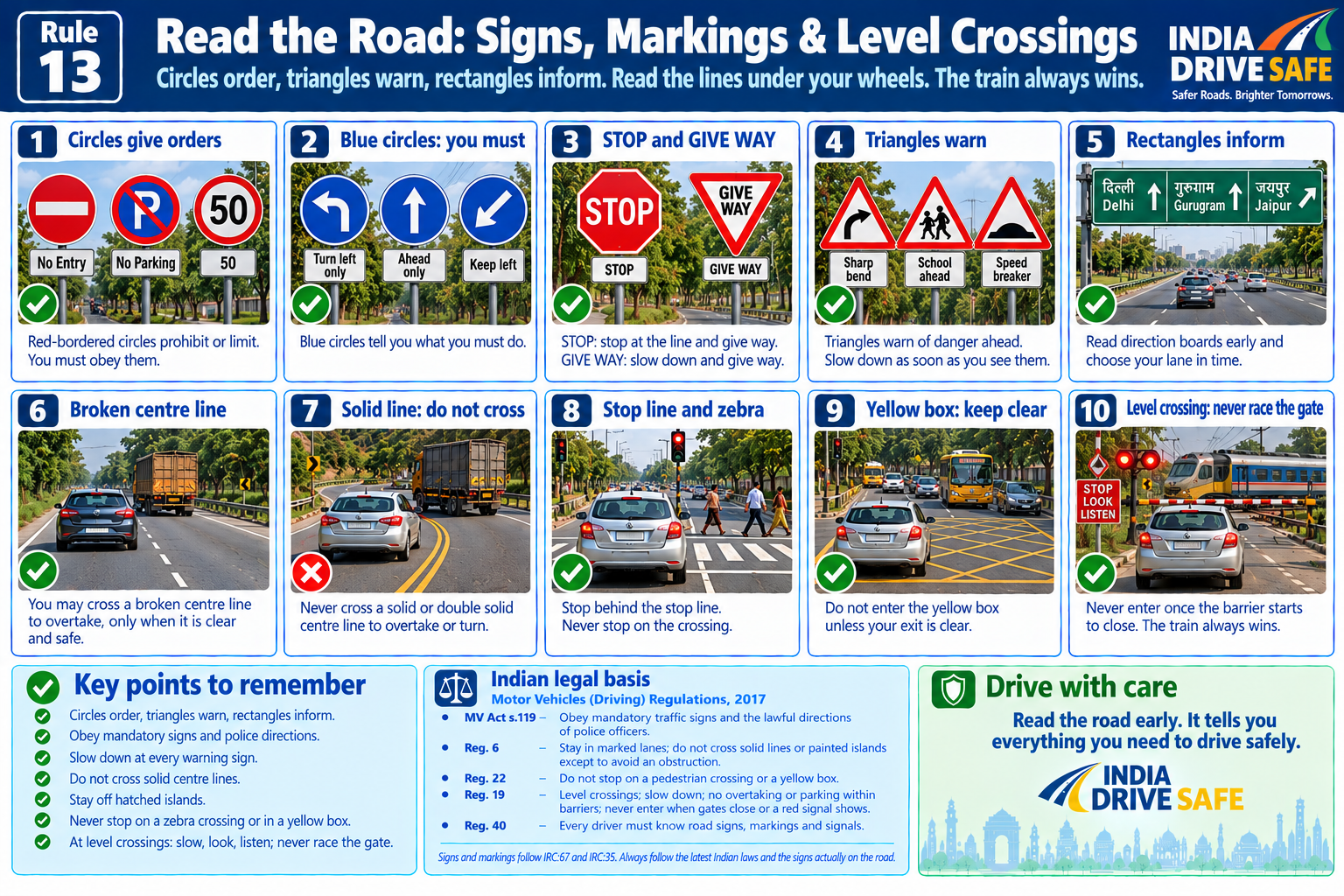
Signs and road markings are how the road talks to you. They tell you what you must do, what you must not do, what danger is ahead and where you are going. Indian law requires every driver to know and obey them, so learning to "read the road" is part of driving safely, not an optional extra.
Obey every mandatory sign and road marking, slow down for every warning sign, and at a railway level crossing, the train always has priority. If a police officer gives a different direction, follow the officer.
What Indian law clearly requires
- Section 119 of the Motor Vehicles Act, 1988: every driver must drive in accordance with mandatory traffic signs (those in Part A of the Schedule to the Act), follow the driving regulations, and obey the lawful directions of a police officer regulating traffic.
- Regulation 24: obey police officers, authorised persons and mandatory signs and signals.
- Regulation 40: every driver must know and understand road signs, road markings and traffic-control signals.
- Regulation 6: stay within marked lanes; use lanes marked for a particular class of vehicle only if you belong to that class; do not drive over a single or double solid longitudinal line or a painted traffic island except to avoid an obstruction; at turning lanes separated by solid lines, stay in the lane for your direction.
- Regulation 19: slow down when approaching a railway level crossing; do not overtake or park within its barriers; never enter once the gates or barriers are closing or closed, or when the red signal is showing; trains have overriding priority.
When signs, markings, signals and a police officer's directions disagree, follow the police officer (Regulations 13 and 24). In general, traffic signals then take priority over signs, and signs over road markings.
The three families of road signs
Indian road signs follow the Indian Roads Congress code IRC:67, and their shapes tell you their purpose even before you can read them.
1. Mandatory (regulatory) signs: you must obey
- Red-bordered circles forbid or limit something: No Entry, No Parking, No Overtaking, No U-turn, speed limits, weight and height limits. Ignoring them is an offence.
- Blue circles tell you what you must do: Compulsory Turn Left, Compulsory Ahead, Compulsory Keep Left, cycle tracks, bus lanes.
- STOP is the only eight-sided (octagonal) sign: stop completely at the stop line and give way.
- GIVE WAY is an inverted triangle: slow down and give way to traffic on the road you are entering.
2. Cautionary (warning) signs: slow down and look
Triangles pointing upwards warn of a hazard ahead: bends, narrow roads, narrow bridges, schools, pedestrian crossings, speed breakers, steep slopes, slippery roads, falling rocks, cattle, men at work and railway crossings. A warning sign does not order a specific action, but it tells you to reduce speed and be ready to stop. Most warning signs are placed some distance before the hazard, so act on them straight away.
3. Informatory signs: where you are and where to go
Rectangles give information: direction and distance signs, place names, route numbers, kilometre stones, fuel, hospitals, parking, toll plazas and rest areas. Direction boards are usually white lettering on green or blue backgrounds. Read them early, so you can choose your lane before the junction rather than at the last moment.
Lines along the road (longitudinal markings)
Road markings follow the Indian Roads Congress code IRC:35. Most are white. Yellow is used for lines you must not cross and for parking restrictions.
- Broken white centre line: separates opposing traffic. You may cross it to overtake, but only when the road ahead is clear and overtaking is safe and legal.
- Solid single line (white or yellow): do not cross it to overtake (Regulations 6 and 14).
- Double solid line (white or yellow): do not cross it from either side, either to overtake or to turn.
- Solid line beside a broken line: you may cross only if the broken line is on your side. If the solid line is on your side, stay in your lane.
- Short broken lane lines: separate lanes going the same way. Change lanes only after checking and signalling (Rule 02).
- Longer dashes with shorter gaps (warning lines): a solid line or a junction is coming, so plan ahead.
- Edge lines: mark the edge of the carriageway. Keep inside them except to stop in an emergency.
- Hatched or chevron areas: painted islands that separate traffic or protect turning lanes. Do not drive on them except to avoid an obstruction (Regulation 6).
Lines across the road (transverse markings)
- Stop line (solid white line): where you must stop for a red light, a STOP sign or a police officer's stop signal. A double stop line with the word STOP marks a STOP-sign junction.
- Give-way line (double broken line): often with a triangle marked on the road before it. Slow down and give way to traffic on the road ahead.
- Zebra crossing: stop and let pedestrians cross (Regulation 39). Do not stop on it, or within 5 metres before it (Regulation 22).
- Yellow box (criss-cross yellow lines): do not enter unless your exit is clear. Never stop inside the box (Regulation 22).
- "KEEP CLEAR": do not stop on the marked area, so that side roads and entrances stay open.
- Speed-breaker markings: slow down before the hump.
Arrows and words on the road
- Lane arrows: show the direction you must take from that lane at the junction. Get into the correct lane early and stay in it (Regulation 6).
- Merging arrows: the lane is ending; move over in good time and merge smoothly.
- Words such as SLOW, SCHOOL, BUS ONLY or STOP: obey them as you would a sign.
- Coloured lanes: blue for bus lanes and green for cycle tracks, where provided. Do not drive or park in them unless permitted.
Kerb and edge markings for parking
- a continuous yellow line along the kerb means no parking (Regulation 22);
- on many city roads, a double yellow edge line means no stopping or parking at all; and
- black-and-white painted kerbs mark the kerb so it can be seen; they are not parking bays.
Look for supporting signs, which may limit parking to certain times.
Railway level crossings
A train cannot swerve, and it may need more than a kilometre to stop. At a level crossing the train always wins.
Guarded crossings (with gates or barriers)
- Slow down when you see the warning sign, and keep to the left.
- Do not overtake on the approach or within the barriers, and do not park there (Regulation 19).
- Never enter once the gates or barriers have started to close, or when the red signal is showing. Never go round or under a lowered barrier.
- Do not stop on the tracks. Cross only if there is space for your vehicle on the other side.
Unguarded crossings
- Slow down, and stop if necessary. Open your window, turn off music, then look and listen in both directions.
- Cross only when no train is in sight (Regulation 19(4)).
- Drivers of buses (including school buses), goods vehicles, tractor-trolleys and vehicles carrying hazardous goods must stop before the crossing. An attendant or the driver must walk up to the crossing, check both directions, and then guide the vehicle across (Regulation 19(4)(b)).
Indian Railways has removed most unmanned crossings, but some remain. Treat every unfamiliar crossing as if a train is coming.
Common mistakes
Solid centre lines mark places where overtaking is unsafe. Wait for a broken line.
They are placed before the hazard. Slow down when you see them, not when you reach the danger.
Read direction boards and lane arrows early and get into lane in time.
Wait behind the line until there is space beyond.
They protect turning traffic and separate streams. Stay off them.
Never enter once barriers start to close. The train always wins.