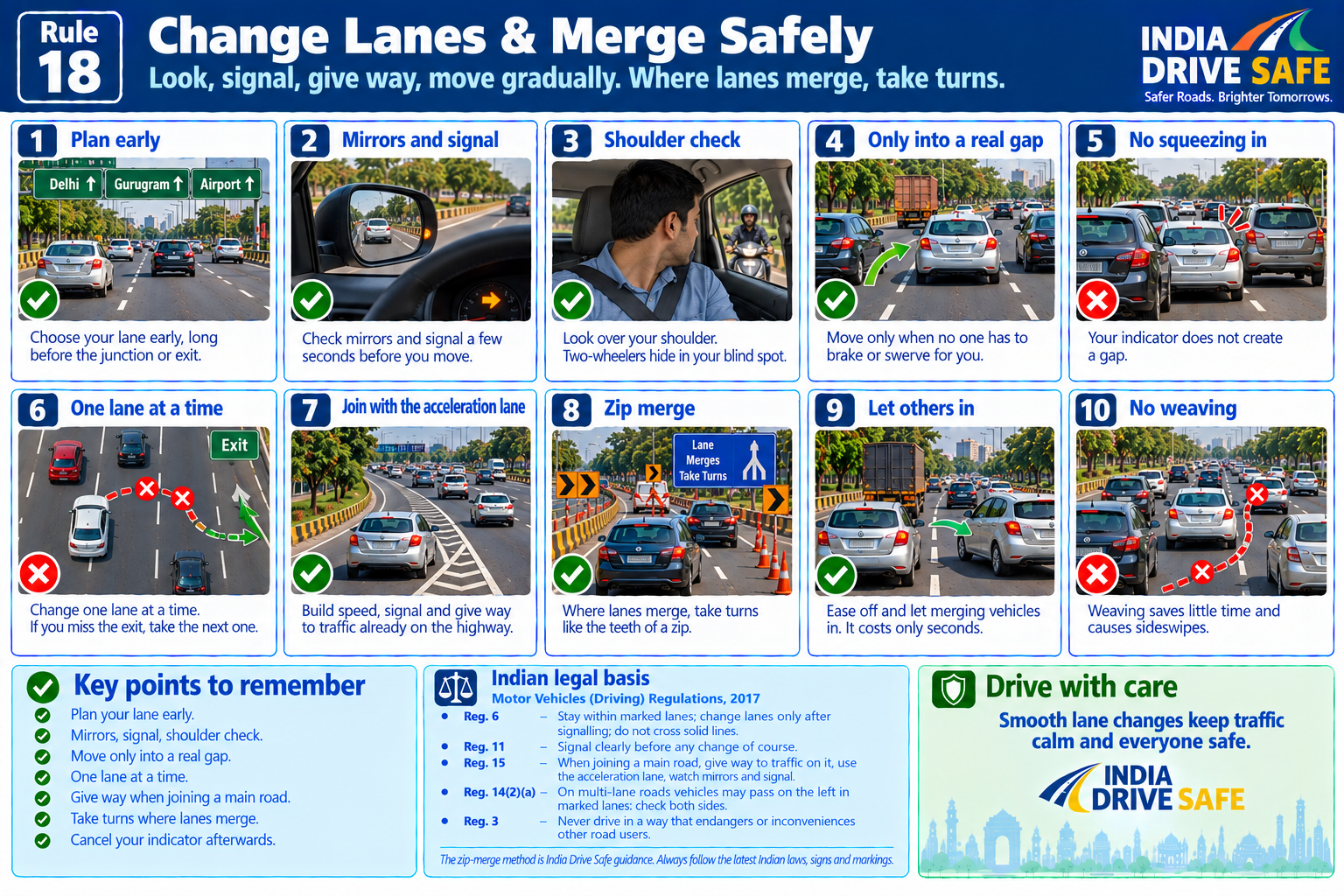
Lane changes and merges are where two streams of traffic try to use the same space. Done well, they are smooth and almost invisible. Done badly, by squeezing in, weaving or changing lanes without looking, they cause sideswipes, sudden braking and the angry horn-blowing that fills Indian roads. The secret is simple: look, signal, give way and move gradually.
Move into another lane only when there is a safe gap that you can enter without making anyone brake or swerve. Signal first, check your blind spot, and change one lane at a time.
What Indian law clearly requires
- Regulation 6(1): drive within the marked lanes and change lanes only after giving a signal, or where a road marking or sign directs you to.
- Regulation 6(2)–(3): a lane marked for a particular class of vehicle (for example a bus lane) may be used only by that class.
- Regulation 6(4)–(6): do not cross a solid longitudinal line or painted island except to avoid an obstruction, and stay in your lane where turning lanes are separated by solid lines.
- Regulation 11: signal clearly before any change of course.
- Regulation 15: when joining a national highway, state highway or major district road, give way to traffic already on it; use the acceleration lane where provided; watch your mirrors and signal while merging; and do not start overtaking until you have settled in your lane.
- Regulation 4(5): heavy and speed-restricted vehicles keep to the left lane on multi-lane roads, leaving it only to overtake.
- Regulation 14(2)(a): on a multi-lane road, a vehicle may be passed on the left in a marked lane, so faster traffic can be on either side of you.
- Regulation 33: motorcycles may filter between lanes only on urban roads with limits of 40 km/h or less, where signs permit, and slowly.
Regulation 3 adds the overarching duty: never drive in a way that endangers or inconveniences other road users. A lane change that forces someone to brake breaks that duty even if you signalled.
The safe lane-change routine
- Plan early. Decide which lane you need well before the junction, exit or obstruction.
- Mirrors: check the inside mirror and the door mirror on the side you are moving to.
- Signal in good time, at least a few seconds before you move.
- Blind spot: take a quick look over your shoulder. Motorcycles and scooters often sit exactly where your mirrors cannot see.
- Check the gap again. A signal is a request, not a right. If the gap closes, wait.
- Move gradually, keeping your speed matched to the new lane.
- Cancel the indicator once you are in the lane.
Good lane habits
- change one lane at a time, with a full check and signal for each lane;
- do not cut across several lanes to reach an exit or turn. If you miss it, go on to the next one;
- do not change lanes in or just before a junction, on a pedestrian crossing, or across solid lines;
- do not weave from lane to lane in slow traffic. It rarely saves time and greatly increases the risk of a crash;
- on multi-lane roads, keep left unless overtaking (Rule 09), and remember that vehicles may pass you on either side; and
- stay out of lanes reserved for buses or other vehicle classes (Regulation 6).
Joining a main road (Regulation 15)
- Use the full length of the acceleration lane or slip road to reach the speed of the traffic you are joining.
- Check your mirror and look over your shoulder for a gap.
- Signal and merge smoothly at a shallow angle.
- Give way to traffic already on the main road.
- Settle in the left lane before considering any overtake.
If you are already on the main road and see vehicles joining, move to the next lane if it is safe, or adjust your speed to let them in.
When lanes merge or a lane ends
Where two lanes become one, at road works, bridges, flyovers and narrowings, the safest and fastest method is the zip merge:
- use both lanes up to the merge point when traffic is slow;
- at the merge point, vehicles from each lane take turns, one from each side, like the teeth of a zip;
- signal, match speed and leave a gap; and
- do not race ahead to block someone out, and do not stop dead in the ending lane.
If your own lane is ending (marked by arrows or signs), give way to vehicles already in the lane you are moving into; Regulations 3 and 6 require you to change lanes without endangering them. India Drive Safe recommends this zip-merge method, which matches New Zealand and NSW guidance and the UK Highway Code's "merge in turn" advice for slow traffic.
When someone else wants to merge into your lane
- if it is safe, ease off and let them in. One vehicle costs you a few seconds;
- do not speed up to close the gap or use your horn to stop them; and
- watch for buses pulling out from stops and give them room where you safely can.
Two-wheelers and large vehicles
- two-wheelers move into gaps quickly. Always do the shoulder check, especially on the left (Rule 15);
- riders: filter only where Regulation 33 allows, slowly, and never cut across in front of a car changing lanes;
- trucks and buses need a much larger gap and longer time to change lanes. Do not dive into the space in front of them (Rule 17); and
- if you drive a large vehicle, check every mirror twice and move across slowly.
Common mistakes
Signal first, check the gap and the blind spot, then move.
Scooters and motorcycles hide in your blind spot.
One lane at a time. Missed exits are cheaper than crashes.
Take turns. A zip merge keeps everyone moving.
It gains seconds and causes most sideswipes. Stay in your lane.
Others may think you are about to turn. Cancel it after every lane change.
The routine to remember
Lanes merging? Take turns.