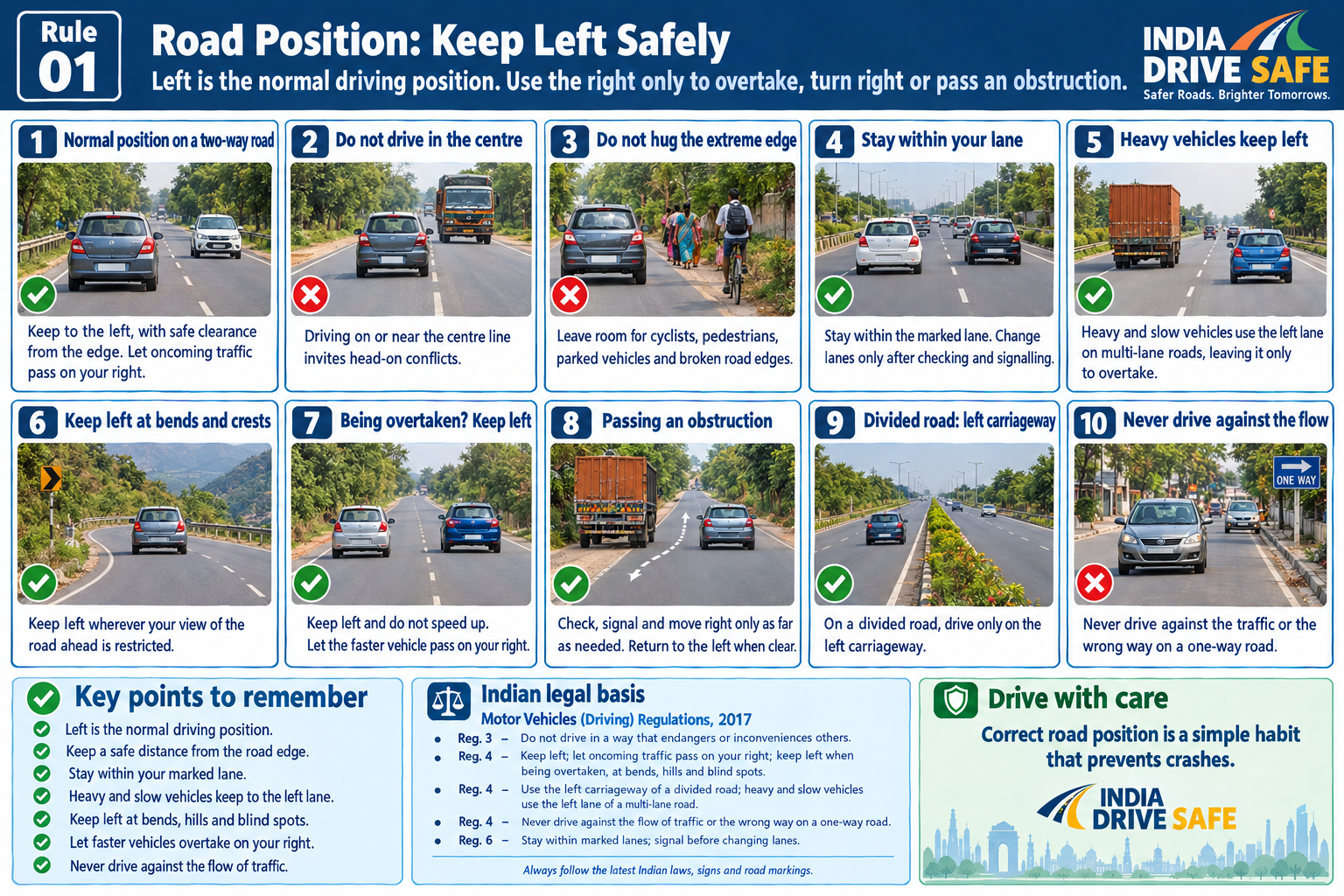
India uses left-hand traffic. On an ordinary two-way road, your normal position is on the left side of the carriageway so that approaching traffic passes on your right.
Keep generally to the left, but choose a safe and predictable position. Do not drift unnecessarily toward the centre of the road, and do not hug a dangerous road edge.
What Indian law requires
The Motor Vehicles (Driving) Regulations, 2017 make the starting point clear. Unless road signs or road markings indicate otherwise, a driver must keep the vehicle as far as possible to the left of the carriageway and allow traffic coming from the opposite direction to pass on the right.
The regulations reinforce the left-side position when you are being overtaken and when approaching a bend, hill or other place where your view ahead is restricted. On a dual carriageway, traffic normally uses the left carriageway unless a police officer or road sign directs otherwise.
Keep left — but do not blindly hug the edge
“Keep left” describes your normal road position. It does not mean placing your wheels as close as physically possible to a kerb, broken shoulder, open drain, parked vehicle, pedestrian or cyclist.
Indian regulations separately require due care and caution, a good lookout, and special care for vulnerable road users. Your position must therefore leave sensible clearance from hazards while still keeping properly to the left.
- Leave room from pedestrians walking near the carriageway.
- Do not squeeze cyclists or two-wheelers against the road edge.
- Allow for doors that may open from parked vehicles.
- Avoid broken shoulders, potholes, debris, drains and standing water.
- Do not move toward the centre merely because the left edge is imperfect; slow down and choose the safest available line.
On a road with a centre line
Stay on the left side of the centre line unless a lawful manoeuvre requires otherwise. Do not allow the vehicle to wander across the centre line, especially on bends, crests and other places where you cannot see far enough ahead.
If a solid longitudinal line applies, do not cross or drive over it except where the Indian regulations permit because of an obstruction. Road markings are instructions, not decoration.
On a road with marked lanes
When traffic lanes are marked, drive within your lane. Change lanes only after checking that it is safe and giving the proper signal. If a lane is reserved for a particular class of vehicle or special purpose, use it only when the rules allow.
For ordinary cars, the Indian regulations do not use exactly the same blanket “keep left unless overtaking” wording found in some foreign road codes. The safe India Drive Safe practice is to keep generally left when conditions permit, follow signs and arrows, and use lanes farther to the right when overtaking, preparing for a right turn, passing an obstruction, following lane directions, or when traffic conditions reasonably require it.
Heavy and speed-restricted vehicles
Indian law is more explicit for a heavy vehicle or speed-restricted vehicle: on a carriageway with several lanes in one direction, it must use the left lane except while passing an obstruction or a slower vehicle, and it must return to the left lane once safely past.
At bends, hills and restricted-view locations
Keep well to the left and reduce speed enough to deal with what may be hidden ahead. Cutting toward the centre of a blind bend can put part of your vehicle directly into the path of oncoming traffic.
A useful habit is to ask: “Could an oncoming motorcycle, car, bus or truck appear around this bend right now?” If the answer is yes, your position and speed must leave a safe margin.
When another vehicle is overtaking you
Maintain a predictable line and keep left. Do not move right to discourage the overtake, and do not make sudden lateral movements. The overtaking manoeuvre is easier to complete safely when the vehicle being passed remains stable and predictable.
Passing a parked vehicle or obstruction
You may need to move right temporarily to create clearance from a parked vehicle, roadworks, debris, a stopped vehicle, a cyclist or another obstruction. Before moving out:
- look well ahead for oncoming traffic;
- check mirrors and blind spots;
- signal when a signal will help other road users;
- move out smoothly only when there is enough space;
- pass with safe clearance; and
- return to a normal left-side position when it is safe.
Never force oncoming traffic to brake or leave the road simply because your side is obstructed.
What the international manuals teach us
The UK Highway Code uses a simple teaching rule: keep left unless signs or markings say otherwise, with practical exceptions for overtaking, turning right and passing obstructions. New Zealand similarly teaches drivers to keep left, remain within marked lanes and reserve the lane nearer the centre mainly for passing, turning right or when the left lane is blocked or full. NSW guidance also strongly reinforces keeping left, staying in the lane while being overtaken, and obeying dividing lines.
These manuals are useful teaching references because they explain why predictable left-side positioning reduces conflict. They do not replace Indian law.
Common mistakes
Driving unnecessarily close to opposing traffic leaves little recovery space.
Being “left” is not a reason to endanger pedestrians, cyclists or your own vehicle on a damaged edge.
Straddling two marked lanes makes your intentions unclear and blocks other traffic.
Moving toward the centre of a restricted-view bend can create a head-on conflict.
A simple road-position routine
While driving, repeatedly scan far ahead → road markings → left-side hazards → mirrors → escape space. Your position should change gradually as the road situation changes, not as a last-second reaction.
Good road position is not about occupying one exact strip of asphalt. It is about staying legally and predictably on the left while continuously preserving space from danger.