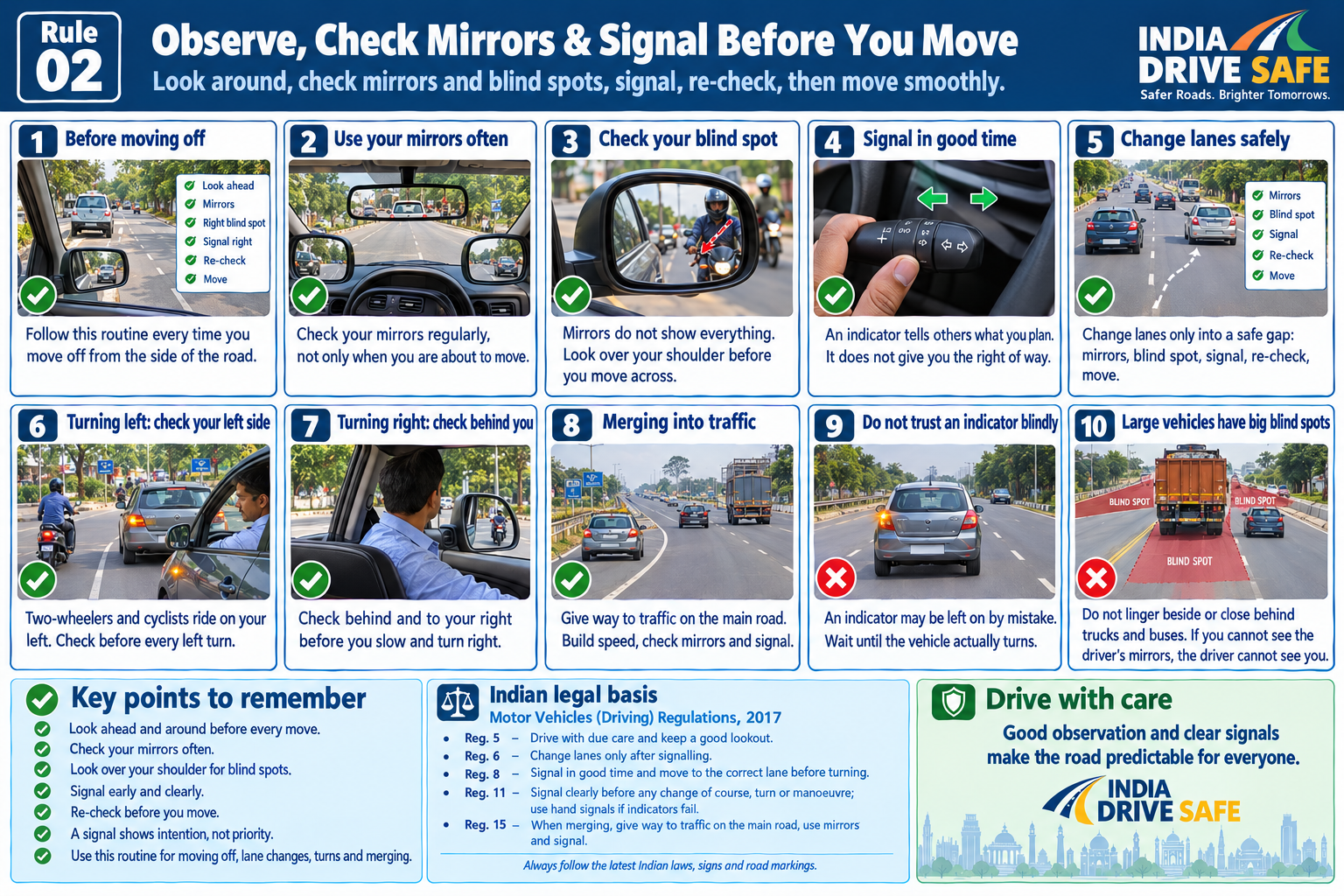
A safe manoeuvre begins before the steering wheel moves. Whether you are pulling away from the side of the road, changing lanes, merging, turning or moving around an obstruction, first build a clear picture of the traffic around your vehicle.
Observe → Mirrors → Blind-spot check → Signal → Re-check → Move smoothly.
Why observation comes first
Indian regulations require every driver to maintain a good lookout, concentrate on the road and traffic, and avoid distractions. That means you should not discover another motorcycle, cyclist, car or pedestrian only after you have begun moving into their space.
Your observation should answer three questions:
- What is ahead? — traffic, pedestrians, junctions, road markings, stopped vehicles and hazards.
- What is behind? — vehicles that may be following, overtaking or approaching quickly.
- What is beside me? — motorcycles, cyclists, cars and pedestrians that may be hidden from the mirrors.
Mirrors do not show everything
Use the interior rear-view mirror and both exterior mirrors frequently enough to maintain awareness of traffic behind and beside you. Check the appropriate mirrors again before you change speed, lane or direction.
But mirrors have limits. Pillars, the body of the vehicle, mirror coverage and the position of nearby road users create areas you cannot see properly. These are commonly called blind spots.
A motorcycle or bicycle can disappear from a mirror while still being alongside your vehicle. A quick, controlled head check toward the side you intend to move can reveal a road user that the mirrors do not show.
Before moving off from the side of the road
When your vehicle is stationary at the left side of the road and you intend to join traffic:
- look ahead for pedestrians, vehicles and other hazards;
- check the interior and exterior mirrors;
- check the right-side blind spot, because you will normally be moving out into traffic to your right;
- give a right indicator when the signal will warn or inform other road users;
- look again for approaching traffic, especially motorcycles and cycles;
- move away smoothly only when there is a safe gap; and
- cancel the indicator after the manoeuvre if it does not cancel automatically.
Do not force an approaching vehicle to brake or swerve simply because you have switched on your indicator.
Before changing lanes
Indian regulations require a driver to stay within a marked lane and to change lanes only after giving a proper signal. The turn regulations also require the driver to keep traffic beside and behind in view before moving into another lane.
Use this sequence:
- Plan early. Do not wait until the last few metres before a junction or obstruction.
- Check ahead. Make sure the lane you want actually remains usable.
- Check mirrors. Note the speed and position of traffic behind.
- Check the relevant blind spot. Look toward the side you intend to enter.
- Signal. Give other road users time to understand your intention.
- Re-check. Traffic positions may have changed while you were signalling.
- Move gradually. Cross the lane line smoothly and settle fully into the new lane.
Signal intention — not entitlement
A direction indicator communicates what you intend to do. It does not create a safe gap, transfer responsibility to other drivers or give you automatic priority.
Indian Regulation 11 requires a driver to clearly indicate an intention to change course, turn left or right, and before making a manoeuvre. Good signalling therefore has three qualities:
- Correct: use the signal that matches the movement you intend to make.
- Timely: signal early enough to be useful, but not so early that it misleads others.
- Finished: cancel the signal after the manoeuvre so it does not falsely suggest another movement.
Do not trust another vehicle's indicator blindly
An indicator shows an intention, not a guarantee. The driver may have forgotten to cancel it, may be signalling for a different turn, or may change plans. Before you cross another vehicle's path, judge its speed and actual movement as well as its signal.
Turning left: look for two-wheelers and cyclists on your left
A left turn can create a serious conflict with a motorcycle, scooter or cyclist travelling between your vehicle and the left edge of the road. Indian Regulation 8 specifically requires observation of traffic to the left and behind before moving into the left lane and requires drivers to give way to cyclists and other slow-moving traffic before turning left.
Before turning left, check the left exterior mirror and the left blind area. Do not turn across a road user who is already alongside you.
Turning right: check behind and to your right
Prepare for a right turn in good time. Before moving toward the right side or right-turn lane, check traffic behind and to your right, signal clearly, and move only when the lane is safe to enter.
Be especially alert for a motorcycle already overtaking or filtering on your right. A late right turn without observation can place the motorcycle directly beside your front or rear quarter.
Merging into faster traffic
Indian Regulation 15 expressly requires a driver, before and while merging, to keep close watch on traffic through the rear-view and side-view mirrors and to signal the intention to merge.
When an acceleration lane is provided, use it to build an appropriate speed, observe the traffic stream, identify a safe gap, signal and merge smoothly. Do not stop unnecessarily at the end of a usable acceleration lane unless traffic conditions require you to stop.
Large vehicles have larger blind areas
Buses and trucks can have substantial areas around the cab, sides and rear that are difficult for the driver to see. Do not remain beside a large vehicle unnecessarily, particularly near its front-left side or immediately behind it.
If you cannot see the large vehicle's mirrors, assume its driver may not be able to see you.
Common observation mistakes
A vehicle can be hidden in the blind spot even when the mirror looks clear.
Other traffic needs time to see the signal, and the gap still has to be safe.
A blind-spot check should not make you lose awareness of the road ahead.
A gap safe for the vehicle ahead may close before you reach it.
A simple habit for every manoeuvre
Do not treat mirrors, blind-spot checks and indicators as separate test exercises. They are one continuous safety process:
The best drivers do this routinely, long before a manoeuvre becomes urgent.