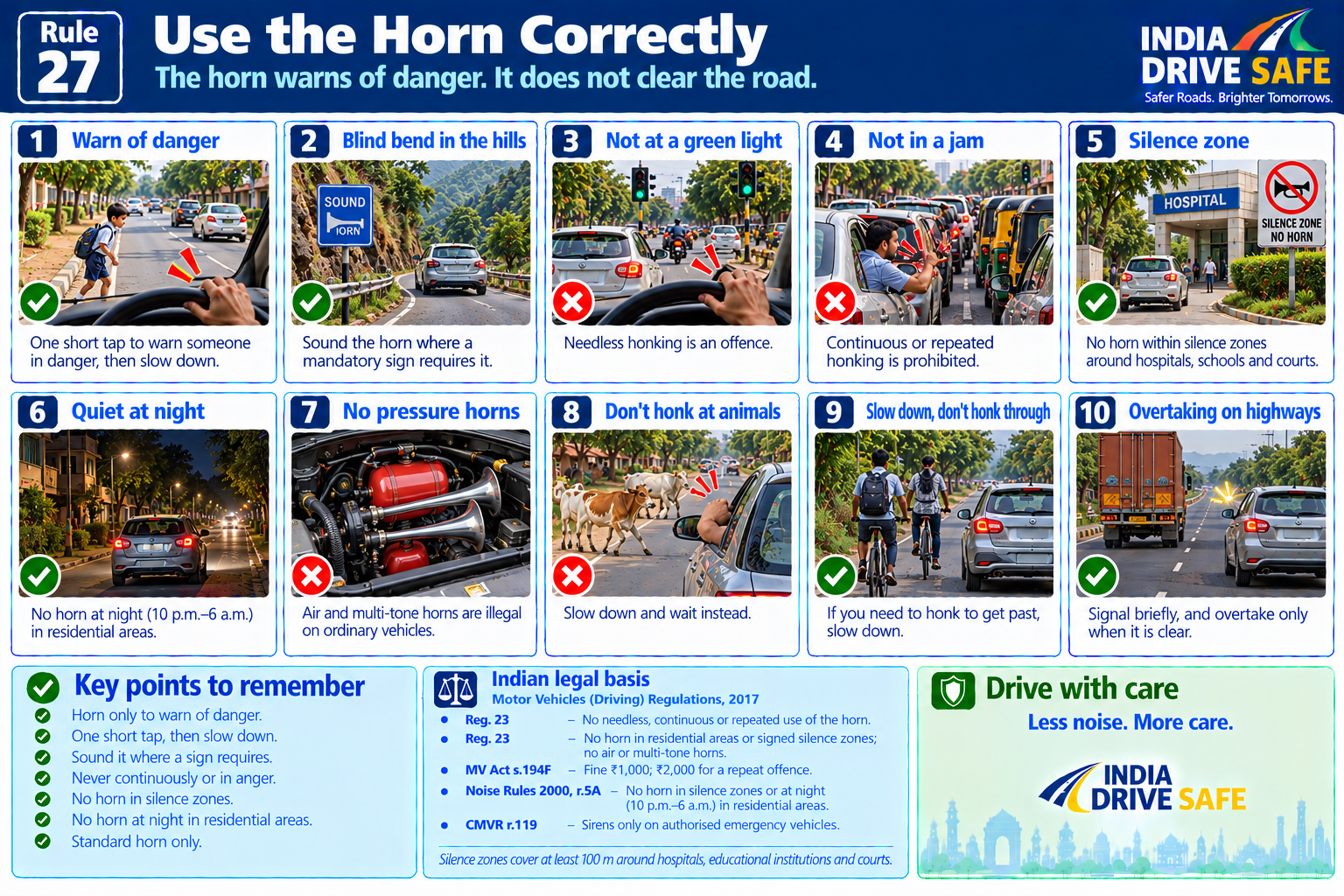
On Indian roads the horn is often used as a habit: to say "I am here", "move", "I am overtaking", or simply out of impatience. Constant honking does not make anyone safer. It hides the warnings that matter, stresses everyone who hears it, and harms the hearing and health of people who live and work beside busy roads. Indian law treats the horn as a warning device for danger, not a way of clearing the road.
Use the horn only to warn someone of danger, with one short tap. Never honk continuously or in anger, never in silence zones or at night in residential areas, and keep only the standard horn your vehicle was built with.
What Indian law says
Regulation 23 of the Motor Vehicles (Driving) Regulations, 2017 sets out how the horn may be used:
- do not sound the horn needlessly. As far as possible, use it only when you apprehend danger to yourself or another road user;
- sound the horn where a mandatory sign tells you to, for example the "compulsory sound horn" sign on some blind bends in the hills;
- do not sound it continuously, repeatedly or for longer than necessary, and do not use it in residential areas or in a silence zone marked by a sign;
- do not fit or use an air horn or multi-toned horn that makes a harsh, shrill, loud or alarming sound. Sirens and special sound signals are allowed only on vehicles such as ambulances, fire engines and police vehicles (Central Motor Vehicles Rules, Rule 119);
- do not remove or bypass the silencer, and do not drive a vehicle that makes undue noise.
Penalties
Under Section 194F of the Motor Vehicles Act, 1988, sounding the horn needlessly, continuously or more than necessary, or where a sign prohibits it, and driving with an exhaust cut-out, carry a fine of ₹1,000 for a first offence and ₹2,000 for a repeat offence. Fitting illegal horns or a modified exhaust may also be treated as an unauthorised alteration of the vehicle (Rule 21).
Silence zones and night time
- under the Noise Pollution (Regulation and Control) Rules, 2000, an area of at least 100 metres around hospitals, educational institutions and courts may be declared a silence zone;
- no horn may be used in a silence zone, or at night (10 p.m. to 6 a.m.) in residential areas, except in a public emergency (Rule 5A); and
- many cities also mark "No Horn" zones with signs. Obey them.
When the horn helps
- a pedestrian, cyclist or animal is about to step or move into your path and has not seen you;
- a vehicle is reversing or pulling out towards you without seeing you;
- on a blind bend in the hills or a narrow road where a sign requires it, or where you cannot see oncoming traffic; and
- in any other situation where someone is in danger and a warning will help.
In each case, one or two short taps are enough. Then slow down and be ready to stop: the horn is a warning, not a right of way.
When not to use it
- to tell the vehicle ahead to move faster or get out of your way;
- the moment a signal turns green, or while waiting in a jam. The traffic will not move faster;
- to greet someone, to call someone out of a house, or to show anger;
- near hospitals, schools and courts, and in residential streets at night;
- at animals. Honking frightens them into unpredictable moves (Rule 25); and
- as a substitute for slowing down. If you need to honk to get past safely, you are probably going too fast or too close.
Overtaking on highways
Many trucks still carry the words "Horn OK Please". On highways a short tap, or a flash of the headlights by day, can let the driver ahead know you are about to overtake. It does not make an overtake safe: overtake only when the road ahead is clear and the driver ahead has seen you (Rule 04). At night, use a brief headlight flash rather than the horn, and do not dazzle.
Your horn and your vehicle
- keep the horn the vehicle was built with, and make sure it works;
- do not fit pressure horns, musical or multi-tone horns, sirens, hooters or "reverse horns" that play tunes;
- do not remove the silencer or fit loud aftermarket exhausts; and
- remember that only authorised emergency vehicles may use sirens and flashing red or blue lights. In 2025 the Supreme Court directed action against unauthorised hooters and strobe lights.
Common mistakes
Needless honking is an offence. Give drivers ahead a moment.
Continuous honking is prohibited and changes nothing.
Silence zones extend at least 100 metres. No horn at all.
Air and multi-tone horns are illegal on ordinary vehicles.
The horn warns; it does not give you the right of way.
Phone them instead, especially at night in residential areas.