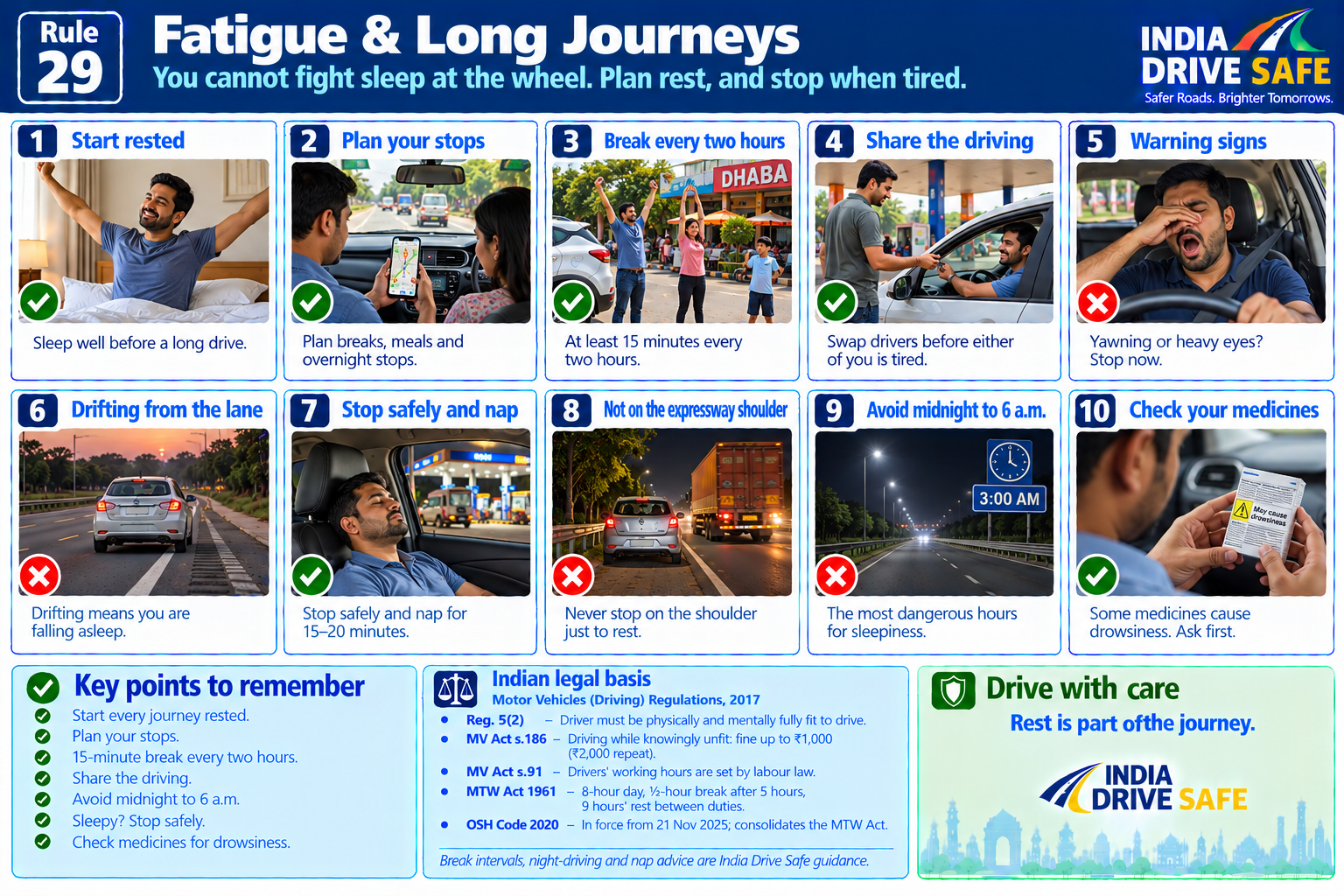
Tiredness kills quietly. A driver who falls asleep for just three or four seconds at 80 km/h travels the length of a cricket pitch several times with nobody in control. Sleepy drivers do not brake or steer before the crash, so these crashes are often severe. On Indian highways the danger is greatest late at night and before dawn, on long straight roads, and after a long day's work.
India Drive Safe rule:
Start every journey rested. Plan a break of at least 15 minutes every two hours, avoid driving between midnight and 6 a.m. where you can, and stop as soon as you feel sleepy. You cannot fight sleep at the wheel.
Start every journey rested. Plan a break of at least 15 minutes every two hours, avoid driving between midnight and 6 a.m. where you can, and stop as soon as you feel sleepy. You cannot fight sleep at the wheel.
What Indian law says
- Regulation 5(2) of the Motor Vehicles (Driving) Regulations, 2017 requires a driver to be physically and mentally fully fit to drive. A driver too tired to stay alert is not fit to drive.
- Section 186 of the Motor Vehicles Act, 1988: driving while knowing that you suffer from a disease or disability that makes your driving a danger to the public carries a fine of up to ₹1,000 (up to ₹2,000 for a repeat offence).
- A crash caused by driving while exhausted may also lead to charges of dangerous driving (Section 184) and, if someone is hurt or killed, criminal charges under the Bharatiya Nyaya Sanhita, 2023.
- Commercial drivers: under Section 91 of the Motor Vehicles Act, the working hours of drivers of transport vehicles are set by labour law. The Motor Transport Workers Act, 1961 set a normal limit of eight hours a day, a break of at least half an hour after five hours of work, and at least nine consecutive hours of rest between duties, with longer hours allowed only in limited cases on long-distance routes. From 21 November 2025 this Act has been brought into the Occupational Safety, Health and Working Conditions Code, 2020, and detailed rules for transport workers were still being finalised. Transport operators must check the current rules, and must not schedule drivers beyond them.
Before a long journey
- sleep well the night before. Do not start a long drive after a night shift, a late wedding or a night of little sleep;
- plan the route and the stops: where you will take breaks, eat and, on very long trips, stay overnight. Allow time for traffic, so you are not tempted to push on;
- avoid the danger hours. The body is programmed to sleep between about midnight and 6 a.m., and there is a smaller dip in the early afternoon. Plan driving for the daytime where possible;
- share the driving with another licensed driver on long trips, and swap before either of you is tired;
- eat light meals. A heavy meal before or during the drive makes you drowsy; and
- check your medicines. Many common medicines, including some for colds, allergies, pain, anxiety and sleep, cause drowsiness. Read the label and ask your doctor or pharmacist (Rule 14 covers alcohol and drugs).
Take regular breaks
- stop for at least 15 minutes every two hours, even if you do not feel tired;
- get out of the vehicle, walk, stretch and drink water;
- stop only in a safe place: a dhaba, fuel station, rest area or lay-by, well off the carriageway. Never stop on the carriageway or hard shoulder of an expressway just to rest (Rule 09; Regulation 22); and
- keep the cabin cool and well ventilated. A warm, stuffy car makes sleep come faster.
Warning signs: stop now
If you notice any of these, you are already in danger:
- yawning repeatedly, heavy eyelids, or rubbing your eyes;
- not remembering the last few kilometres;
- drifting from your lane, or hitting the rumble strips or road edge;
- missing a turn, a sign or a speed-breaker;
- following too closely, or changing speed without meaning to; and
- your head nodding, or a sudden jerk as you wake.
Opening the window, turning up the music or slapping your face do not work for more than a few minutes.
What to do when you feel sleepy
- Find a safe place to stop as soon as possible, off the main carriageway.
- Lock the doors and, if it is safe, take a short nap of 15 to 20 minutes. A drink containing caffeine just before the nap helps, as caffeine takes about 20 minutes to act.
- Get out, walk and wake up fully before you drive again.
- If you are still sleepy, stop for the night or hand over to a rested driver. Caffeine and a short nap are only a temporary fix.
Night driving on highways
- slow down. Unlit vehicles, parked trucks, animals and pedestrians are harder to see (Rules 11 and 25);
- watch for other drivers who may be sleepy: vehicles drifting across lanes or travelling at changing speeds. Keep well back and pass them only with great care; and
- never park on the carriageway at night. If you must stop because of a breakdown, get the vehicle off the road, switch on hazard lights and get everyone behind the barrier (Rule 12).
For employers and fleet operators
- do not set schedules that can only be met by driving without rest or at excessive speed;
- keep records of driving and rest hours, and give drivers clean, safe places to rest; and
- allow drivers to stop when they are tired, without penalty.
Common mistakes
"Just one more hour"
Sleep can come within seconds. Stop when you feel sleepy.
Sleep can come within seconds. Stop when you feel sleepy.
Driving through the night to save time
Midnight to 6 a.m. is the most dangerous time. Plan daytime driving.
Midnight to 6 a.m. is the most dangerous time. Plan daytime driving.
Cold air and loud music
They work for minutes, not hours. Only sleep cures tiredness.
They work for minutes, not hours. Only sleep cures tiredness.
Resting on the expressway shoulder
Parked vehicles are often hit. Use a rest area or fuel station.
Parked vehicles are often hit. Use a rest area or fuel station.
Long drive after a night shift
Sleep first, then drive.
Sleep first, then drive.
Ignoring drowsy medicines
Read the label; ask a doctor or pharmacist.
Read the label; ask a doctor or pharmacist.
Remember
Start rested → plan stops → 15 minutes every two hours → avoid midnight to 6 a.m. → sleepy? Stop safely, nap, or stay the night.