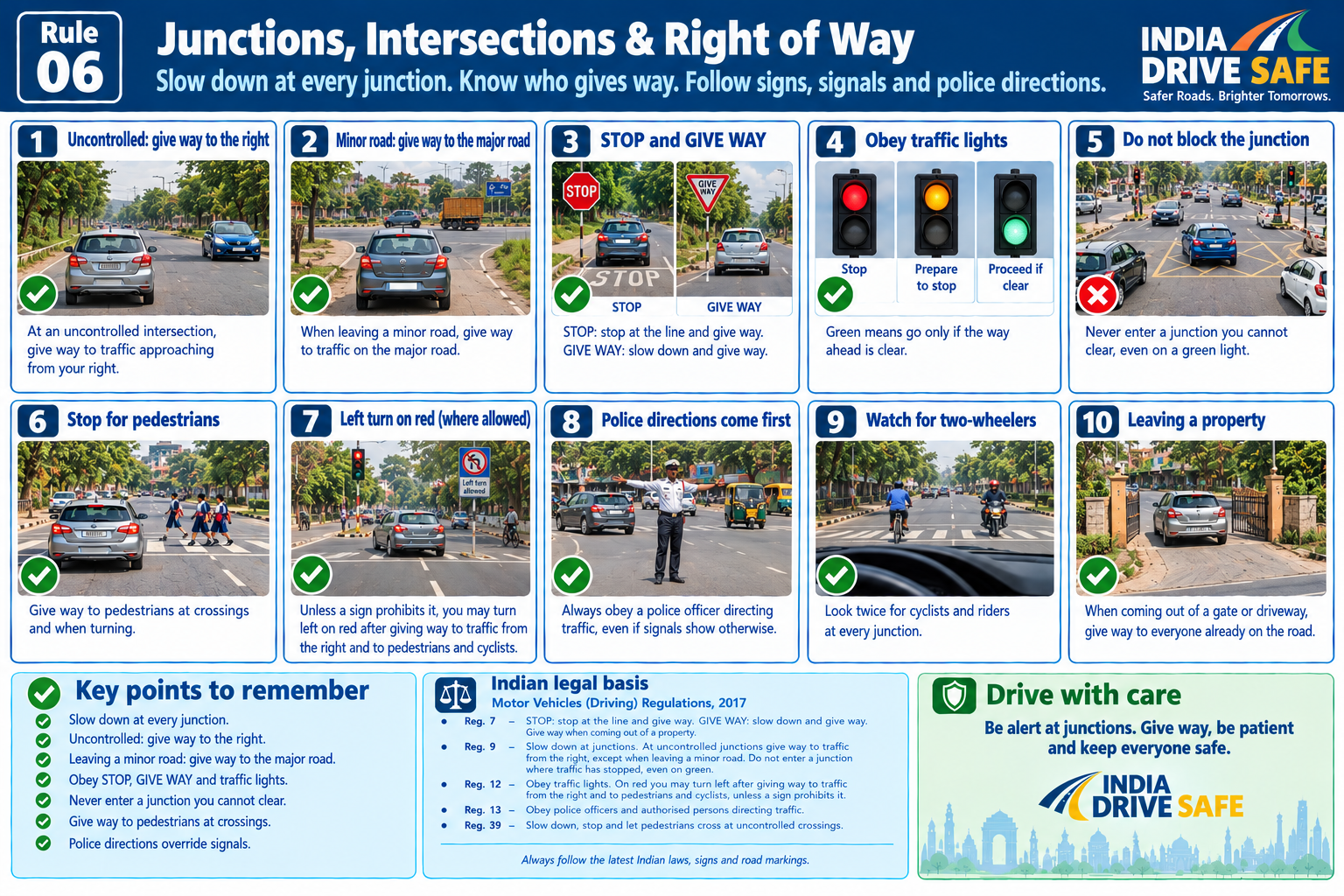
Intersections bring together vehicles, pedestrians, cyclists and two-wheelers whose paths may cross. A safe driver therefore treats every junction as a place to slow down, look, decide and be prepared to stop.
Do not enter a junction simply because you arrived first or because another driver appears to be slowing. Identify the controlling rule and proceed only when the path is genuinely safe.
Slow down before every intersection
Indian Regulation 9 requires a vehicle to slow down when approaching a road intersection, road junction, pedestrian crossing or road corner. You must not enter if doing so is likely to endanger road users already on, or moving onto, the junction.
Approach slowly enough that you can stop if:
- a vehicle appears from a side road;
- a pedestrian begins crossing;
- a motorcycle is hidden by another vehicle;
- traffic ahead stops unexpectedly; or
- your view is blocked by buildings, parked vehicles, trees, signs or road geometry.
First question: who controls the junction?
Before applying any general priority rule, look for the highest relevant control:
- Police officer or authorised traffic controller
- Traffic lights or directional arrows
- STOP, Give Way or other mandatory signs and road markings
- Major-road / minor-road relationship
- Uncontrolled-intersection right-of-way rule
Regulation 9 expressly says that the ordinary “vehicle from the right” rule does not apply when the junction is being controlled by an authorised person, traffic lights or mandatory traffic signs.
Uncontrolled intersections: give way to traffic from your right
At an intersection or junction with no controlling traffic lights, manual signals or mandatory signs, Regulation 9 provides that vehicles approaching from the right side have the right of way.
This means that if another vehicle is approaching the same uncontrolled intersection from your right, you should slow or stop as necessary and allow it to proceed without having to brake or swerve because of you.
Minor road entering a major road
The right-side rule does not apply when a vehicle is exiting a minor road and entering a major road. The vehicle emerging from the minor road must treat traffic already on the major road as having priority.
Regulation 7 also says that a driver facing a STOP sign must stop, give way to traffic on the major road and enter only when the way ahead is clear. A driver facing a Give Way sign must slow down, give way to traffic on the road being approached and proceed cautiously.
STOP means stop
At a STOP sign:
- stop before the transverse STOP line;
- if the line is absent or not visible, stop immediately before the sign;
- give way to traffic on the major road; and
- enter only after confirming that the road is clear.
Do not perform a rolling stop. A slow crawl is not the same as stopping.
Give Way means be ready to stop
At a Give Way sign, reduce speed early enough to assess the road you are joining. If another road user would have to brake, slow sharply or change direction because of you, wait.
If there is no marked pedestrian crossing before a STOP or Give Way sign, Regulation 7 still requires you to give way to pedestrians.
Emerging from a property
A vehicle emerging onto a road from a property bordering that road must give way to vehicles and other traffic already using the road.
This applies to movements such as leaving a driveway, petrol station, parking area, shop entrance or similar property access. Check the footpath and roadside for pedestrians and cyclists before crossing it.
Traffic lights: green does not mean “go regardless”
Regulation 12 requires drivers approaching traffic control signals to slow down and obey the signal.
Green light
You may enter only if the way ahead is clear. If the junction is blocked and you cannot clear it, remain behind the stop line even though the signal is green.
When a green directional arrow is displayed, move only in the direction shown by that arrow. Give way to pedestrians already in the intersection or adjacent crossing and to vehicles already in the intersection when the light changes.
Red light
Stop before the stop line preceding the pedestrian crossing. If there is no visible stop line, stop before the pedestrian crossing; if there is no marked crossing, stop before the primary traffic signal.
Left turn on red: an India-specific rule
Regulation 12 permits a vehicle to turn left on a red signal unless a traffic control device or road sign prohibits the turn. Before doing so, the driver must give way to traffic approaching from the right and to pedestrians and cyclists crossing on the left.
Amber light
An amber signal generally requires you to stop before the line or crossing. The regulation recognises an exception where you have already crossed the stop line or are so close that abrupt stopping may create a collision risk.
Do not accelerate toward an amber light merely to “beat” the red.
Traffic police directions override the normal junction routine
When a uniformed police officer or authorised person is directing traffic, Regulation 13 requires drivers to slow down and follow those directions. If told to stop, remain stopped until given permission to proceed.
Never block an intersection
Regulation 9 expressly prohibits entering an intersection if traffic there has come to a standstill — even if you are on the main road or have a signal to proceed.
This is one of the most important congestion rules for Indian cities. If there is no space for your entire vehicle on the far side, wait before the junction.
Do not stop across:
- the intersection;
- a pedestrian crossing;
- a yellow box marking; or
- the path needed by crossing or turning traffic.
Pedestrian crossings at and near junctions
Regulation 39 requires drivers approaching an uncontrolled pedestrian crossing to slow down, stop and give way to pedestrians, wheelchair users and users of invalid carriages.
When traffic ahead is stationary, do not drive onto the crossing unless you can move completely beyond it.
Look beyond the first vehicle
At intersections, one vehicle can hide another. Common examples include:
- a motorcycle hidden beside a bus or truck;
- a pedestrian hidden by a stopped car;
- a vehicle emerging from behind a parked vehicle;
- an oncoming motorcycle hidden by a vehicle waiting to turn right; or
- a cyclist travelling along the edge of the road.
Do not move merely because the nearest visible vehicle has stopped. Check the space around and beyond it.
Do not rely on eye contact alone
Eye contact can help confirm that another road user has seen you, but it does not transfer right of way. The other driver may misjudge your intention or may be looking past you.
Use road position, speed, signs, signals and actual movement — not gestures alone — to decide whether it is safe to proceed.
International teaching points worth adopting
NSW guidance recommends approaching intersections at a speed that allows the driver to stop and give way, and warns not to force a dangerous situation even when another driver should yield. New Zealand guidance defines giving way in a useful practical way: the road user you yield to should not need to brake, slow, swerve or take evasive action because of you.
These principles are excellent safety teaching for India, while the actual priority rules remain those in Indian law.
Common junction mistakes
A green signal does not permit you to block the intersection.
Indian uncontrolled-junction priority is based on the right-side rule, subject to controls and major/minor-road status.
STOP requires an actual stop before proceeding.
Avoid the crash even when another driver is legally required to yield.
Leave the crossing clear when traffic beyond the junction is stationary.
Scan right, left, ahead and again before entering; motorcycles and pedestrians may be hidden.
A simple junction decision
If priority is uncertain, reduce speed further and be prepared to stop. A few seconds of caution is better than entering a conflict you cannot escape.