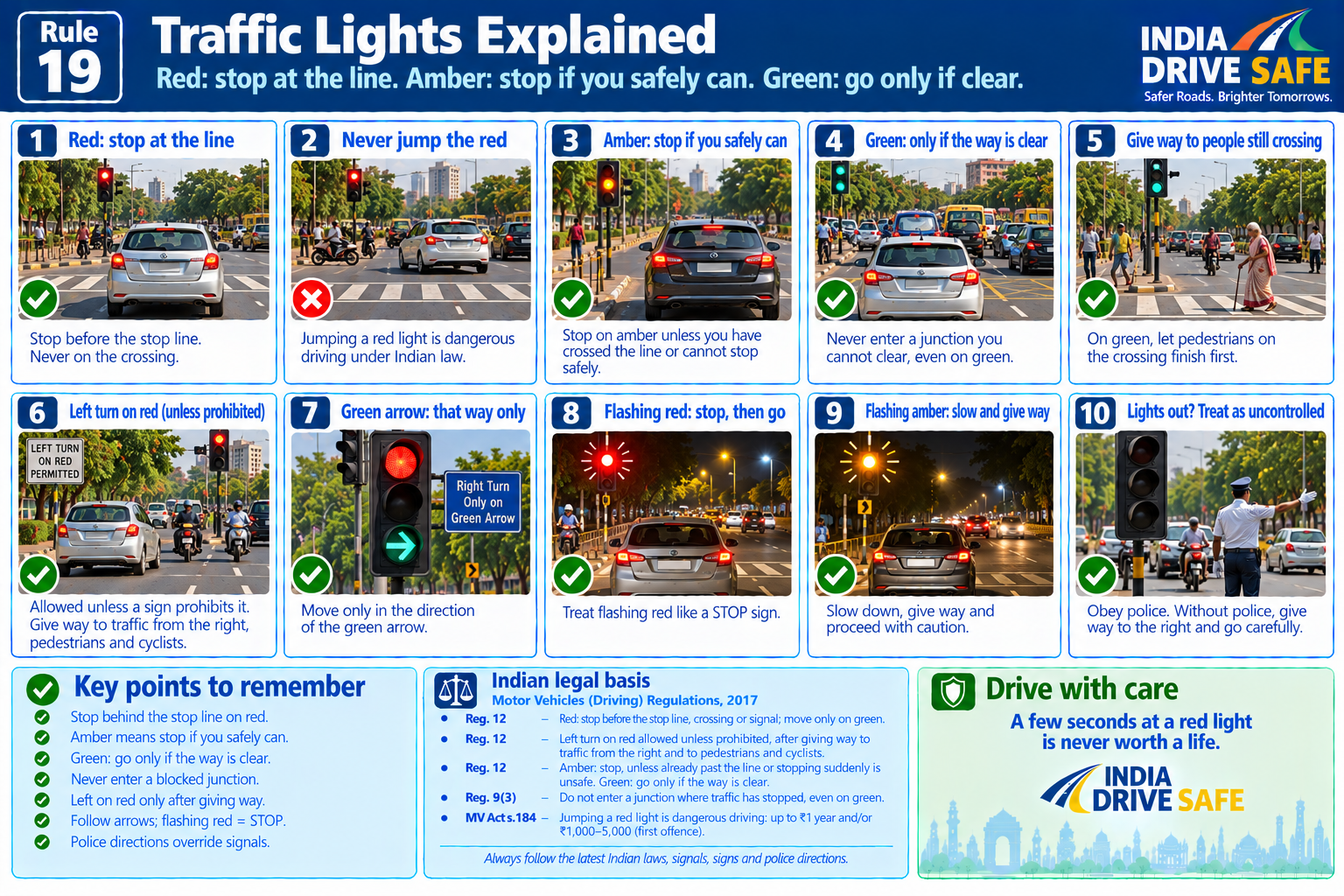
Traffic lights decide who goes and who waits at the busiest junctions in every Indian city. Most drivers know that red means stop and green means go, but many crashes happen in the grey areas: an amber light, a flashing signal, a green arrow, a left turn on red, or a junction that is blocked when the light turns green. This article explains every signal you will meet under Indian law.
Red: stop behind the line. Amber: stop unless it is unsafe to do so. Green: go only if the way ahead is clear. And whatever the light shows, give way to pedestrians and vehicles already in the junction.
What Indian law clearly requires (Regulation 12)
Regulation 12 of the Motor Vehicles (Driving) Regulations, 2017 sets out what each traffic signal means. Jumping a red light is also listed as dangerous driving under Section 184 of the Motor Vehicles Act, 1988, with a first-offence penalty of 6 months to 1 year in prison, a fine of ₹1,000–5,000, or both.
Where exactly to stop
When a signal requires you to stop, stop:
- before the stop line painted before the pedestrian crossing;
- if there is no visible stop line, before the pedestrian crossing; and
- if there is no marked crossing either, before the primary signal (the first traffic light post).
Never stop on the zebra crossing, and never creep past the line while waiting.
Red light
- stop at the correct point (above) and wait;
- move off with caution only when the green signal appears (Regulation 12(1)(d)); and
- do not start moving because the cross-traffic light has turned amber or because a countdown timer is about to reach zero.
Left turn on red
Indian law allows a left turn on a red signal unless a sign or traffic-control device prohibits it. Before turning, you must give way to traffic approaching from your right and to pedestrians and cyclists crossing on your left (Regulation 12(1)(f)).
- look for "No Left Turn on Red" signs, a red left arrow or a separate left-turn signal, which override the general rule;
- stop first if pedestrians are crossing the road you are turning into; and
- do not block the left lane if you are going straight. Vehicles behind you may be entitled to turn left on red.
Amber light
A steady amber means stop, at the same point as for red, unless:
- you have already crossed the stop line when amber appears; or
- you are so close that stopping suddenly could cause the vehicle behind to hit you (Regulation 12(3)).
Amber is not a signal to speed up and "beat the red". As you approach a signal that has been green for a while, be ready for it to change.
Green light
Green means you may go, not that you must or that it is safe:
- enter the junction or crossing only if the way ahead is clear (Regulation 12(2)(a));
- when the light turns green, give way to pedestrians still on the crossing and to vehicles still in the junction;
- never enter the junction if traffic beyond it has stopped and you cannot clear it, even on green (Regulation 9(3)); and
- when turning right on a full green, give way to oncoming traffic and to pedestrians crossing the road you are turning into.
Green arrows
- a green arrow lets you move only in the direction of the arrow, giving way to pedestrians and vehicles already in the junction (Regulation 12(2)(a));
- if your lane shows a red light but another lane shows a green arrow, only the vehicles going in the arrow's direction may move; and
- a flashing green arrow lets you turn in its direction after giving way to pedestrians, cyclists and merging vehicles (Regulation 12(2)(b)).
Flashing signals
- Flashing red: treat it like a STOP sign. Stop at the correct point, give way to pedestrians and to traffic on the major road, then proceed when it is safe (Regulation 12(1)(e)).
- Flashing amber: slow down, give way to pedestrians and vehicles already in the junction, and proceed with caution (Regulation 12(3)(c)). Many signals switch to flashing amber late at night. It does not mean the junction is safe to cross at speed.
- Flashing red lights at level crossings mean a train is coming. Stop and wait (Rule 13).
When signals are not working
- if a police officer is directing traffic, follow the officer. Police directions override signals (Regulation 13);
- if there is no officer and the lights are dark or broken, treat the junction as uncontrolled: slow right down, give way to traffic from your right unless you are leaving a minor road, and proceed with great care (Regulation 9; Rule 06); and
- never assume the other driver will treat it the same way. Make eye contact and be ready to stop.
Pedestrian signals
At signal-controlled crossings, pedestrians cross on their green walking figure. When your light turns green, people who started crossing may still be on the road, especially children, older people and people with disabilities. Wait for them to finish crossing (Regulation 39; Rule 08).
Countdown timers
Many Indian signals show a countdown. Use it to plan a smooth stop, not to race the last seconds of green or to start before your green appears. Drivers jumping off the line early are a common cause of crashes with vehicles clearing the junction.
Common mistakes
Amber means stop unless it is unsafe to do so.
Stop behind the stop line, before the crossing.
Wait until your exit is clear (Regulation 9(3)).
Give way to traffic from the right and to pedestrians and cyclists. Check for signs that prohibit it.
Plan to stop; do not race the last seconds.
It means slow down and give way, not "no rules".