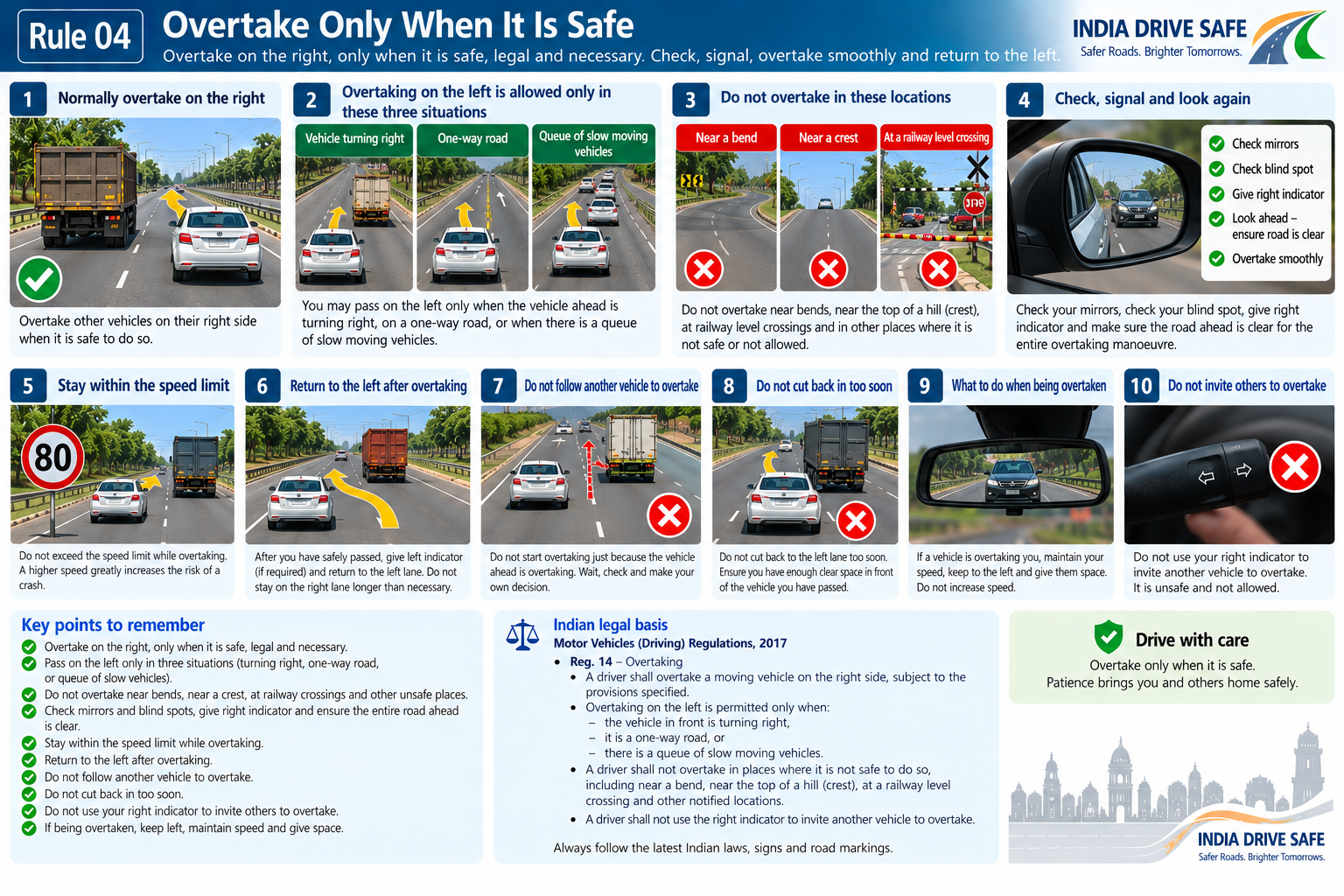
Overtaking is one of the highest-risk everyday driving manoeuvres because it can combine speed, lane changing, blind spots and — on a two-way road — possible exposure to oncoming traffic.
If there is any doubt about whether you can complete the overtake safely, do not start it.
The normal Indian rule: overtake on the right
Regulation 14 says that a vehicle is normally overtaken from the right side. This matches India's left-hand traffic system: slower traffic normally remains to the left while an overtaking vehicle moves to the right when it is safe and legal to do so.
Before moving right, make sure that:
- the road ahead is clearly visible for enough distance;
- there is no oncoming vehicle that would be impeded;
- no vehicle behind has already started overtaking you;
- the vehicle ahead is not about to turn, change lane or overtake;
- road signs and markings permit the manoeuvre; and
- there is a safe space to return to the left after passing.
Do not overtake merely because the vehicle ahead is slow
Being delayed is not an emergency. A safe driver waits until the entire manoeuvre can be seen and completed safely.
Do not rely on the vehicle ahead to decide for you. The driver in front may have a different view of the road, a faster vehicle, or may already be taking a risk. If one vehicle overtakes, that does not mean there is enough room for you as well.
The overtaking sequence
- Hold a useful following distance. Do not drive close to the rear of the vehicle you intend to pass; doing so reduces your view ahead.
- Look far ahead. Identify bends, junctions, crossings, road narrowing, oncoming traffic and speed-limit changes.
- Check mirrors and the right blind spot. Make sure another vehicle or motorcycle is not already overtaking you.
- Signal your intention. Use the right direction indicator as required.
- Re-check the road ahead. Do not commit simply because the indicator is on.
- Move out smoothly. Keep enough lateral clearance from the vehicle being passed.
- Pass without exceeding the speed limit.
- Do not cut back in. Wait until there is adequate clearance.
- Signal left and return to the left side as soon as it is safe.
You may not exceed the speed limit to overtake
Regulation 14 requires the overtaking vehicle to be travelling faster than the vehicle being passed, but it also expressly prohibits exceeding the applicable maximum speed limit.
If you cannot complete the manoeuvre safely while staying within the legal speed limit, you do not have a safe overtaking opportunity.
Never force oncoming traffic to slow down or move aside
Indian law prohibits an overtake that is likely to impede oncoming traffic. On a two-way road, this means you must have enough clear road to complete the pass and return to your side without making an approaching driver brake, swerve or leave the carriageway.
Where Indian law prohibits overtaking
Regulation 14 specifically prohibits overtaking in several situations. Do not overtake:
- when the traffic situation is unclear;
- where a mandatory traffic sign prohibits it;
- by crossing a continuous single or double solid longitudinal line dividing the road;
- on a bend, corner or other obstruction where the road ahead is not clearly visible;
- at junctions, intersections or pedestrian crossings;
- where the road narrows or traffic lanes reduce in width;
- on a narrow culvert; or
- where signs indicate a School Zone, Hospital Zone or Construction Zone.
This list should be treated as a legal minimum, not a list of the only dangerous places. Even where no specific prohibition applies, Regulation 14 begins with the wider requirement that the overtake must be safe.
When passing on the left is permitted
Passing on the left is an exception to the normal right-side overtaking rule. Regulation 14 permits it when it is safe and one of the following applies:
- Multi-lane road: both vehicles are travelling on a multi-lane road and the vehicle ahead can be safely passed in a marked lane to its left.
- Vehicle turning right or making a U-turn: the vehicle ahead is correctly positioned and signalling for that manoeuvre, and it is safe to pass on its left.
- Stationary vehicle: the vehicle ahead is stationary and it is safe to pass it on the left.
Do not turn these exceptions into a habit of weaving between lanes. Lane changes still require observation, signalling, sufficient space and compliance with road markings.
Be cautious around a vehicle signalling right
If a vehicle ahead is signalling a right turn or U-turn, passing on its left may be lawful when the conditions in Regulation 14 are met — but first look for pedestrians, cyclists, motorcycles, parked vehicles and narrow road space on the left.
Never squeeze through a gap simply because it technically exists.
Outside built-up areas: India's specific warning provision
Regulation 14 contains an India-specific rule for overtaking outside built-up areas. The driver may signal the intention to overtake with a very short horn signal or a headlight-flasher signal, and may proceed after receiving a signal from the driver ahead or if the way ahead is clear.
This provision must not be misunderstood. A signal from the driver ahead is not a guarantee that the road is safe. The overtaking driver must still personally verify that the manoeuvre is legal and safe.
Do not use your right indicator to invite someone to overtake
Regulation 14 expressly says that a driver must not use the right-turn indicator to signal permission to a following vehicle to overtake.
This is an important Indian driving habit to eliminate. A right indicator should mean what other road users expect it to mean: an intention to move or turn right, not “please pass me”.
When you are being overtaken
If another vehicle is overtaking you, Regulation 14 requires you not to increase speed and not to interfere with the overtaking vehicle's safe return to the left lane.
Remain predictable:
- keep a steady course;
- do not accelerate to compete with the overtaking vehicle;
- keep left where appropriate;
- avoid unnecessary braking or swerving; and
- leave room for the overtaking vehicle to return safely.
Overtaking trucks and buses
Large vehicles require more time and distance to pass. They can also block your view of oncoming traffic and road hazards.
Do not begin from immediately behind a truck. Hold back enough to see farther ahead. Once you move out, reassess the road before committing to the pass.
Do not cut immediately in front of a truck after overtaking. Give the heavy vehicle enough stopping space.
Overtaking motorcycles, cyclists and pedestrians
Give vulnerable road users generous lateral space. A motorcycle or bicycle can change line because of potholes, drains, debris, wind or parked vehicles.
Do not pass a cyclist or motorcycle closely simply to avoid crossing the centre line. If there is not enough room to pass safely, wait.
Common overtaking mistakes
This hides the road ahead and leaves little acceleration space.
There may be room for one overtake but not two.
Overtaking does not suspend the speed limit.
Leave enough clearance before returning to the lane.
Indian Regulation 14 expressly prohibits this use.
You must verify the road yourself before overtaking.
The safest overtaking decision
clear road ahead → mirrors and blind spot clear → legal place → adequate speed difference within the limit → safe return space.
If one part is missing, stay behind and wait for a better opportunity.