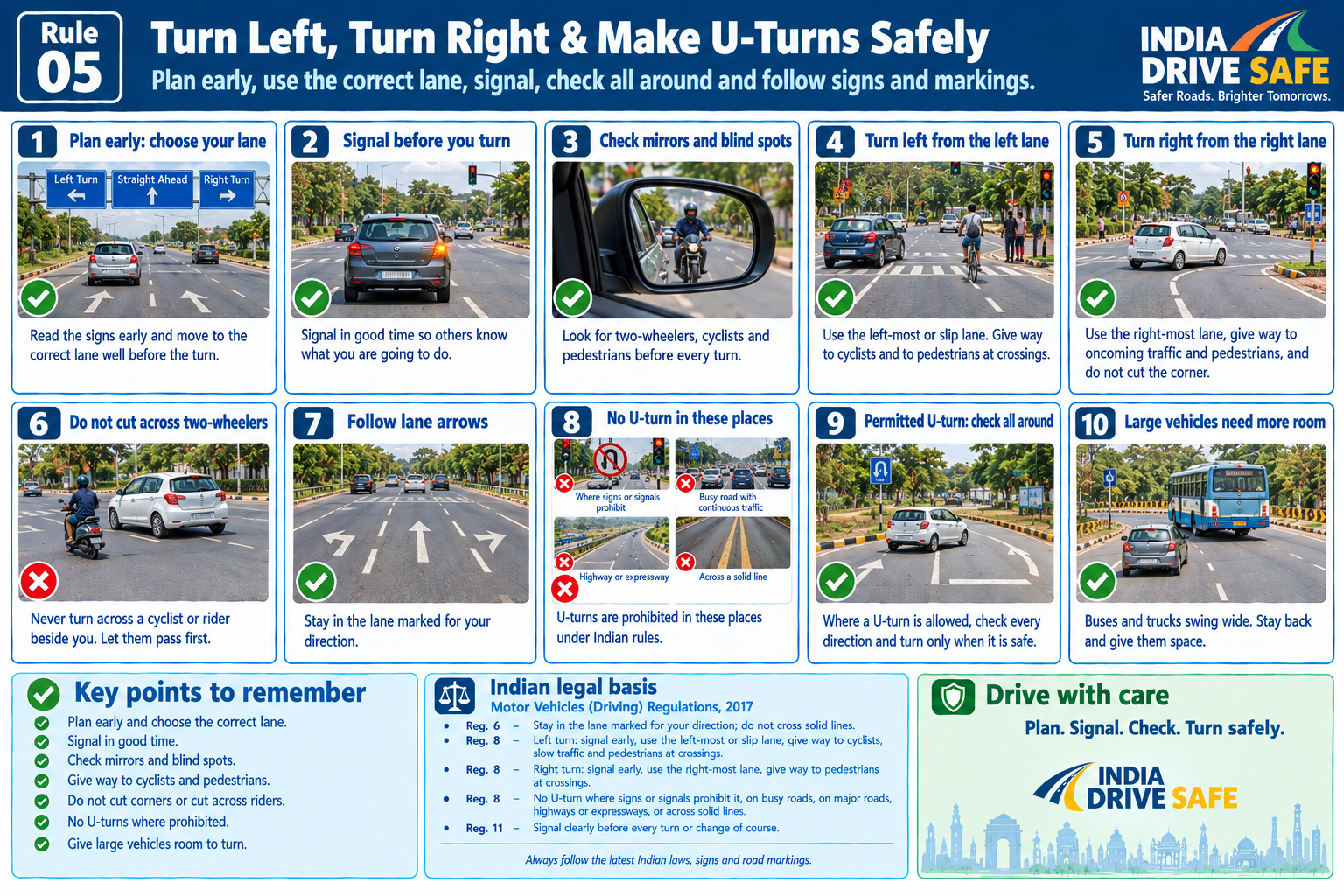
A safe turn begins well before the junction. Last-second lane changes, late indicators and wide swings make your movement difficult for other road users to predict.
Plan early → choose the correct lane → observe → signal → give way where required → turn smoothly → settle into the correct road position.
What Indian law requires
Regulation 8 of the Motor Vehicles (Driving) Regulations, 2017 requires drivers to plan turns well in advance, move into the appropriate lane and signal the intended turn. Regulation 6 separately requires drivers to remain within marked lanes and to follow turning lanes and direction markings. Regulation 11 requires a clear indication before changing course or turning.
Turning left
For a normal left turn, Indian Regulation 8 requires the driver to:
- signal the intention to turn left clearly and in good time;
- move to the left-most lane in reasonable time, or use a slip lane where one is provided;
- use a lane marked with a left-turn arrow when such lane directions are provided;
- observe traffic to the left and behind before moving into the left lane;
- give way to cyclists and other slow-moving traffic before turning; and
- give way to pedestrians at an uncontrolled pedestrian crossing.
Do not cut across a cyclist or motorcycle on your left
Two-wheelers can be difficult to see, particularly beside the rear-left quarter of a car, bus or truck. Before turning left, check the left mirror and the area beside the vehicle. If a cyclist, scooter or motorcycle is already alongside, let it clear before you turn.
The UK Highway Code makes the same safety principle explicit: drivers turning left should check mirrors, signal early and watch for road users coming up on the left rather than cutting across them. citeturn502826view0
Large vehicles may need more room
Indian Regulation 8 recognises that a large vehicle may be unable to negotiate a left turn from the extreme left lane because of its turning radius. Where necessary, it may use the next lane, but the driver must watch traffic on the left and exercise extreme caution.
If you are beside a turning bus or truck, do not try to squeeze through the space on its left. The rear wheels can track much closer to the kerb than the front of the vehicle.
Turning right
For a right turn, Regulation 8 requires the driver to:
- signal right clearly and in good time;
- move into the right-most lane in good time;
- remain in a lane marked with a right-turn arrow where such markings are provided;
- observe traffic to the right and behind before moving into the right lane; and
- give way to pedestrians at an uncontrolled pedestrian crossing.
On a two-way road, a right turn normally carries you across the path of oncoming traffic. Do not start merely because you are correctly positioned and signalling. Wait until the movement can be completed safely and without forcing another road user to brake or swerve.
Do not cut the corner
A right turn should be controlled and predictable. Do not swing diagonally across the wrong side of the junction or enter the opposing side of the road you are turning into. Follow lane markings where provided and establish yourself on the left side of the new road after the turn.
The UK Highway Code similarly teaches drivers to position for the right turn, wait for a safe gap, check again for cyclists and motorcycles, and avoid cutting the corner. citeturn502826view0
Use lane arrows and turning lanes
Where arrows or solid lane lines guide traffic at an intersection, choose the lane matching your intended movement before the final approach. Do not cross a solid turning-lane line at the last moment because you have realised you are in the wrong lane.
If you miss your turn, continue safely and find another legal route. A missed turn is inconvenient; a sudden cross-lane manoeuvre can cause a crash.
Slip lanes
When a left-turn slip lane is provided, Regulation 8 directs the driver to use it. A slip lane does not remove your duty to observe and give way. Pedestrians, cyclists and traffic on the road you are joining may still cross your path.
Making a U-turn
A U-turn changes your direction completely and can expose the vehicle to traffic approaching from several directions. Indian Regulation 8 therefore restricts U-turns more heavily than ordinary turns.
Do not make a U-turn:
- where a road sign or traffic signal prohibits it;
- on a busy road with continuous traffic flow;
- on a major road, highway or expressway; or
- across a continuous single or double solid line.
In addition, Regulation 20 prohibits a U-turn inside a tunnel.
Before a permitted U-turn
Do not begin a U-turn if blind spots prevent you from confirming that the space is safe. Observe:
- traffic approaching from the opposite direction;
- traffic beside you;
- traffic behind through the rear and side mirrors; and
- pedestrians and cyclists whose path you may cross.
Give way to road users who have the right of way and make sure the turn does not cause undue inconvenience or danger.
Large vehicles and U-turns
Regulation 8 permits a large vehicle to begin a U-turn from the left lane only where this is permitted. This reflects the larger turning circle of buses and trucks. Other drivers should stay clear rather than trying to pass through the space the large vehicle needs.
Do not confuse a right turn with a U-turn
Both use the right direction indicator, but they are different manoeuvres. A place where a right turn is permitted is not automatically a place where a U-turn is permitted. Look specifically for road signs, signals and markings, and apply the restrictions in Regulation 8.
Pedestrians have to be part of the turn decision
Before turning, look beyond motor traffic. A pedestrian may be crossing the road you are leaving or the road you are entering. Regulation 8 expressly requires drivers to give way to pedestrians at uncontrolled pedestrian crossings during left and right turns.
Slow enough that you can stop if a person steps into the turning path.
Indicators: tell others early, then cancel
Signal early enough to help other road users understand what you are about to do. Do not signal so early that it could be mistaken for an earlier side road or entrance.
After completing the turn, make sure the indicator has cancelled. A forgotten indicator can cause another driver to pull out or cross your path based on a movement you no longer intend to make.
International teaching points worth adopting
NSW guidance reinforces several useful habits: plan early, check mirrors and blind spots, use the lane intended for the turn, and follow lane lines through the turn. These are strong teaching practices for Indian drivers, while the legal position remains governed by Indian rules. citeturn846975view1turn846975view2
Common turning mistakes
Crossing several lanes just before the turn surprises traffic beside and behind you.
Check the left side and allow cyclists or motorcycles already alongside to clear first.
Move into the correct right-turn lane in good time unless signs or road design direct otherwise.
Do not cross into the wrong side of the road you are entering.
Indian rules prohibit U-turns in several types of road and location even if the vehicle can physically turn.
A signal communicates intention; it does not clear traffic from your path.
A simple rule for every turn
Correct lane → clear observation → useful signal → safe gap → smooth path.
If you are in the wrong lane or the gap is unsafe, continue ahead and find another safe route rather than forcing the turn.