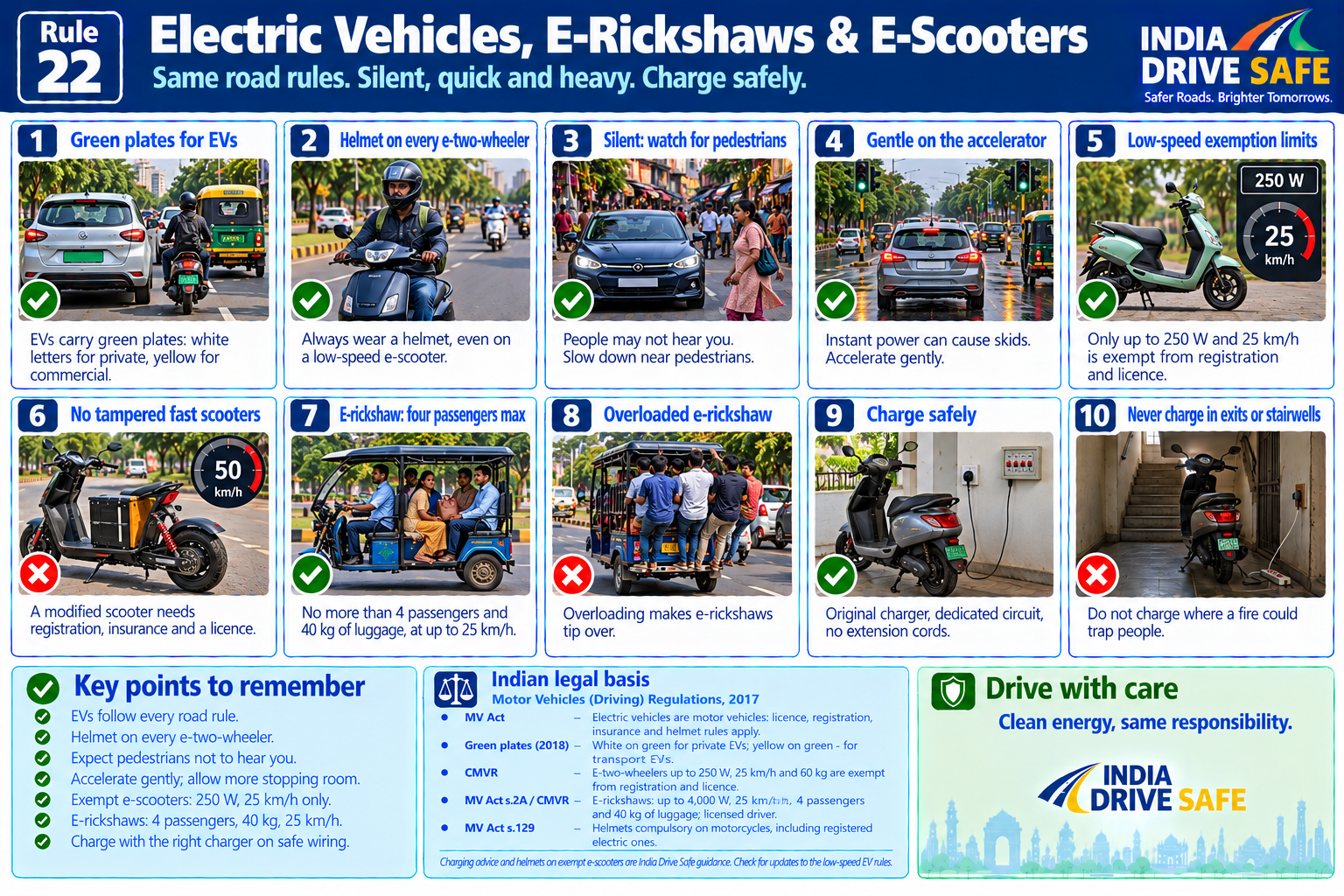
Electric scooters, cars and e-rickshaws are now everywhere in India. They are cleaner and cheaper to run, but they bring new things to learn. They are almost silent, they accelerate instantly, many are heavier than they look, and their batteries need careful charging. E-rickshaws and slow e-scooters also have their own legal rules.
India Drive Safe rule:
An electric vehicle is still a motor vehicle. Follow every road rule, wear a helmet on any two-wheeler, remember that pedestrians may not hear you, and charge only with the right charger on safe wiring.
An electric vehicle is still a motor vehicle. Follow every road rule, wear a helmet on any two-wheeler, remember that pedestrians may not hear you, and charge only with the right charger on safe wiring.
What Indian law says
Electric cars, motorcycles and scooters
- Electric vehicles are motor vehicles under the Motor Vehicles Act, 1988. The normal rules apply: a driving licence for the vehicle class, registration, insurance, helmets on two-wheelers (Section 129) and every rule in this guide.
- Since 2018, battery-operated vehicles carry green number plates: white letters on green for private vehicles, and yellow letters on green for transport (commercial) vehicles.
Low-speed e-scooters and e-cycles
- Electric two-wheelers with a motor of 250 W or less, a top speed of 25 km/h or less and an unladen weight of 60 kg or less are currently exempt from registration as motor vehicles, so no registration or driving licence is needed for them.
- A draft notification in August 2026 proposed raising the power limit to 600 W and removing the weight limit, keeping the 25 km/h top speed. Check whether it has been finalised before relying on it.
- A scooter that has been modified with a bigger motor or battery, or that can go faster than 25 km/h, is no longer exempt. It must be registered and insured, and the rider needs a licence. The Ministry has warned States about such tampered scooters.
- Even when the law does not require it, India Drive Safe strongly recommends an ISI-marked helmet on every e-scooter and e-cycle, and following all road rules.
E-rickshaws and e-carts
E-rickshaws are a special category under the Motor Vehicles Act (Section 2A, added in 2015) and the Central Motor Vehicles Rules:
- a three-wheeled battery vehicle with motor power not exceeding 4,000 W;
- maximum speed 25 km/h;
- no more than 4 passengers besides the driver, and no more than 40 kg of luggage;
- the driver needs an e-rickshaw driving licence, generally after a learner's licence, at least ten days of training from a registered association or manufacturer and a driving test; and
- the vehicle must be registered, insured and certified fit. Some States also require a public service badge and police verification of drivers.
Many expressways prohibit three-wheelers, including e-rickshaws (Rule 09).
Driving an electric vehicle
- You are nearly silent. At low speed, pedestrians, children, cyclists and animals may not hear you coming. Slow down near people, especially in lanes, car parks and markets, and be ready for someone to step out.
- Instant acceleration. Electric motors deliver full power immediately. Press the accelerator gently, particularly when moving off, in traffic and on wet roads.
- Regenerative braking. Lifting off the accelerator may slow the vehicle strongly. Learn how your vehicle behaves, and keep a safe following distance so that drivers behind are not surprised.
- Weight. Batteries make many EVs heavier than similar petrol vehicles, which means longer stopping distances. Allow more space.
- Plan your range. Running out of charge on a highway leaves you stranded where stopping is dangerous and often prohibited (Regulation 22). Plan charging stops before long trips.
- Floodwater. Do not drive any vehicle into floodwater (Rule 11).
Charging safely
Most EV battery fires in India have involved two-wheelers charging indoors. Follow these steps:
- use only the charger supplied or approved by the manufacturer;
- have an electrician check that your connection can handle the load, and install a dedicated circuit with an MCB, RCCB and proper earthing;
- never use extension cords, multi-plug adapters or makeshift wiring;
- charge in a dry, ventilated place, not in a stairwell, near the only exit, or next to beds;
- let the battery cool for a while after a ride before charging;
- stop charging immediately if you smell burning, see smoke, or notice a swollen battery or damaged cable, and contact the manufacturer; and
- avoid leaving a two-wheeler charging unattended overnight indoors.
If an electric vehicle catches fire
- get everyone out and well away immediately. Battery fires can flare suddenly and release toxic smoke;
- call 112 and tell them it is an electric vehicle; and
- do not try to fight a battery fire yourself, and do not go back for belongings.
For e-rickshaw drivers and passengers
- never carry more than four passengers or overload with goods. E-rickshaws tip over easily on turns and slopes;
- stop close to the kerb to pick up and drop passengers, not in the middle of the road or at junctions (Regulation 22);
- use indicators, keep left and do not suddenly cut across traffic;
- keep headlights, tail lights and reflectors working (Regulation 31); and
- passengers: get in and out on the kerb side, and do not sit on the sides or hang outside.
Common mistakes
Assuming people can hear you
EVs are nearly silent. Slow down near pedestrians.
EVs are nearly silent. Slow down near pedestrians.
Flooring the accelerator
Instant torque causes skids and rear-end crashes. Be gentle.
Instant torque causes skids and rear-end crashes. Be gentle.
"No licence needed" on a fast e-scooter
Over 25 km/h or a modified motor means registration, licence and insurance.
Over 25 km/h or a modified motor means registration, licence and insurance.
Charging on an extension cord
Use the original charger on a dedicated, protected circuit.
Use the original charger on a dedicated, protected circuit.
Overloaded e-rickshaw
Four passengers and 40 kg of luggage at most.
Four passengers and 40 kg of luggage at most.
Running out of charge on a highway
Plan charging stops; stopping on fast roads is dangerous.
Plan charging stops; stopping on fast roads is dangerous.
Remember
Same road rules → helmet on every two-wheeler → gentle accelerator → expect pedestrians not to hear you → plan your range → charge safely with the right charger.