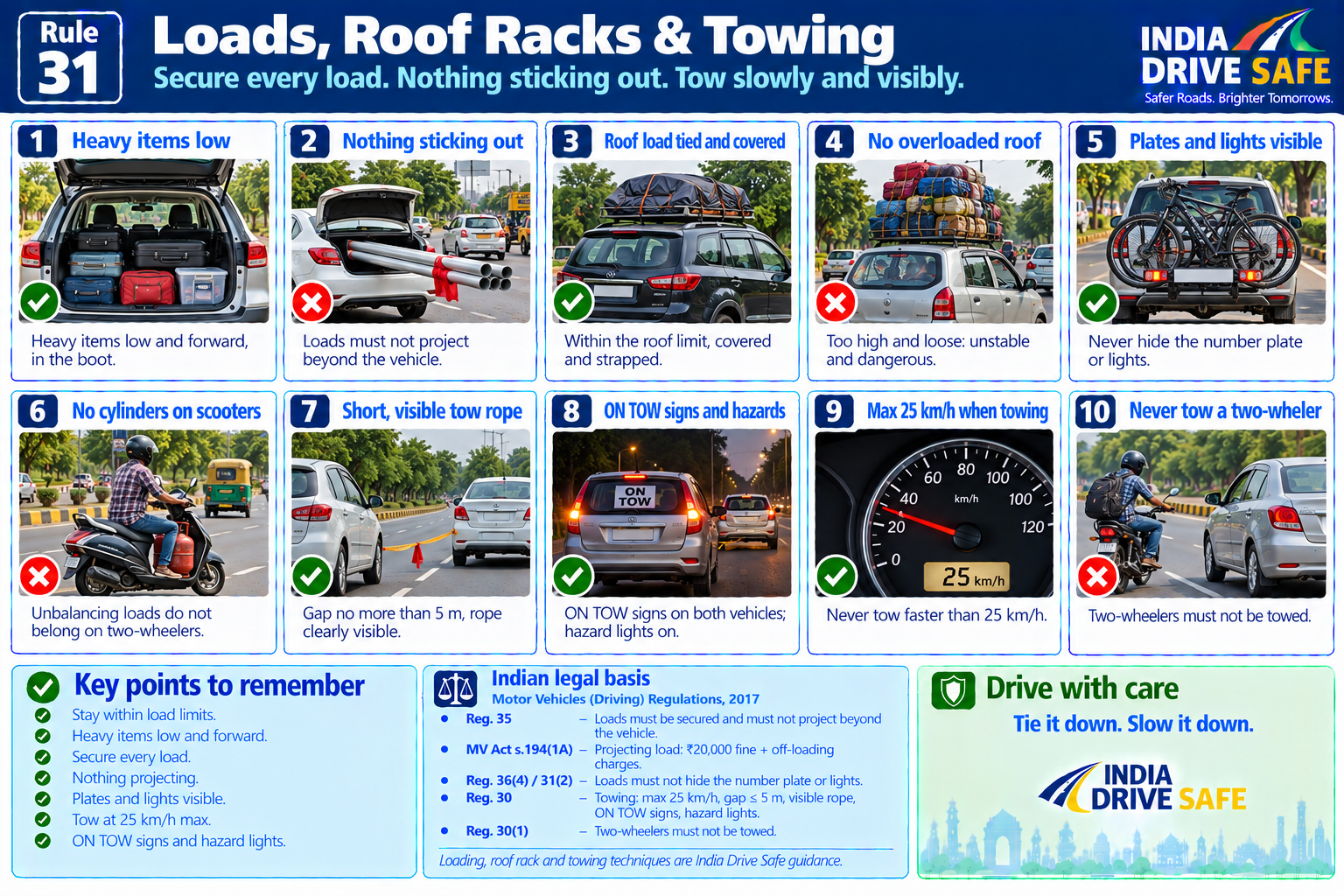
Families travel with luggage on the roof, people carry gas cylinders, furniture or building material in their cars, and broken-down vehicles are pulled home with a rope. Each of these changes how a vehicle handles and brakes, and a load that shifts or falls off can kill someone behind you. Indian law has clear rules on loads and towing for every vehicle, not just trucks.
India Drive Safe rule:
Never overload your vehicle, secure every load so it cannot move, and never let it stick out beyond the sides, front or back, or hide your lights and number plate. Tow only when you must: with a bar or a short, visible rope, at no more than 25 km/h, with "ON TOW" signs and hazard lights.
Never overload your vehicle, secure every load so it cannot move, and never let it stick out beyond the sides, front or back, or hide your lights and number plate. Tow only when you must: with a bar or a short, visible rope, at no more than 25 km/h, with "ON TOW" signs and hazard lights.
What Indian law says about loads
- Secure the load: every load must be secured so that it cannot slip, roll, fall off or make avoidable noise, even under emergency braking or a sudden swerve (Regulation 35(1) of the Motor Vehicles (Driving) Regulations, 2017). You must not drive if the load is arranged in a way that endangers anyone (Regulation 35(2)).
- No projecting loads: loads must not extend beyond the sides, front or rear of the vehicle body, and must stay within the height and weight limits in the registration certificate (Regulation 35(3)).
- Penalties: under Section 194 of the Motor Vehicles Act, 1988, driving with a load that projects sideways, forward, backward or above the permitted height carries a fine of ₹20,000 plus off-loading charges, and the vehicle may not move until the load is rearranged (Section 194(1A)). Overloading beyond the permitted weight carries ₹20,000 plus ₹2,000 per extra tonne (Section 194(1)). Section 194(1A) is not limited to trucks; it applies to any vehicle carrying a projecting load.
- Keep plates and lights visible: no load may hide the number plate (Regulation 36(4)) or any light (Regulation 31(2)).
- People are not luggage: never carry anyone on the roof, in the boot, or in the back of a goods vehicle for hire (Regulation 32; Rule 17). Every passenger needs a proper seat and a seat belt (Rule 28).
Loading a car or SUV
- Know the limits. Your owner's manual gives the maximum load (passengers plus luggage) and the roof load limit, which is often only 50 to 75 kg including the rack;
- heavy items low and forward: in the boot floor, against the back of the rear seats, not on the parcel shelf or roof;
- secure loose items in the cabin. In a crash, a bag, water bottle or phone becomes a missile. Use the boot, tie-down points, nets or a cargo barrier;
- keep your view clear: do not stack luggage above the rear seat backs if it blocks the rear window and mirror;
- adjust tyre pressures and headlights for a heavy load, as the owner's manual says. A loaded car's headlights may point upwards and dazzle oncoming drivers; and
- never carry the boot open with long items sticking out. Exhaust fumes can enter the cabin, and the load projects illegally.
Roof racks and carriers
- use a proper roof rack or carrier designed for your car, fitted to the manufacturer's instructions, and check the fixings before every trip and at each stop;
- stay within the roof load limit, and keep the load within the length and width of the car;
- cover the load with a fitted cover or tarpaulin, and tie it down with straps or ratchet belts, not with a single rope;
- a roof load raises the centre of gravity. The car will lean more in bends, be more affected by crosswinds, and take longer to stop: drive more slowly, especially on ghat roads and expressways;
- remember the extra height at low bridges, parking garages and toll canopies; and
- remove an empty roof carrier when you do not need it; it adds noise, drag and fuel use.
Two-wheelers and loads
- do not carry gas cylinders, long rods, glass panes or large boxes on a scooter or motorcycle. They upset balance and can hit other road users;
- use proper carriers and luggage boxes, keep loads within the width of the handlebar, and never hang bags from the handlebar; and
- a two-wheeler must not be towed by another vehicle (Regulation 30(1)), including by a rider holding on to another vehicle or pushing with a foot.
Towing a broken-down vehicle
Regulation 30 sets the rules for towing:
- speed: no more than 25 km/h while towing;
- distance: the gap between the two vehicles must not exceed 5 metres;
- visibility: the rope or chain must be clearly visible to other road users. Tie a bright cloth to the middle of a rope;
- "ON TOW" signs: a retro-reflective sign reading ON TOW on a white background, with letters at least 10 cm high, on the front of the towing vehicle and the back of the towed vehicle; and
- hazard lights: at night, in darkness or bad weather, both vehicles must show hazard lights. If the towed vehicle's hazard lights do not work, the towing vehicle's must be on.
How to tow safely
- Use a tow truck if you can. On expressways and busy highways, call the highway helpline (1033 on National Highways) or a recovery service instead of towing with a rope (Rule 12).
- Use the vehicle's proper towing eyes, not the bumper or suspension. A rigid tow bar is safer than a rope.
- The towed vehicle needs a licensed driver at the wheel, with the ignition on (to unlock the steering) and gear in neutral.
- Agree signals before you start. Pull away gently, keep the rope taut, and brake early and gently.
- Remember that power steering and brake assistance do not work in a vehicle with the engine off. Steering is heavy and the brake pedal needs much more force.
- Automatic and many electric vehicles can be damaged by towing with the wheels on the ground. Check the owner's manual; use a flatbed if needed.
Trailers
A trailer counts as a motor vehicle under the Motor Vehicles Act and must be registered and insured. Fitting a tow bar and towing a trailer or caravan with a private car may need approval from the RTO. Check the rules with your RTO before towing a trailer, and never exceed the towing limit in the owner's manual.
Common mistakes
Pipes or rods sticking out of the boot
Projecting loads are prohibited: ₹20,000 fine.
Projecting loads are prohibited: ₹20,000 fine.
Luggage piled high on the roof
Check the roof limit; tie down, cover and drive slower.
Check the roof limit; tie down, cover and drive slower.
Loose bags in the cabin
They become missiles in a crash. Use the boot.
They become missiles in a crash. Use the boot.
Long, invisible tow rope
Maximum 5 m, clearly visible, with ON TOW signs.
Maximum 5 m, clearly visible, with ON TOW signs.
Towing a motorcycle by hand
Two-wheelers must not be towed by another vehicle.
Two-wheelers must not be towed by another vehicle.
Number plate hidden by a bike rack
Plates and lights must stay visible.
Plates and lights must stay visible.
Remember
Within the limits → heavy items low → everything tied down → nothing sticking out → plates and lights clear. Towing: bar or short visible rope → 25 km/h → ON TOW signs → hazard lights.