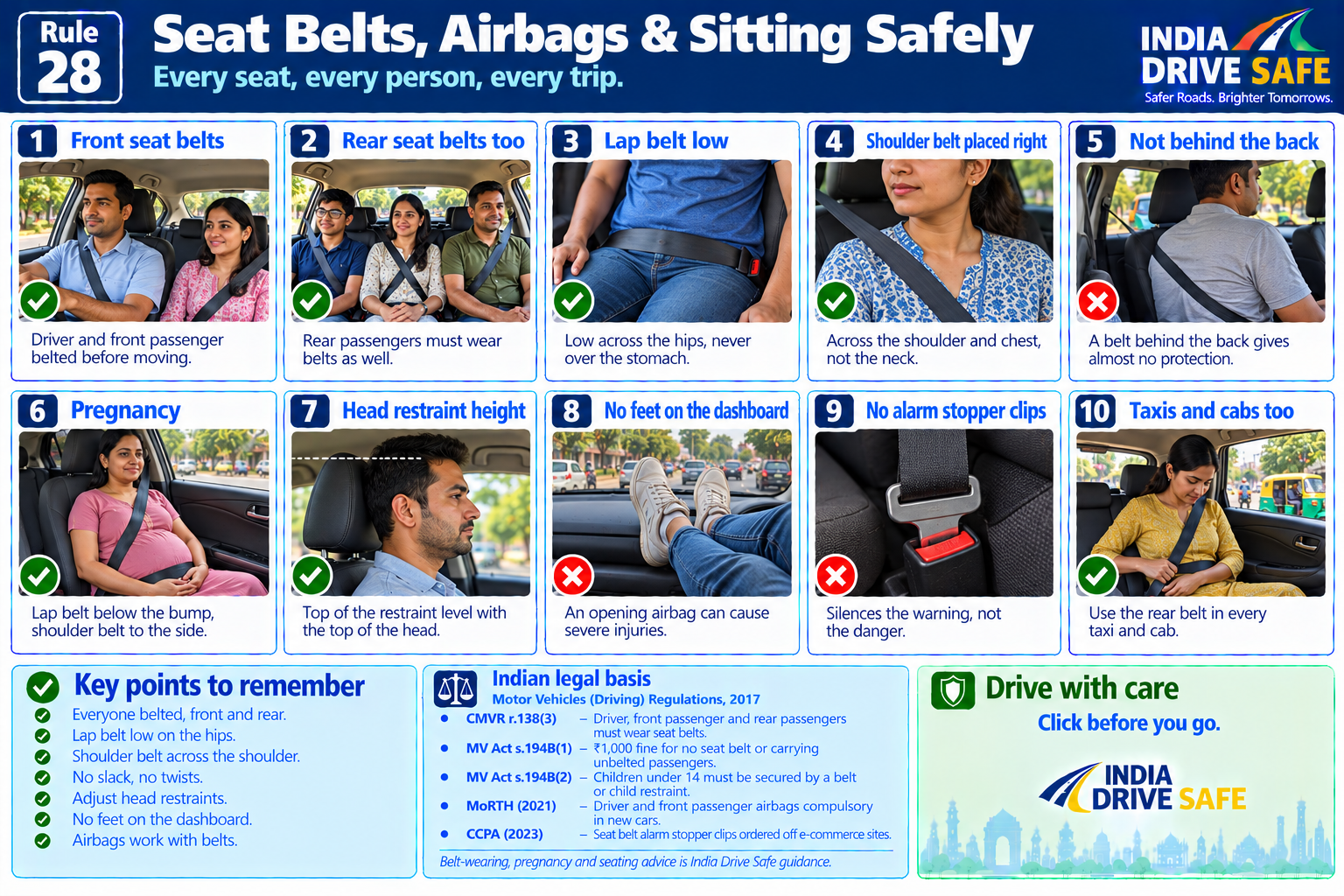
A seat belt is the single most effective safety device in a car. In a crash at only 50 km/h, an unbelted person is thrown forward with a force many times their own weight, into the steering wheel, the windscreen, the seat in front or the people sitting there. Many Indian passengers still believe belts are only for the driver, or only for the front seat. The law and the physics say otherwise: everyone, in every seat, on every trip. This article covers adults; children are covered in Rule 16.
Before the vehicle moves, every person in it wears a seat belt correctly, in the front and in the back. Airbags work with seat belts, not instead of them.
What Indian law says
- Every seat with a belt: Rule 138(3) of the Central Motor Vehicles Rules, 1989 requires the driver, the front-seat passenger and passengers in front-facing rear seats to wear the seat belts provided while the vehicle is moving. Rear-seat belts are not optional.
- Fine: Section 194B(1) of the Motor Vehicles Act, 1988: driving without a seat belt, or carrying passengers who are not wearing one, is punishable with a fine of ₹1,000. The driver is responsible for the passengers too. Children under 14 must be secured by a belt or child restraint (Section 194B(2); Rule 16).
- Belts must be fitted: cars must be fitted with seat belts that meet Indian Standards (Rule 125). Removing them, or tying them out of the way, makes the vehicle unsafe and is not allowed (Rule 21).
- Airbags: new passenger cars have had to be fitted with airbags for the driver and front passenger since 2021–22. More airbags are not compulsory; in 2023 the Government said it would not make six airbags mandatory, leaving buyers to compare safety ratings.
- Rear seat belt reminders: draft rules published in August 2024 proposed audible reminders for rear seats in new cars. Whatever your car has, the duty to wear the belt applies in every vehicle, old or new.
- Alarm stopper clips: in 2023 the Central Consumer Protection Authority ordered e-commerce sites to stop selling clips that silence the seat belt alarm. Do not use them.
Wear the belt correctly
- Sit upright, with your back against the seat. Do not recline the seat far back while the car is moving: you can slide under the belt in a crash.
- Lap belt low: across the hips and the top of the thighs, never across the stomach.
- Shoulder belt across the middle of the shoulder and chest, away from the neck. Never put it under your arm or behind your back.
- Remove the slack. The belt should lie flat, not twisted, and fit snugly. Thick jackets and shawls add slack; open them or take them off.
- One person, one belt. Never share a belt, and never hold a child on your lap with the belt around you both.
If you are pregnant
Wear a seat belt throughout pregnancy. Place the lap belt below the bump, across the hips and upper thighs, and the shoulder belt between the breasts and to the side of the bump. Never put the lap belt over the bump. Move the seat back as far as is practical from the steering wheel or dashboard.
Head restraints and seating position
- adjust the head restraint so its top is level with the top of your head, or at least the top of your ears, and as close to the back of your head as is comfortable. This protects your neck in a rear-end crash;
- drivers should sit at least about 25 cm from the steering wheel, with arms slightly bent and the whole pedal travel within easy reach;
- front passengers should keep feet on the floor and never put feet on the dashboard. An airbag opening there can cause severe injuries; and
- never let anyone sit in the boot, on the floor, or on another person's lap.
Airbags: what they do and do not do
- an airbag opens in a fraction of a second with great force. It is designed for a person held in position by a seat belt;
- without a belt, you can be thrown into the airbag as it opens, which can cause serious injury;
- never place a rear-facing child seat in front of an active front airbag (Rule 16);
- do not fit seat covers that block side airbags, or stick anything on the airbag covers; and
- if the airbag warning light stays on, have it checked.
In taxis, cabs and the back seat
- the rear-seat rule applies in taxis and app cabs too. If the belts are tucked away under the seat, pull them out and use them;
- an unbelted rear passenger can be thrown forward into the people in front and seriously injure them as well as themselves; and
- the middle rear seat often has only a lap belt. Wear it anyway, low across the hips.
Common mistakes
Rule 138(3) requires them, and the fine is ₹1,000.
Offers almost no protection and can cause internal injuries.
Silences the warning, not the danger. Wear the belt.
An opening airbag can cause severe injuries.
Keep it low across the hips, especially in pregnancy.
Airbags are designed to work with seat belts.