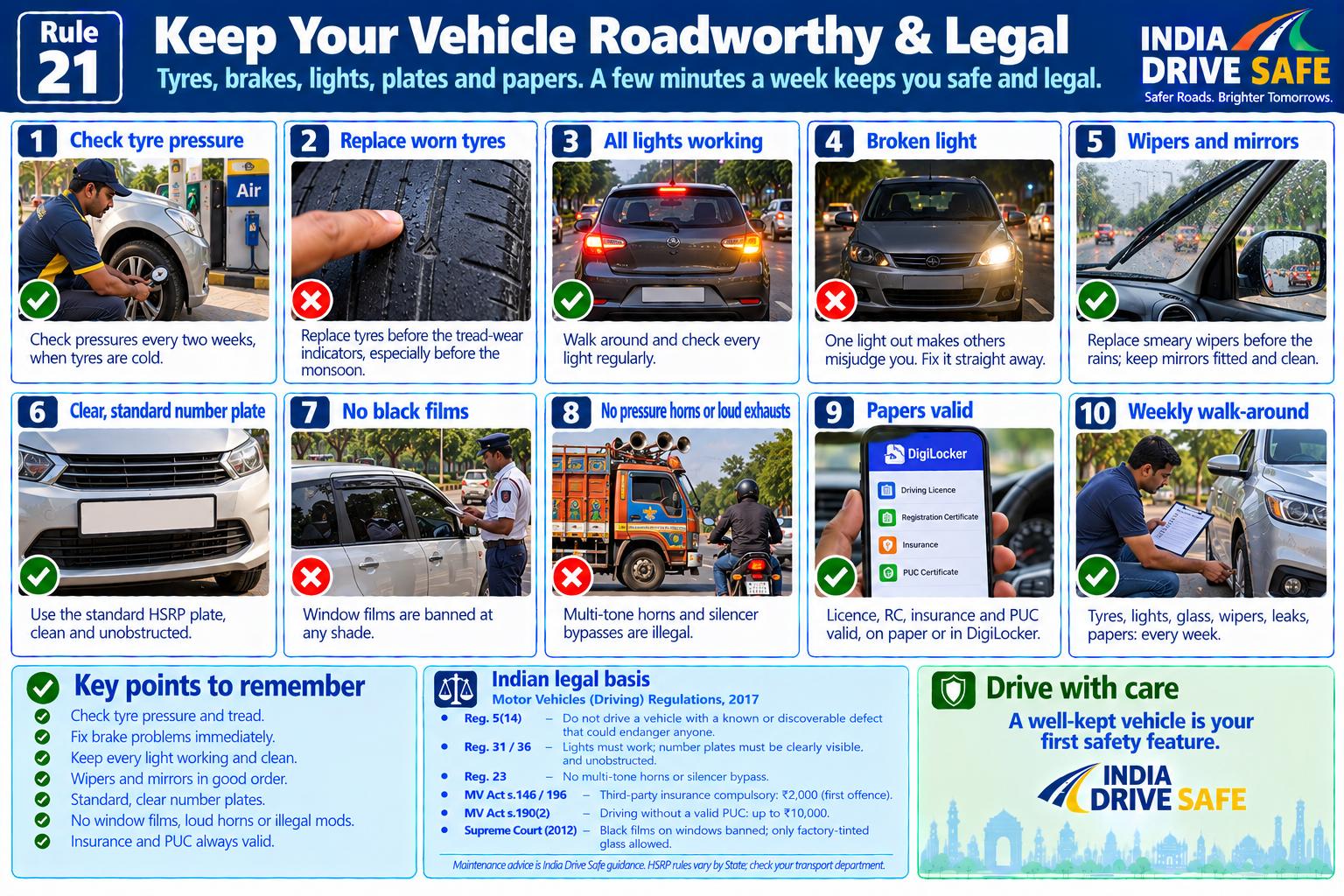
A safe driver needs a safe vehicle. Worn tyres, weak brakes, dirty or broken lights and illegal modifications cause crashes that no amount of driving skill can prevent. Your vehicle also needs valid papers: registration, insurance and a pollution certificate. Checking them takes minutes and avoids both danger and fines.
Do not drive a vehicle with a defect that could endanger anyone. Check tyres, brakes, lights, wipers and mirrors regularly, keep registration, insurance and pollution certificates valid, and do not fit modifications the law does not allow.
What Indian law clearly requires
- Regulation 5(14) of the Motor Vehicles (Driving) Regulations, 2017: do not drive a vehicle in a public place with a defect that you know about, or could discover with ordinary care, that could endanger the occupants or other road users. Regulation 5(15): if a defect appears while driving, get the vehicle off the road as quickly as possible.
- Regulation 31(2): keep all lights in good working order and not obscured.
- Regulation 36: registration plates must be displayed, clearly visible and unobstructed, with no extra markings, and no load may hide them.
- Regulation 23: no multi-tone or harsh air horns (except where permitted), no bypassing the silencer, and no vehicle that makes undue noise.
- Regulation 38: carry your documents, in physical or electronic form (DigiLocker or mParivahan): driving licence, registration certificate, insurance certificate and pollution under control (PUC) certificate, and for transport vehicles, the permit, fitness certificate and tax receipt as applicable.
- Insurance (Sections 146 and 196 of the Motor Vehicles Act, 1988): third-party insurance is compulsory. Driving uninsured carries up to 3 months in prison and/or a ₹2,000 fine for a first offence, and ₹4,000 for a repeat.
- Pollution certificate (Section 190(2)): driving a vehicle that breaks the emission standards, including without a valid PUC certificate, can bring a fine of up to ₹10,000 and/or up to 3 months in prison, and disqualification from holding a licence for 3 months.
- Registration (Section 39): a vehicle must be registered before it is driven in a public place. Driving an unregistered vehicle is an offence under Section 192.
- No unauthorised alterations (Section 52): a vehicle must not be altered so that its particulars differ from the registration certificate, except as the rules allow (for example, an approved CNG kit endorsed on the registration).
Tyres
- check pressures at least every two weeks and before long trips, when the tyres are cold, using the figures on the door pillar or in the owner's manual, not the maximum on the tyre wall;
- look for cuts, bulges, cracks and uneven wear;
- replace tyres before the tread reaches the tread-wear indicators (small raised bars in the grooves). The UK legal minimum is 1.6 mm; India Drive Safe recommends replacing well before that, especially before the monsoon;
- check the spare too; and
- old tyres harden and crack even with good tread. Have tyres more than about six years old inspected.
Brakes and steering
- have brakes serviced as the manufacturer recommends;
- warning signs: squealing or grinding, a soft or sinking pedal, the car pulling to one side, or a brake warning light. Get them checked immediately; and
- steering that feels loose, heavy or vibrates needs inspection.
Lights, wipers, mirrors and horn
- walk around the vehicle regularly and check headlights (dipped and main beam), tail lights, brake lights, indicators and number-plate lights;
- clean dirty lights and windows. Dust and mud can halve the light from your headlights;
- replace wiper blades that smear, before the monsoon;
- keep both door mirrors fitted, clean and adjusted; and
- keep a standard horn. Pressure horns and musical horns are not permitted (Regulation 23).
Fluids and battery
Check engine oil, coolant, brake fluid and windscreen-washer water regularly, and before long journeys. Overheating on highways and ghat roads often starts with low coolant.
Registration plates
- use the standard plate, keep it clean and readable, and do not add names, logos, slogans or fancy fonts (Regulation 36);
- High Security Registration Plates (HSRP), fitted by authorised dealers, are required for vehicles, and many States require older vehicles to be fitted with them too. Check your State transport department's rules and deadlines; and
- never cover or bend a plate, or hide it with a bike rack, luggage or tow bar.
Window glass and tinted films
Following the Supreme Court's judgment in Avishek Goenka v. Union of India (2012), black films or any other material on windscreens and windows are not allowed, whatever their darkness. Only factory-fitted tinted safety glass is permitted, letting through at least 70% of light at the front and rear windscreens and 50% at the side windows (Central Motor Vehicles Rules, Rule 100). Dark windows also hide pedestrians and two-wheelers from you at night.
Modifications
- do not change the vehicle's structure, engine, fuel system or dimensions without approval and an endorsement on the registration certificate (Section 52);
- loud exhausts, removed silencers and multi-tone horns are illegal (Regulation 23);
- the Ministry of Road Transport and Highways has said that crash guards and bull bars contravene Section 52, and courts have examined the issue. Whatever the final legal position, India Drive Safe recommends not fitting them: they increase injuries to pedestrians and can interfere with airbags and crumple zones; and
- extra bright aftermarket headlamps and coloured lights dazzle other road users. Keep standard, correctly aimed headlights.
Transport vehicles
Buses, trucks, taxis and other transport vehicles must also hold a valid fitness certificate and the required permit, and are inspected at set intervals. Overloading, speed limiters and loads are covered in Rule 17.
A quick weekly walk-around
- Tyres: pressure and damage.
- Lights: front, rear, brake, indicators.
- Glass and mirrors: clean, no cracks in your view.
- Wipers and washer water.
- Under the vehicle: any fresh oil, coolant or brake-fluid leaks.
- Documents: licence, RC, insurance and PUC valid, on paper or in DigiLocker.
Common mistakes
Worn tyres cannot clear water. Replace them before the rains.
Others misjudge your size, distance and braking. Fix it straight away.
Up to ₹10,000 for PUC; ₹2,000 for insurance, and no cover after a crash.
Banned by the Supreme Court at any shade.
Plates must be standard, clear and unobstructed.
Illegal and harmful. Keep standard parts.