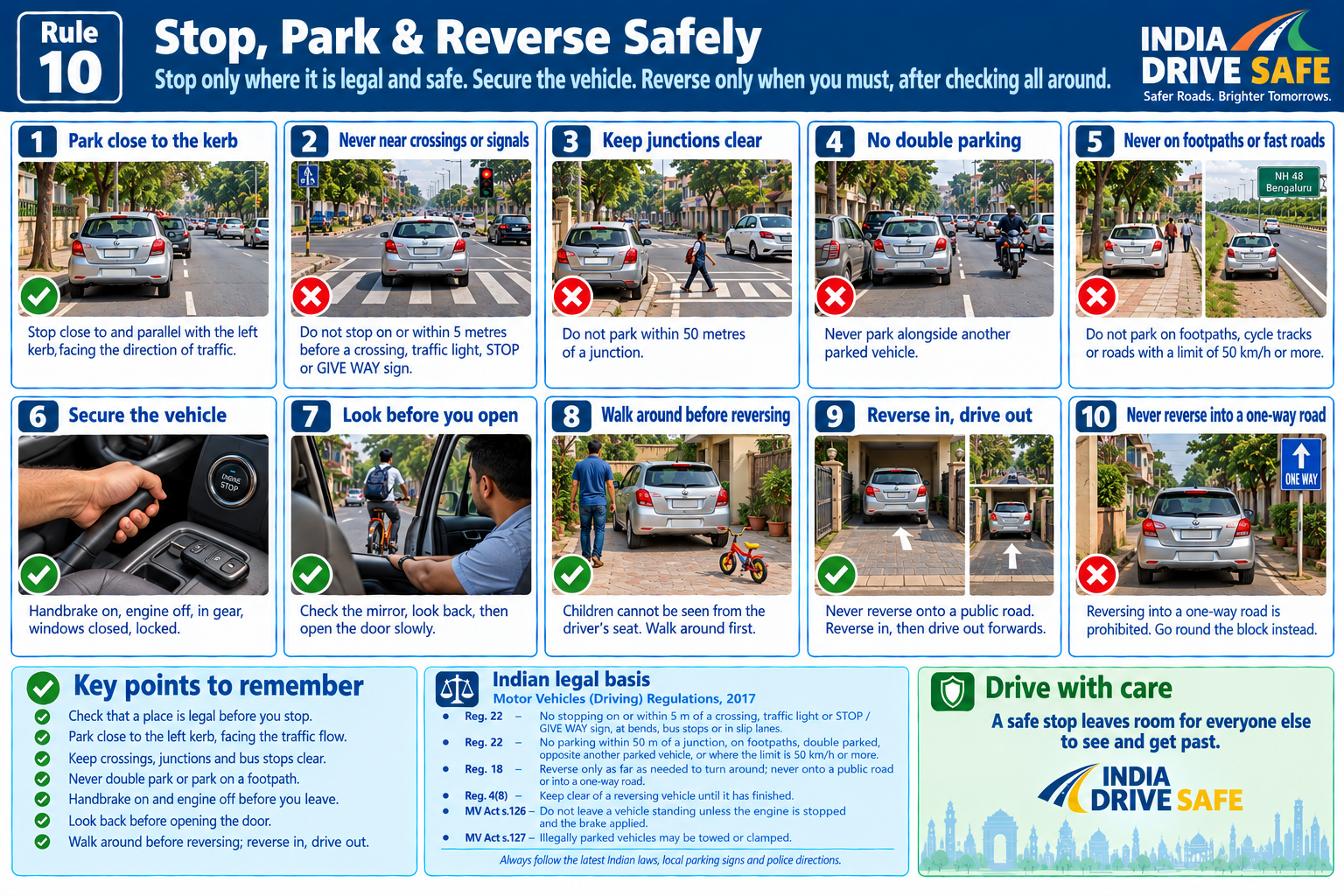
Every journey ends with a stop, and many begin with a reverse. These are slow manoeuvres, but they cause a surprising number of injuries: children hit by reversing cars, cyclists struck by opening doors, crashes caused by vehicles parked on bends or near junctions, and traffic jams caused by double parking. Where and how you stop matters as much as how you drive.
Stop only where you are allowed to and where others can see you and get past safely. Park in a marked space where one is available. Reverse only when you must, only as far as you must, and only after you have checked all around.
Stopping and parking are different
Regulation 22 of the Motor Vehicles (Driving) Regulations, 2017 has one list of places where you must not stop at all, and a longer list where you must not park. In everyday terms, stopping is a brief halt, for example to let a passenger get in or out. Parking means leaving the vehicle standing for longer. Every place where stopping is prohibited is also a place where parking is prohibited.
A traffic jam or a police officer's direction can force you to stop anywhere. These rules are about where you choose to stop.
Where you must not stop (Regulation 22)
- where the road is narrow or the view is obstructed;
- on or near a sharp bend;
- in an acceleration or deceleration lane;
- on a pedestrian crossing, or within 5 metres before one;
- on a level crossing;
- within 5 metres before a traffic light, STOP sign or GIVE WAY sign, or where your vehicle would hide them;
- at a bus stop, unless you are driving a bus;
- on a yellow box marking; and
- where a "No Stopping" sign applies.
Where you must not park (Regulation 22)
In addition to every place listed above, do not park:
- on a main road or stretch where the speed limit is 50 km/h or more;
- on a footpath, cycle track or pedestrian crossing;
- within 50 metres before or after the edge of an intersection or junction;
- near a bus stop, at the entrance of a school or hospital, or where you would block a traffic sign or fire hydrant;
- in front of the entrance or exit of any property;
- in a tunnel or a bus lane;
- where a continuous yellow line is marked along the kerb;
- away from the edge of the footpath, alongside another parked vehicle (double parking) or opposite another parked vehicle;
- where you would block access to other parking spaces, or obstruct or inconvenience anyone;
- beyond the permitted time, in a space reserved for another category of vehicle, or in a space reserved for drivers with disabilities if you are not entitled to it;
- outside marked bays where bays are marked, or in a way that takes up more space than necessary; and
- where a "No Parking" sign applies.
How to stop and park safely
- Choose your place early, and check that it is legal before you arrive.
- Check your mirrors, especially the left mirror for cyclists and two-wheelers.
- Signal left in good time.
- Slow down gradually so the vehicle behind is not surprised.
- Stop close to and parallel with the left kerb or road edge, facing the direction of traffic.
- Leave enough space in front and behind for other vehicles to get out.
In a marked bay, park within the lines. Reversing into a bay where it is allowed gives you a much better view when you drive out.
Before you leave the vehicle
Section 126 of the Motor Vehicles Act, 1988 says a vehicle must not be left stationary in a public place unless a licensed driver is in the driver's seat, or the engine has been stopped and the brake applied so that it cannot move on its own.
- apply the handbrake firmly and switch off the engine;
- leave a manual car in gear (or an automatic in Park);
- on a slope, turn the front wheels so that if the vehicle rolled it would run into the kerb, not into traffic;
- switch off headlights and fog lamps, close the windows and lock the vehicle; and
- never leave a child or a pet alone in a parked vehicle. The inside of a closed car can become dangerously hot within minutes.
Opening the door
Regulation 5(13) requires care when getting in or out, for your own safety and for other road users. Check your mirror, then look over your shoulder, and open the door slowly. Using your far hand on the handle (the "Dutch reach") turns your body so you naturally look back. Ask passengers to get out on the kerb side. (See Rule 08.)
Moving off from a parked position
Traffic already on the road comes first. Use the full routine from Rule 02:
- check ahead and in all mirrors;
- look over your right shoulder for vehicles and two-wheelers in the blind spot;
- signal right;
- check again; and
- move out only when you can do so without making anyone brake or swerve.
Reversing: the law is strict
Regulation 18 says you must not drive backwards on a road, in a parking area or in any other public place, except:
- for the distance and time reasonably needed to turn the vehicle around; and
- only if it does not endanger or unduly inconvenience other road users.
Two further prohibitions are absolute:
- never reverse onto a public road (Regulation 18(2)), for example out of a gate or driveway; and
- never reverse into a road marked ONE WAY (Regulation 18(3)).
You must not reverse in a tunnel (Regulation 20), and you must never reverse on a highway or expressway to reach a missed exit (Rule 09).
How to reverse safely
- Walk around the vehicle first if it has been parked, especially at home, near schools and in residential lanes. Small children, animals and objects cannot be seen from the driver's seat.
- Check all mirrors and look over both shoulders.
- Reverse slowly, looking mainly through the rear window. Remember that the front of the vehicle swings out the opposite way when you steer.
- Do not rely only on a camera or sensors. They help, but they have blind areas too.
- If you cannot see clearly, ask someone to guide you from a safe position where you can see them.
- Stop at once if anyone appears behind you, and reverse no further than you need.
When another vehicle is reversing
Regulation 4(8) requires you to keep a safe distance from a reversing vehicle and not to move towards it until it has finished. Trucks, buses and cars reversing out of parking spaces often cannot see you. Wait, and if necessary use a short horn tap to warn them that you are there.
Breakdowns and unavoidable stops
If you have to stop where stopping or parking is not allowed because of a breakdown or an emergency, switch on your hazard lights straight away. On highways and fast roads, place a warning triangle 50 metres behind (Regulation 28). In a tunnel, switch on hazard lights and place triangles about 20 metres in front and behind (Regulation 20). Move the vehicle off the road as soon as you can (Regulation 5(15)). See Rule 09 for the full breakdown routine.
What happens to badly parked vehicles
Under Section 127 of the Motor Vehicles Act, 1988, a uniformed police officer can have a vehicle towed away or wheel-clamped if it is parked where parking is prohibited, or left unattended in a public place for ten hours or more. A vehicle causing a traffic hazard can be removed immediately. The owner pays the towing cost on top of any fine.
Common mistakes
It blocks a lane and forces others into oncoming traffic. Find a legal space.
Indian law prohibits parking within 50 metres of a junction, because it hides traffic and pedestrians.
Prohibited by Regulation 18(2). Reverse in, drive out.
Walk around first and look over your shoulder.
Parking is prohibited where the limit is 50 km/h or more. Use a lay-by, fuel station or dhaba.
Section 126 requires the engine stopped and the brake applied.