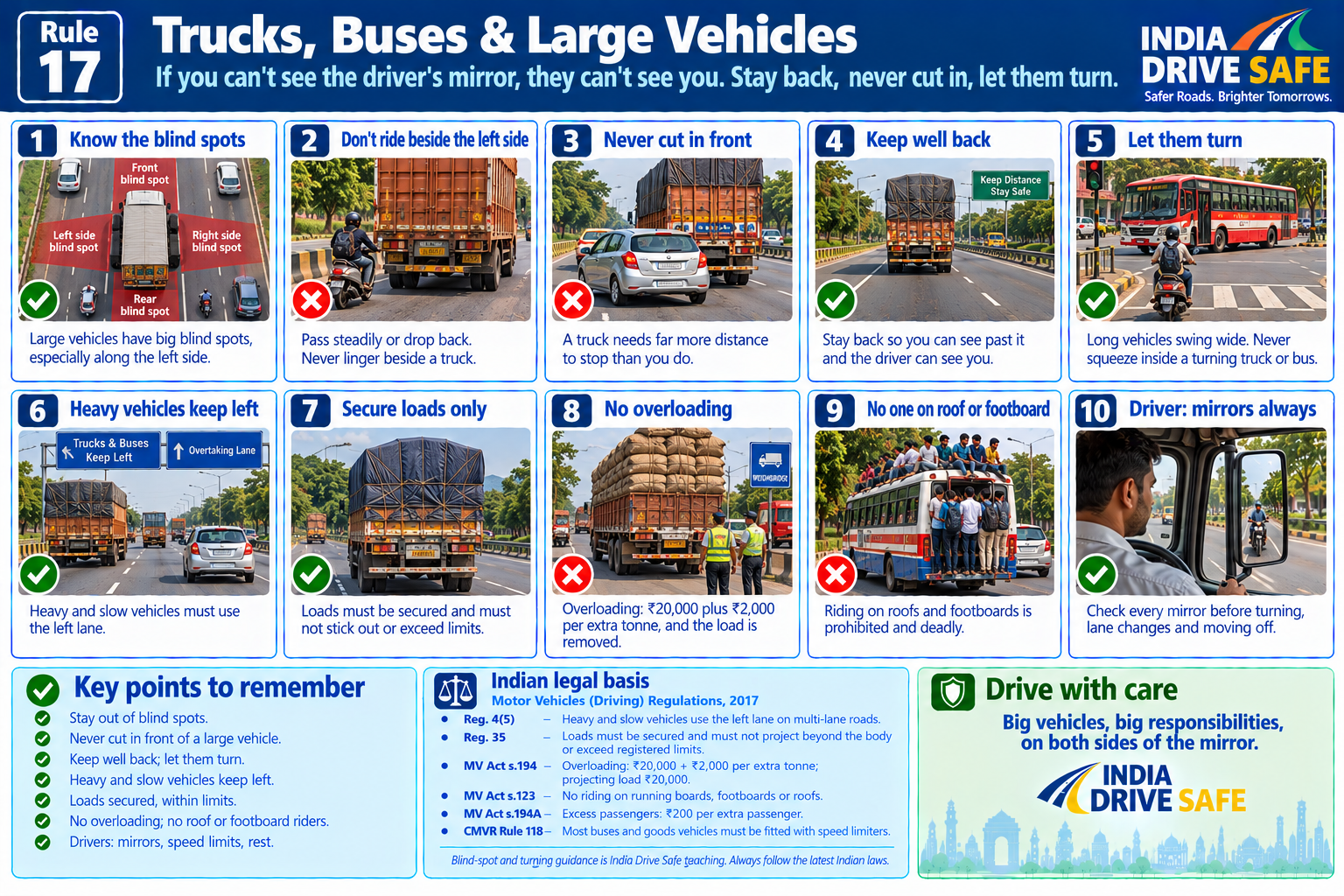
Trucks, buses, tankers and tractor-trolleys keep India moving, but their size and weight make every mistake around them more serious. They take longer to stop, need more room to turn and have large blind spots where a car, motorcycle or pedestrian can disappear completely. This article is for everyone who shares the road with large vehicles, and for the people who drive them.
If you cannot see the driver's face in their mirror, they cannot see you. Stay out of blind spots, never cut in front of a large vehicle, and give it room to turn and to stop.
Part 1: Sharing the road with large vehicles
Know the blind spots ("no zones")
A truck or bus driver sits high up but cannot see:
- directly in front, for several metres below the windscreen;
- directly behind, often for many metres;
- along the left side, the largest blind spot in Indian left-hand traffic, where the driver is furthest away; and
- just behind the cab on the right side.
Do not linger in these zones. Either pass steadily or drop back until you can see the driver's mirrors.
Do not cut in front
A loaded truck needs far more distance to stop than a car. If you overtake and pull in close in front of it, then brake, the truck may not be able to stop. After overtaking, return to the left only when you can see the whole front of the truck in your rear-view mirror (Rule 04).
Keep back
- a large vehicle hides everything ahead of it. Keep well back so you can see past it and the driver can see you in the mirror;
- loose gravel, sand or cargo can fall or blow off open trucks; and
- when stopped behind a truck or bus on a slope, leave extra space, as it may roll back slightly when moving off.
Give them room to turn
Long vehicles swing wide and their rear wheels cut inside the path of the front wheels. A truck turning left may first move right to get round the corner.
- never squeeze up the left side of a truck or bus at a junction. Its rear wheels can crush a car, motorcycle or cyclist;
- at roundabouts, large vehicles may need more than one lane (Rule 07); and
- Regulation 8 allows a large vehicle to make a U-turn from the left lane where this is permitted. Hold back and let it complete the turn.
Overtaking large vehicles
- you need a much longer clear stretch of road to pass a long truck. If in doubt, do not start (Rule 04);
- expect a gust of wind and spray as you pass, especially on highways and in the rain; and
- give buses priority when they signal to pull out from a stop, where it is safe, and watch for passengers crossing in front of or behind them.
At night
Trucks parked or broken down on the highway shoulder are a major cause of fatal night crashes. Look far ahead for reflective tape, tail lights and hazard lights, and slow down as soon as you see them (Rule 09).
Part 2: If you drive a truck, bus or other large vehicle
What Indian law clearly requires
- Regulation 4(5): on a multi-lane carriageway, heavy and speed-restricted vehicles must use the left lane, leaving it only to overtake.
- Regulation 35: secure the load so it cannot slip, fall over, roll or fall off, even under emergency braking. Nothing may stick out beyond the sides, front or rear of the body, and the height and weight must stay within the limits on the registration certificate.
- Section 194 of the Motor Vehicles Act, 1988: overloading carries a fine of ₹20,000 plus ₹2,000 for every extra tonne, and the vehicle cannot move until the excess is unloaded. A load sticking out or too high carries a ₹20,000 fine. Refusing to stop to be weighed carries a ₹40,000 fine.
- Section 194A: carrying more passengers than permitted: ₹200 for each extra passenger, and the extra passengers must be offloaded.
- Section 123: no one may ride on the running board, footboard or roof of a vehicle.
- Regulation 32: no passengers on a tractor; no more people in a goods vehicle's cab than the registration allows; and no passengers for hire in a goods vehicle.
- Regulation 34: drivers of public service vehicles must not carry explosives, highly flammable or other dangerous substances, apart from the vehicle's own fuel and lubricants.
- Regulation 19(4)(b): buses (including school buses), goods vehicles, tractor-trolleys and hazardous-goods vehicles must stop before an unguarded level crossing and check both directions on foot before crossing (Rule 13).
- Speed limiters (Rule 118 of the Central Motor Vehicles Rules): most buses and goods vehicles must be fitted with a speed-limiting device, generally set at 80 km/h, and at 60 km/h for school buses, dumpers, tankers and hazardous-goods vehicles.
Driving a large vehicle safely
- Use all your mirrors constantly, including the close-proximity and front mirrors if fitted, and look again before every turn and lane change.
- Turn wide and slowly, and check the left side for two-wheelers and pedestrians before and during every left turn.
- Keep a long following distance. A loaded vehicle needs much more room to stop.
- On descents, select a low gear before the slope and use the exhaust brake or retarder if fitted, so the brakes do not overheat (Rule 11).
- Never park on the highway except in an emergency. If you break down, switch on hazard lights and place warning triangles behind the vehicle (Regulation 28).
- Keep reflective tape, lights and reflectors clean and working, so others can see you at night.
- At bus stops, pull fully into the stop, keep doors closed while moving, and check for passengers running for the bus before you pull away.
- Use a helper or banksman when reversing a large vehicle, and walk round it first (Rule 10).
Driving hours and fatigue
Long-distance drivers are especially at risk of falling asleep at the wheel. Indian law limits the working hours of transport-vehicle drivers (Section 91 of the Motor Vehicles Act and the Motor Transport Workers Act, 1961). India Drive Safe recommends that every driver take at least a 15-minute break every two hours and stop at the first sign of drowsiness (Rule 09). Operators should never push drivers to exceed safe hours.
Common mistakes
It is the biggest blind spot. Pass steadily or drop back.
It cannot stop as quickly as you. Pull in only when you see its whole front in your mirror.
The rear wheels cut the corner. Wait until it has turned.
₹20,000 plus ₹2,000 per extra tonne, and the brakes and tyres are pushed past their limits.
Prohibited by Section 123 and deadly in any sudden stop or turn.
Get off the road, hazards on, triangles out, reflectors clean.
Remember
Driving one: mirrors always, loads secure and legal, speed within limits, rest before you are tired.