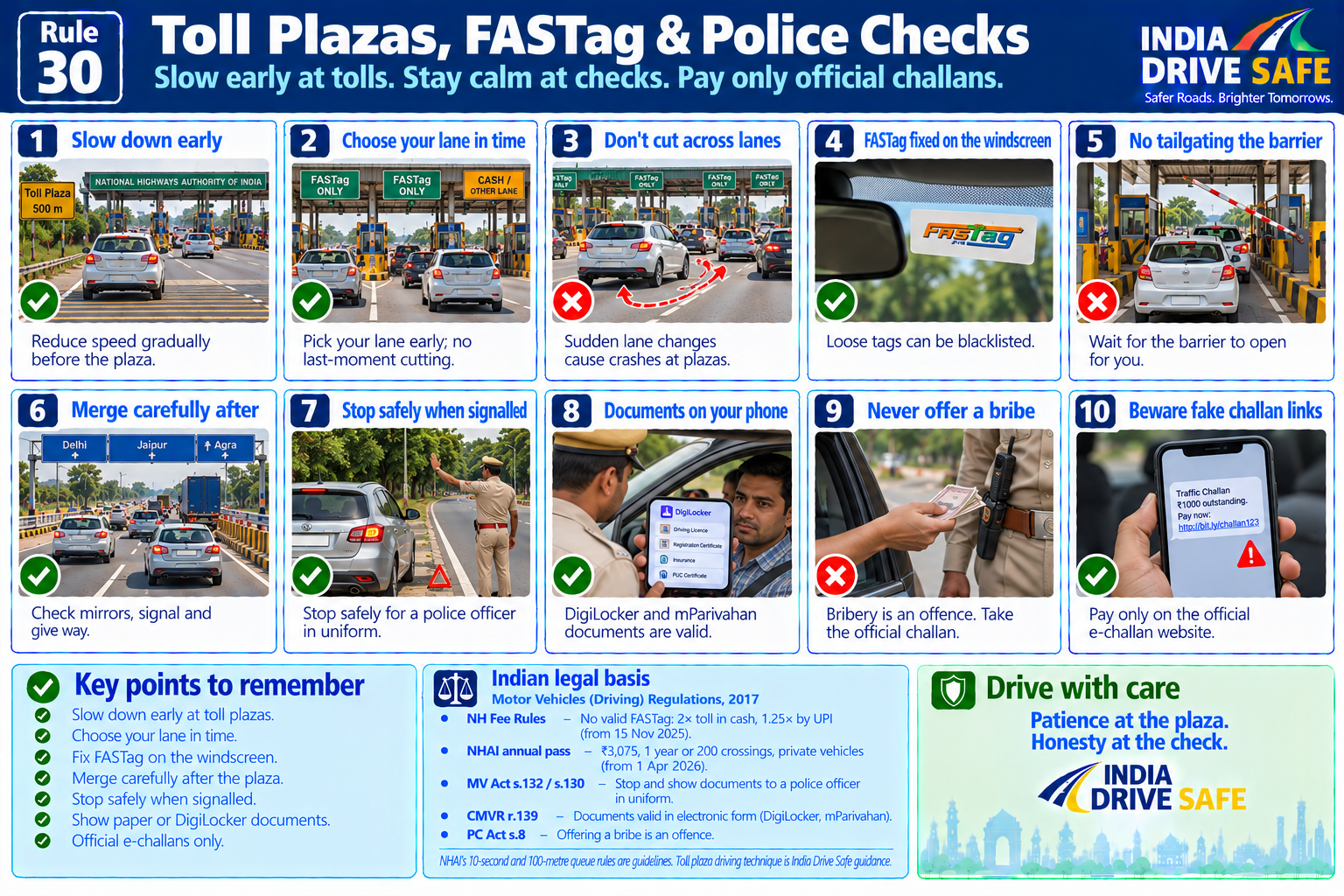
Toll plazas and police checks are routine parts of driving in India, but both cause crashes, delays and disputes when drivers are unprepared. Toll plazas bring fast traffic down to walking speed in a few hundred metres, with vehicles weaving between lanes. At police checks, drivers are often unsure what documents they need and what their rights are. This article explains both.
India Drive Safe rule:
Approach toll plazas slowly, choose your lane early and keep your distance. Keep a working FASTag fixed on the windscreen. At a police check, stop safely, stay calm, show your documents (paper or DigiLocker/mParivahan), and pay any fine only through an official challan.
Approach toll plazas slowly, choose your lane early and keep your distance. Keep a working FASTag fixed on the windscreen. At a police check, stop safely, stay calm, show your documents (paper or DigiLocker/mParivahan), and pay any fine only through an official challan.
Part 1: Toll plazas and FASTag
What the rules say
- FASTag is the normal way to pay on National Highways and National Expressways. Under the National Highways Fee Rules, 2008 (as amended), a vehicle without a valid, working FASTag pays double the toll in cash, or 1.25 times the toll by UPI or another approved digital mode. The UPI rate has applied since 15 November 2025.
- Annual pass: since 15 August 2025, private non-commercial cars, jeeps and vans with a valid FASTag can buy an annual pass for ₹3,075 (from 1 April 2026; it was ₹3,000 before). It covers one year or 200 toll plaza crossings, whichever comes first, at about 1,150 National Highway and National Expressway plazas. Buy it only through the Rajmargyatra app or the NHAI website. It does not cover State highways or toll roads run by States.
- Fix the tag: the FASTag must be fixed on the inside of the windscreen. NHAI has said that "loose" tags carried in the hand or kept in the glovebox will be blacklisted. Use one FASTag per vehicle and keep its details up to date.
- Queues: NHAI guidelines aim for a service time of about 10 seconds per vehicle, and say that if a queue stretches beyond a yellow line marked 100 metres from the booth, vehicles should be let through without paying until the queue is shorter. These are NHAI guidelines; ask the plaza staff if the queue is past the line.
- Exemptions: ambulances, fire engines and certain official and defence vehicles are exempt under the Fee Rules. Ordinary private vehicles are not.
Driving through a toll plaza
- Slow down early. Watch for the "toll plaza ahead" signs and rumble strips, and reduce speed gradually. Vehicles ahead may brake hard.
- Choose your lane in good time: FASTag lanes, or the lane marked for cash or other payment if your tag is not working. Do not cut across several lanes at the last moment.
- Keep a safe gap to the vehicle in front, and do not follow it through the barrier: wait for the barrier to close and open again for you.
- If the barrier does not open, stop and wait. Do not reverse into the vehicle behind; signal to the staff or use the help button.
- After the plaza, merge carefully. Many lanes narrow back into two or three, and vehicles accelerate hard. Check mirrors, signal and give way (Rule 18).
- Keep pedestrians in mind: toll staff and people cross between booths.
Check your FASTag before a trip
- keep enough balance, and check that the tag is active, not blacklisted;
- check SMS alerts after every toll. If you are charged twice or wrongly, raise it with your issuing bank or the NHAI helpline 1033; and
- if you see a fee charged at a plaza you did not cross, report it promptly.
Part 2: Police and traffic checks
Your duties
- Stop when signalled by a police officer in uniform (Section 132 of the Motor Vehicles Act, 1988). Signal, slow down and stop safely at the side of the road. Do not swerve or brake suddenly in traffic.
- Show your documents on demand to a police officer in uniform (Section 130): driving licence, registration certificate, insurance, pollution certificate, and for transport vehicles the permit and fitness certificate.
- Electronic documents are valid. Since 2018, Rule 139 of the Central Motor Vehicles Rules allows documents in electronic form. Documents in DigiLocker or mParivahan must be accepted as equal to the originals (Regulation 38; Rule 21). If you do not have a document with you, the rules allow you to produce it within 15 days.
- Breath tests: you must allow a breath test if the police ask (Section 203; Rule 14).
What you can expect
- the officer should be in uniform. In 2020 the Calcutta High Court held that seizure of a licence under Section 130 by an officer not in uniform was illegal;
- where your documents can be checked online and there is no offence, physical documents need not be seized. Where a document is seized, it is now usually recorded electronically through the e-challan system; and
- fines are recorded on an e-challan. Ask for the challan or receipt, and pay only through official channels, such as the e-challan portal of the Parivahan website or your State's official traffic police app or website.
Stay safe and honest
- switch on hazard lights if you stop on a busy road, and keep passengers inside;
- stay calm and polite. Keep your hands where they can be seen;
- never offer a bribe. Giving a bribe is itself an offence under the Prevention of Corruption Act, 1988. If you believe a fine is wrong, accept the challan and contest it through the official process; and
- beware of fake challan messages with payment links. Check any challan by entering your vehicle or challan number on the official Parivahan e-challan site yourself, not through a link in an SMS.
Common mistakes
Cutting across lanes at the plaza
Choose your lane early, and keep your distance.
Choose your lane early, and keep your distance.
FASTag kept in the glovebox
Loose tags can be blacklisted. Fix it on the windscreen.
Loose tags can be blacklisted. Fix it on the windscreen.
Tailgating through the barrier
Wait for the barrier to open for you.
Wait for the barrier to open for you.
Reversing out of a toll lane
Stop, wait, and ask the staff for help.
Stop, wait, and ask the staff for help.
Offering money at a check
Bribery is an offence. Take the challan and contest it if needed.
Bribery is an offence. Take the challan and contest it if needed.
Paying a challan through an SMS link
Check and pay only on the official e-challan website.
Check and pay only on the official e-challan website.
Remember
Toll: slow early → choose your lane → keep your distance → merge carefully. Police: stop safely → stay calm → show documents (paper or DigiLocker) → official challan only.