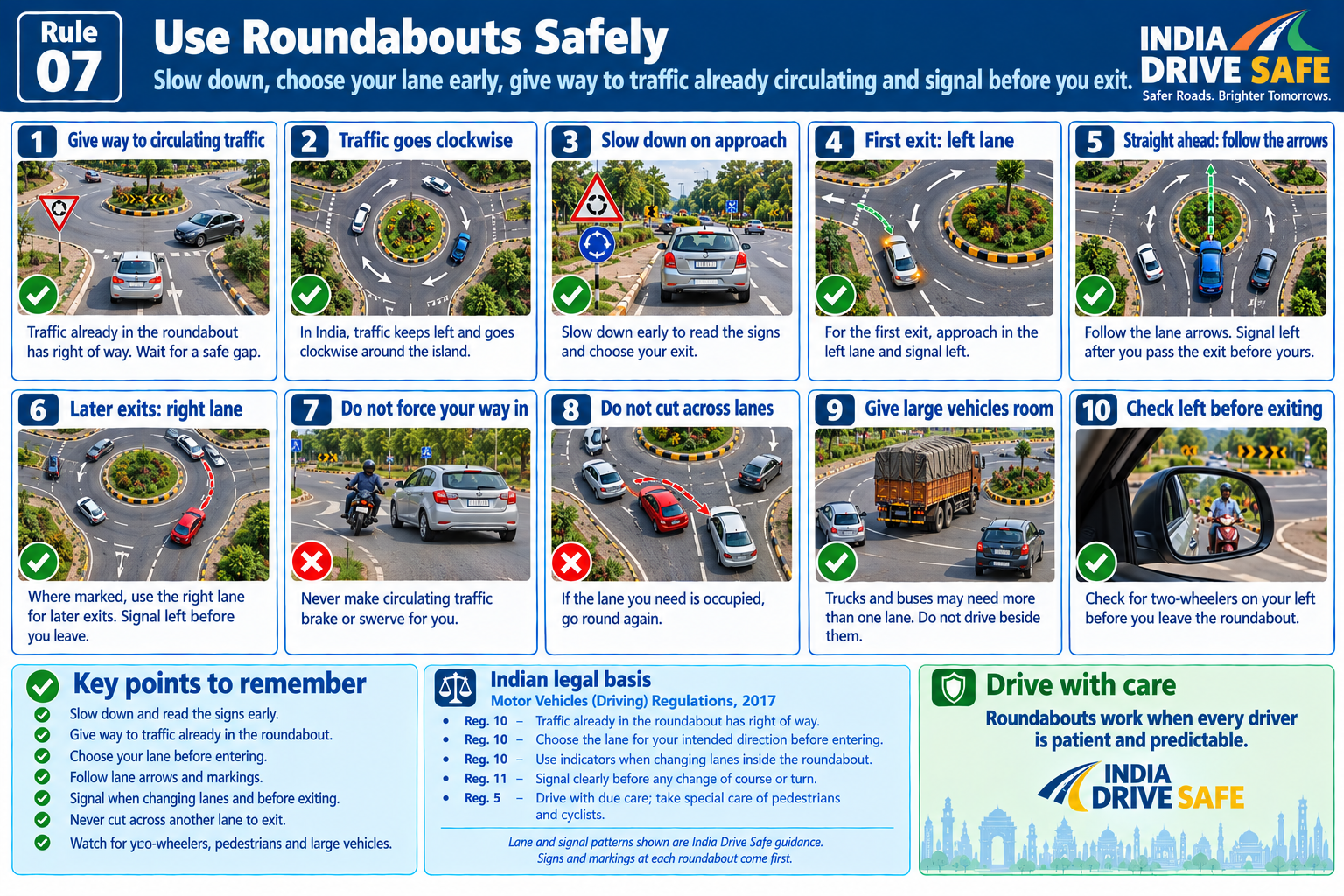
A roundabout is an intersection designed to keep traffic moving around a central island. It works safely only when drivers approach at a manageable speed, choose their lane early and respect traffic that is already circulating.
Give way to traffic already in the roundabout. Do not enter until you can join without making circulating traffic brake, swerve or change lane because of you.
What Indian law clearly requires
Regulation 10 of the Motor Vehicles (Driving) Regulations, 2017 establishes three clear duties:
- traffic already in the roundabout has the right of way;
- a vehicle approaching the roundabout must choose the lane relevant to the direction in which it intends to continue; and
- the driver must use indicators when changing lanes within the roundabout.
Regulation 11 separately requires a driver to indicate clearly before changing course, turning or making a manoeuvre. Regulation 5 requires due care, a good lookout and special care for vulnerable road users.
Slow down before you reach the roundabout
Do not arrive at the give-way point at a speed that forces a sudden decision. Reduce speed early enough to:
- read direction signs and lane arrows;
- identify the exit you need;
- observe traffic already circulating;
- look for motorcycles, cyclists and pedestrians;
- choose a usable gap; and
- stop smoothly if necessary.
The NSW and New Zealand manuals use the same practical approach: slow down, be prepared to give way, select the correct lane and watch traffic already on the roundabout.
Traffic already circulating has priority
This is the core Indian roundabout rule. If another vehicle is already in the roundabout and your entry would interfere with its path, wait.
Do not assume you may enter because:
- your vehicle is larger;
- you reached the roundabout first;
- you are travelling straight ahead;
- the circulating vehicle appears slow; or
- another driver behind is pressuring you to move.
Look to the right — but also look everywhere else
In India's clockwise roundabout circulation, the immediate conflict when entering commonly comes from traffic approaching from your right. International left-driving manuals therefore teach a strong right-side check on approach.
But do not look only to the right. Also check:
- the vehicle directly in front, which may stop unexpectedly;
- pedestrians near the entry or exit;
- cyclists and motorcycles beside you;
- vehicles changing lanes within the roundabout; and
- large vehicles that may need extra road space.
Choose your lane before entering
Indian Regulation 10 requires you to choose the lane relevant to your intended direction. Where lane arrows, direction signs or solid lane lines are provided, they are the first authority for lane choice.
Do not treat every roundabout as if it has the same lane pattern. Some roundabouts have dedicated left-turn lanes, spiral markings, signal control or unusual exit arrangements.
A useful left-driving convention
Where signs and markings do not provide a different instruction, high-quality left-driving manuals commonly teach the following pattern:
- First exit / left turn: approach in the left lane and remain left.
- Straight ahead / intermediate exit: use the lane appropriate to the markings and layout; on some roundabouts either lane may be permitted.
- Right-side exit or going farther around: approach in the right lane where the layout supports it, then move left only when preparing to exit and when safe.
This is useful driving guidance, not a substitute for Indian signs and road markings. If the road says otherwise, follow the road.
Do not change lanes unnecessarily inside the roundabout
Plan early so that you do not have to cut across another vehicle near your exit.
If a lane change is necessary:
- check mirrors;
- check the relevant blind spot;
- signal;
- give way to traffic already occupying the lane; and
- change lane smoothly only where the markings allow.
Regulation 10 expressly requires indicators when changing lanes within the roundabout.
Signalling at roundabouts
Signals should make your intention easier to understand, never more confusing.
First exit to the left
Signal left on approach when you are clearly taking the first exit. Stay in the appropriate left-side lane unless signs or markings indicate otherwise.
Going straight or taking an intermediate exit
A useful international convention is not to give an approach signal that could falsely suggest the first exit. As you pass the exit before the one you want, signal left to show that you intend to leave.
Turning right / travelling more than halfway around
A useful left-driving convention is to signal right on approach when taking a right-side exit or travelling more than halfway around, then change to a left signal after passing the exit before the one you want.
Because Indian Regulation 10 does not spell out this full international signal sequence in the same detail, India Drive Safe presents it as predictable driving guidance, supported by Regulation 11's general duty to signal manoeuvres and by UK, NSW and New Zealand roundabout guidance.
Signal left before leaving
Before exiting, check the left side for a motorcycle, scooter, cyclist or other vehicle that may be continuing around the roundabout. Signal left in time to make your intention clear, then leave smoothly without cutting across another lane.
If the roundabout is very small and the manoeuvre happens too quickly for a useful exit signal, maintaining control and avoiding a misleading signal remains essential. On ordinary and larger roundabouts, a clear exit signal greatly improves predictability.
Do not cut from an inner lane directly across another vehicle
If you are in an inner/right lane and your exit requires moving left, you do not acquire priority merely because your exit is approaching.
If another vehicle occupies the lane you need, continue around the roundabout if necessary and try again rather than forcing your way across.
Pedestrians near roundabouts
Expect pedestrians at approach and exit roads. A person may be crossing while your attention is focused on circulating traffic.
Slow enough to stop before any marked crossing and obey pedestrian-control signals or signs. Even where there is no crossing, maintain a good lookout and do not endanger a pedestrian.
Cyclists and motorcycles
Two-wheelers can be hidden in blind spots and may use a different road position from a car. Do not:
- squeeze alongside a cyclist within the same lane;
- cut across a motorcycle to reach an exit;
- assume a two-wheeler will leave because it is travelling near the outside of the roundabout; or
- enter immediately in front of an approaching two-wheeler whose speed you have misjudged.
Give vulnerable road users enough room to maintain their line safely.
Large vehicles may need more than one lane
Buses, trucks and vehicles towing trailers may track across lane lines because of their size and turning circle. Do not drive beside them unnecessarily on a roundabout.
If a large vehicle is signalling or positioned to turn, allow extra room and expect its rear wheels or trailer to follow a tighter path than the cab.
Blocked roundabout exits
Do not enter merely because there is a gap in circulating traffic if your intended path is blocked and you would stop across another entry, pedestrian crossing or traffic lane.
Good roundabout flow depends on leaving conflict areas clear.
Signal-controlled roundabouts
Some large roundabouts use traffic lights. Obey the signals and lane arrows. A green light still does not justify entering a blocked area or driving into another vehicle's occupied lane.
Common roundabout mistakes
Traffic already circulating has right of way. Wait for a usable gap.
Read arrows and direction signs before reaching the entry.
Give way to traffic in the lane you need. Go around again if necessary.
A clear left signal helps waiting drivers and vulnerable road users understand that you are leaving.
A circulating vehicle may have forgotten to cancel its indicator. Judge its actual path as well.
Large vehicles may need to straddle lanes. Give them room.
A simple roundabout routine
When uncertain, reduce speed and wait. Roundabouts work best when every driver is predictable rather than aggressive.