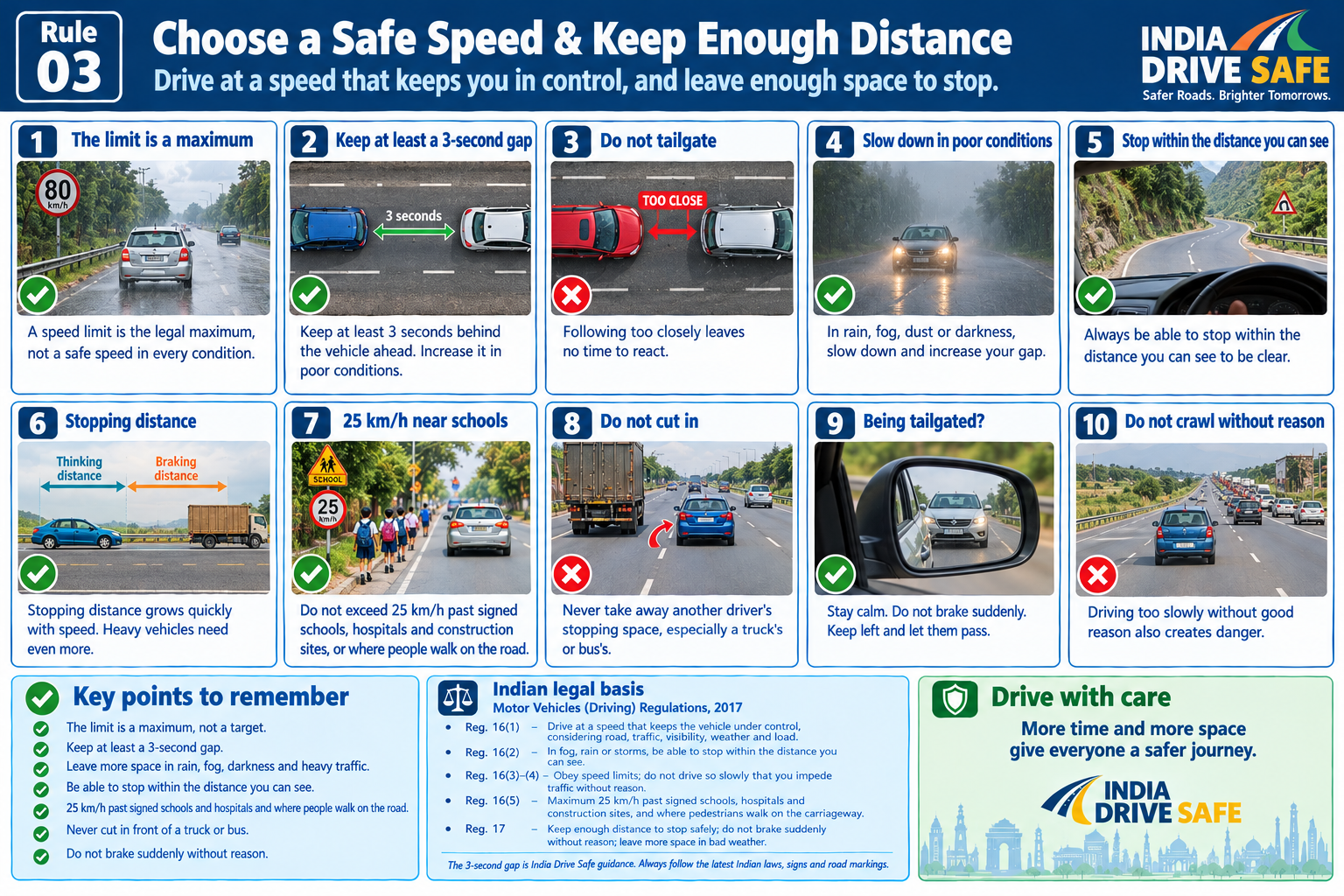
Speed is not just the number on the speedometer. A safe speed is one that gives you enough time and distance to see, decide, react and stop before reaching a hazard.
The posted speed limit is the maximum legal speed, not a target. Your actual speed may need to be much lower.
What Indian law requires
Regulation 16 of the Motor Vehicles (Driving) Regulations, 2017 requires a driver to use only a speed that keeps the vehicle under control at all times. The driver must take into account the vehicle and its load, the road, other traffic, visibility and weather.
The same regulation requires lower speed during fog, rainfall, snowfall, storms, desert winds and other poor conditions so that the vehicle can be stopped within the driver's forward range of vision.
You must also obey:
- the maximum or minimum speed shown by road signs;
- the maximum speed notified for your class of vehicle and the road on which you are driving; and
- special lower-speed requirements that apply in particular locations or conditions.
The speed limit is not a safe-speed guarantee
If a road is signed at 80 km/h, that does not mean 80 km/h is safe at every moment. You may need to drive at 60, 40, 20 km/h or even slower depending on what you can see and what could enter your path.
Reduce speed early when:
- approaching a blind bend, crest or junction;
- pedestrians, children, cyclists, animals or parked vehicles are close to the carriageway;
- traffic is dense or unpredictable;
- the road is narrow, broken, wet, dusty, gravelly or flooded;
- visibility is reduced by darkness, rain, fog, smoke, dust or glare;
- your vehicle is heavily loaded or towing; or
- you cannot clearly see enough road ahead to stop safely.
Be able to stop in the road you can see
A useful safety principle from several high-quality driver manuals is simple: never drive into space that you cannot safely stop within.
On a straight, open road, the visible clear distance may be long. At night, on a bend, behind a large vehicle or in fog, the usable stopping distance can shrink dramatically. Your speed must shrink with it.
Why a small increase in speed matters so much
As speed rises, two distances increase:
- Reaction distance — how far the vehicle travels while you recognise the hazard and begin braking.
- Braking distance — how far the vehicle travels after braking begins.
Braking distance does not increase in a simple one-for-one relationship with speed. Higher speed adds disproportionately to the distance needed to stop and to the energy involved in a crash.
Following distance: leave yourself time
Regulation 17 requires a driver following another vehicle to keep enough distance, appropriate to traffic conditions, to stop safely if the vehicle ahead suddenly slows or stops.
Indian law does not give one universal number of seconds for every ordinary driving situation. For everyday teaching, India Drive Safe recommends a simple baseline:
Poor conditions: increase to at least 4 seconds — and more whenever necessary.
The three-second method is used in the NSW Road User Handbook as a practical crash-avoidance space. The UK and New Zealand manuals use a two-second normal-condition rule; choosing three seconds gives Indian drivers a more conservative everyday margin while remaining easy to measure.
How to measure a 3-second gap
- Choose a fixed object beside the road — a sign, tree, bridge joint, lamp post or shadow.
- When the rear of the vehicle ahead passes it, begin counting: “one thousand one, one thousand two, one thousand three.”
- If your vehicle reaches the same object before you finish, you are too close.
- Ease off, increase the gap and check again.
The important measurement is time, not a fixed number of metres. At higher speed, the same three seconds automatically creates a larger physical gap.
When to increase the gap
Increase your following distance beyond the normal baseline when:
- the road is wet, muddy, sandy, loose or slippery;
- visibility is poor;
- you are driving at night;
- you are tired or your reaction time may be slower;
- you are following a bus, truck or vehicle that blocks your view;
- your vehicle is heavily loaded or towing;
- you are travelling downhill;
- the vehicle ahead is behaving unpredictably; or
- a vehicle behind you is tailgating and you need extra space ahead to brake more gently.
Regulation 17 specifically requires a greater distance during adverse weather conditions.
Do not cut into another driver's stopping space
After overtaking or changing lanes, do not move immediately into the small gap in front of another vehicle — especially a bus or truck. Large or heavily loaded vehicles may need much more stopping distance than your car.
Before returning to the lane, make sure there is enough space for both vehicles to continue safely.
If someone is following you too closely
Do not retaliate by braking suddenly. Regulation 17 says that when another vehicle is following you, you should not brake suddenly without a compelling reason.
Instead:
- increase your own distance from the vehicle ahead;
- avoid sharp acceleration and braking;
- remain predictable; and
- when safe and lawful, allow the tailgating vehicle to pass.
Driving too slowly can also create danger
Regulation 16 also prohibits driving so slowly, without good and sufficient reason, that you impede normal traffic flow.
This does not mean you should speed up when conditions are unsafe. A legitimate safety reason — poor visibility, pedestrians, road damage, congestion or another hazard — may require a much lower speed. The point is to avoid unnecessary obstruction when the road is otherwise clear.
Special 25 km/h provision in Regulation 16
Regulation 16 contains a specific maximum of 25 km/h, or a lower signed speed where applicable, while passing specified construction sites, schools or hospitals where indicated by signage, and on roads described in the regulation where pedestrians use part of the carriageway because suitable pedestrian space is absent.
Drivers should treat these environments as high-risk even apart from the numerical rule: expect people to step into the road and be prepared to stop.
Common speed and distance mistakes
Wrong. The legal maximum does not cancel your duty to slow for conditions.
A fixed short gap that seems adequate at 30 km/h may be dangerously small at 80 km/h.
The empty space ahead is your emergency stopping margin, not wasted road.
Never use abrupt braking to punish a tailgater. Create more space and remain predictable.
A simple driving habit
Repeatedly ask yourself:
If the answer is uncertain, reduce speed or increase the gap — usually both.