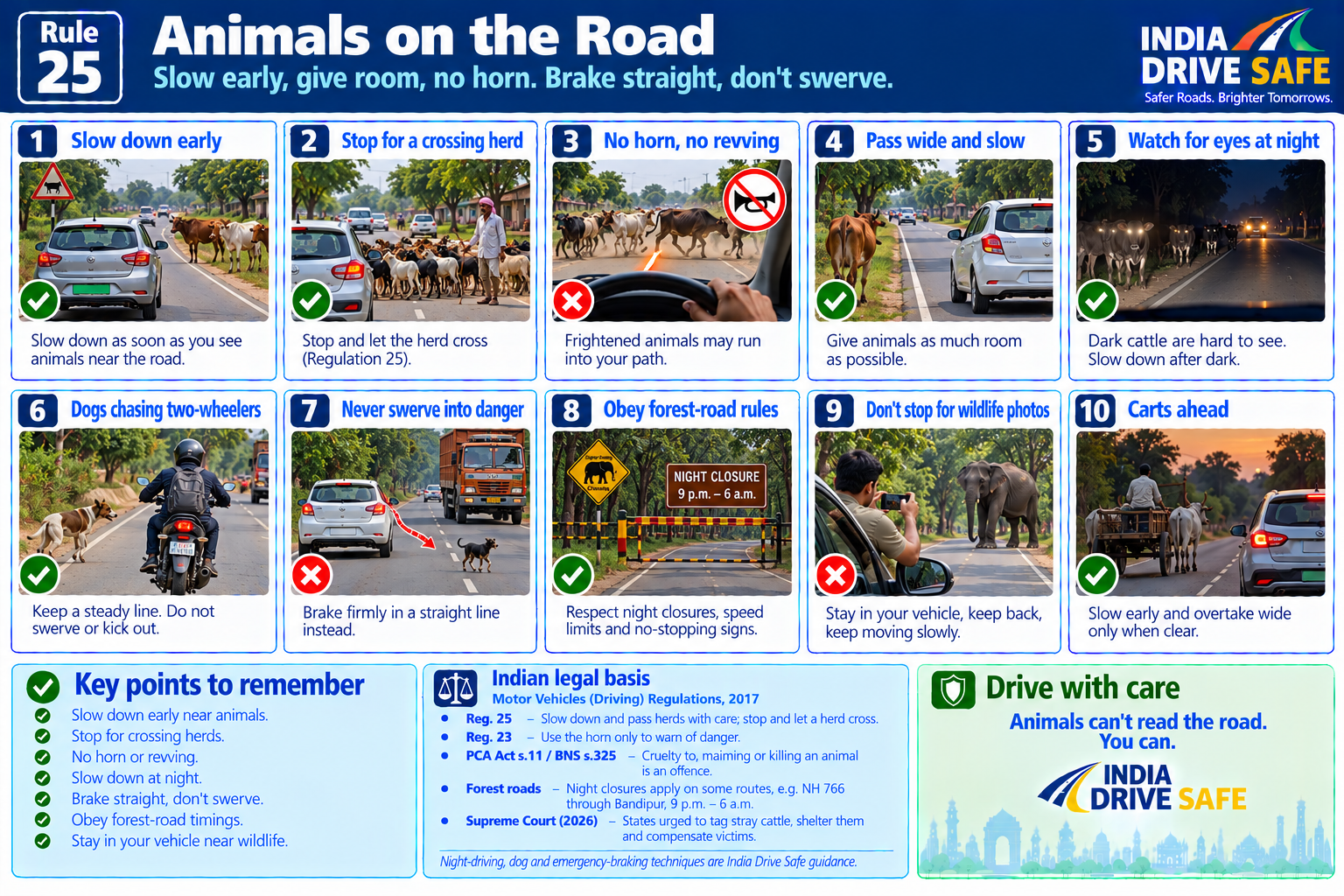
Cattle resting on a highway at night, a dog darting after a motorcycle, a herd of goats crossing a village road, a bullock cart without lights, an elephant or deer on a forest road: animals are a daily part of Indian traffic. In July 2026 the Supreme Court warned that stray cattle on roads are a serious danger to life and asked governments to act. Drivers cannot control animals, but they can control their speed, attention and reactions.
India Drive Safe rule:
Where animals may be on or near the road, slow down early, give them plenty of room, never use the horn or engine to frighten them, and if one suddenly appears, brake firmly in a straight line rather than swerving into danger.
Where animals may be on or near the road, slow down early, give them plenty of room, never use the horn or engine to frighten them, and if one suddenly appears, brake firmly in a straight line rather than swerving into danger.
What Indian law says
- Regulation 25 of the Motor Vehicles (Driving) Regulations, 2017: slow down and pass herds of animals with care and adequate space. If a herd or procession is crossing or about to cross, stop and let it cross.
- Regulation 23: use the horn only when you apprehend danger, never continuously.
- Cruelty to animals: deliberately or recklessly injuring or killing an animal is an offence under the Prevention of Cruelty to Animals Act, 1960 and Section 325 of the Bharatiya Nyaya Sanhita, 2023. Police have registered cases against drivers who ran over animals.
- Owners' responsibility: many States have laws against letting cattle stray onto roads. In July 2026 the Supreme Court urged the Centre and States to enforce them, tag cattle, move abandoned animals to shelters, and create a scheme to compensate people hurt or killed in accidents involving stray cattle (Nisha v. Municipal Council Sangrur, 31 July 2026).
- Protected forests: some roads through tiger reserves and sanctuaries close at night or have strict speed limits and no-stopping rules. For example, traffic on NH 766 and NH 181 through the Bandipur Tiger Reserve is banned from 9 p.m. to 6 a.m. (upheld by the Supreme Court in 2019), with exceptions for emergencies. Obey all forest-road signs and timings.
Cattle and other livestock
- slow down as soon as you see animals near the road; they can move suddenly and unpredictably;
- pass slowly with as much room as possible. Do not drive between a calf and its mother or through the middle of a herd;
- if a herd is crossing, stop and wait until it has crossed (Regulation 25). Switch off your engine if the wait is long;
- do not sound the horn loudly, flash lights or rev the engine near animals. Frightened animals may run into your path; and
- after passing, do not accelerate hard until you are well clear.
At night
Dark-coloured cattle lying or standing on unlit highways are very hard to see until the last moment.
- reduce speed on unfenced highways and village stretches after dark, so that you can stop within the distance you can see (Rule 03);
- use high beam where it is permitted and there is no oncoming traffic, and dip it in good time (Regulation 31);
- watch for eyes reflecting your headlights at the road edge; and
- if you see one animal, expect others nearby.
Dogs and two-wheelers
- dogs often chase motorcycles and bicycles. Do not swerve or kick out. Keep a steady line and speed, or slow down and stop if the dog is in front of you;
- never accelerate hard to escape in traffic, because you may hit someone else; and
- slow down where you see dogs near the road, especially near markets and food stalls.
Wildlife and forest roads
- obey speed limits, night-time closures and "no stopping" signs on roads through reserves and sanctuaries;
- never stop to feed, photograph or follow wild animals, and never get out of your vehicle;
- give elephants, bison and other large animals a very wide berth. Stop well back, keep the engine running, and wait for them to move away. Do not sound the horn or drive closer; and
- watch for "animal crossing" warning signs, and slow down well before them.
Animal-drawn carts
- bullock carts, horse carts and camel carts are slow and often unlit at night. Look far ahead and slow down early;
- overtake only when the road ahead is clear, and pass wide and slowly; and
- do not sound the horn close behind an animal.
If an animal suddenly appears
- Brake firmly in a straight line.
- Do not swerve violently into oncoming traffic, a ditch, a tree or pedestrians. A swerve often causes a worse crash than the animal would.
- Check your mirrors as you brake, so you know what is behind you.
- Once stopped, switch on hazard lights if the animal is still on the road.
If you hit an animal
- stop when it is safe, switch on hazard lights, and protect yourself from traffic (Rule 12);
- if a person has been hurt, call 112 first;
- do not approach an injured large animal; it may kick or charge;
- call a local animal rescue organisation or veterinarian, or the police on 112, to report an injured animal and any hazard to traffic; and
- if the animal belongs to someone, the matter may need to be reported to the police. Note the location and take photographs if it is safe.
Common mistakes
Honking to clear cattle
It frightens them into unpredictable moves. Slow down and wait.
It frightens them into unpredictable moves. Slow down and wait.
Full speed on unlit highways
Dark cattle appear at the last moment. Slow down at night.
Dark cattle appear at the last moment. Slow down at night.
Swerving for a small animal
Brake in a straight line. Swerving often causes a worse crash.
Brake in a straight line. Swerving often causes a worse crash.
Driving through a crossing herd
Regulation 25 requires you to stop and let it cross.
Regulation 25 requires you to stop and let it cross.
Stopping to photograph wildlife
Dangerous and often prohibited in reserves. Keep moving slowly.
Dangerous and often prohibited in reserves. Keep moving slowly.
Kicking out at a chasing dog
You can lose balance. Hold a steady line or stop.
You can lose balance. Hold a steady line or stop.
Remember
Animals ahead? Slow early → give room → no horn, no revving → stop for crossing herds → brake straight, don't swerve → obey forest-road timings.