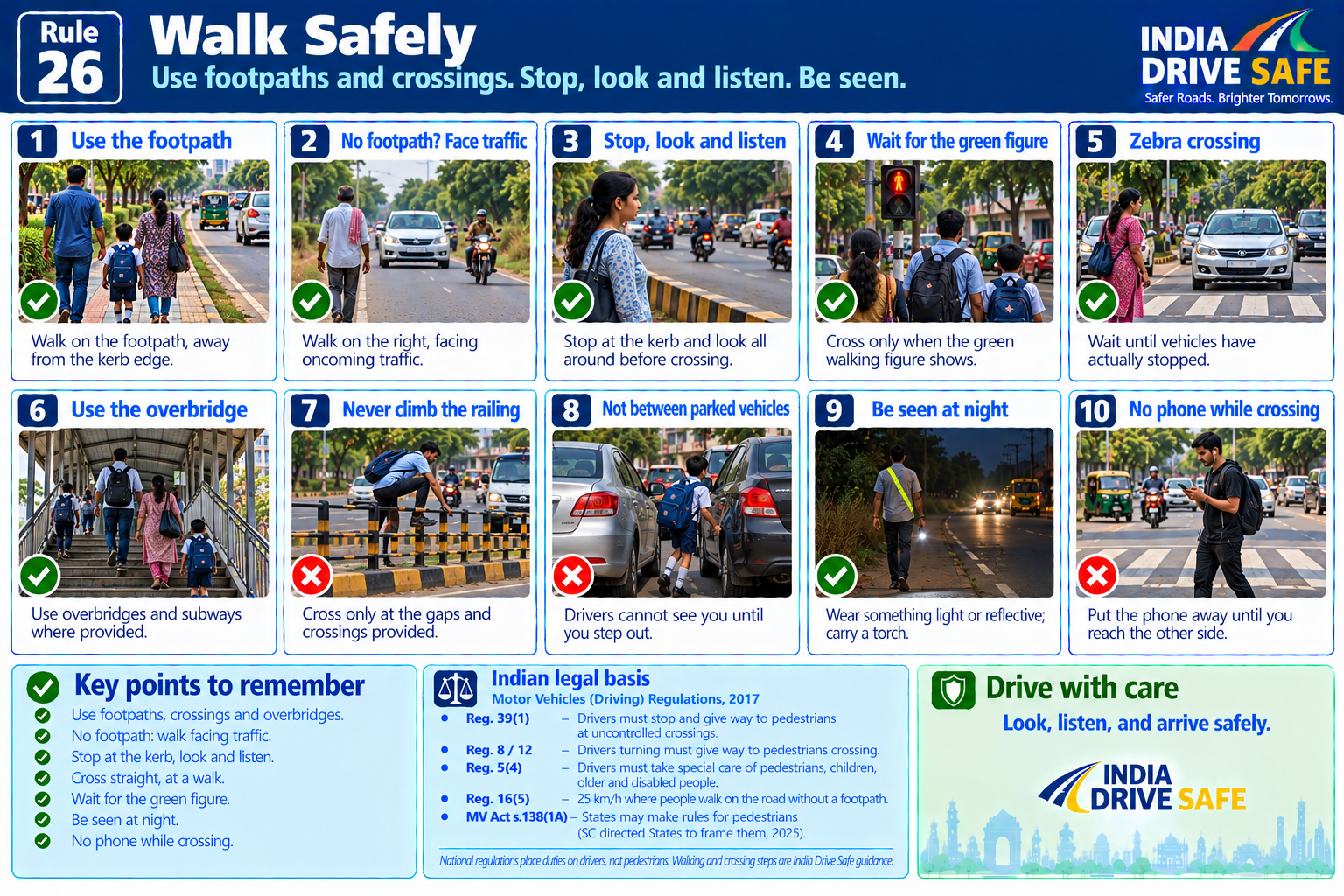
Everyone is a pedestrian at some point in the day: walking to the bus stop, crossing to a shop, or stepping out of a parked car. In 2023, more than 35,000 pedestrians were killed on Indian roads, about one in every five road deaths. Rule 08 explains what drivers must do to protect people on foot. This article is for the person walking.
Use footpaths, crossings, foot overbridges and subways where they exist. Where there is no footpath, walk facing oncoming traffic. Before you cross, stop at the kerb, look both ways and listen, and cross only when the road is clear. Be seen, and never assume a driver has seen you.
What Indian law says about pedestrians
The Motor Vehicles (Driving) Regulations, 2017 place their duties on drivers, not on people walking. For pedestrians they mainly set out the priority drivers must give them:
- at an uncontrolled pedestrian crossing (a zebra crossing without signals), drivers must slow down, stop and give way to pedestrians and wheelchair users (Regulation 39(1));
- drivers turning left or right must give way to pedestrians crossing (Regulations 8 and 12), and must not stop on a crossing or within five metres before it (Regulation 22);
- drivers must take special care of pedestrians, especially children, older people and people with disabilities (Regulation 5(4)); and
- where there is no footpath and people walk on the road, the speed limit is 25 km/h (Regulation 16(5)).
Section 138(1A) of the Motor Vehicles Act, added in 2019, lets State Governments make rules for the movement of pedestrians and non-motorised road users. In October 2025 the Supreme Court directed every State and Union Territory to frame these rules within six months, and ordered audits of footpaths and pedestrian crossings in 50 cities (S. Rajaseekaran v. Union of India). Some States and cities also have their own rules, for example against crossing a road away from crossings. Check the rules where you live.
Having priority at a crossing does not protect you if a driver does not stop. The advice below is India Drive Safe guidance, based mainly on the UK Highway Code rules for pedestrians.
Where to walk
- use the footpath where there is one, and walk away from the kerb edge, with your back to the buildings where possible;
- where there is no footpath, walk on the right-hand side of the road, so that you face oncoming traffic and can step aside. Keep as close to the edge as you can;
- on a sharp right-hand bend, cross to the other side before the bend so that drivers coming round it can see you, then cross back afterwards;
- walk in single file on narrow or busy roads, and keep children on the side away from traffic; and
- do not walk on expressways or access-controlled highways. They are built for fast motor traffic, and many prohibit slow road users altogether (Rule 09).
How to cross the road
Follow these steps every time, even on a quiet road:
- Find the safest place. Use a foot overbridge, subway, signal-controlled crossing or zebra crossing if there is one nearby. Otherwise choose a place where you can see clearly in both directions and drivers can see you. Avoid bends, the brows of hills, and gaps between parked vehicles.
- Stop at the kerb, a little back from the edge.
- Look all around and listen. Traffic may come from either direction, including two-wheelers in the wrong lane and vehicles reversing. Electric vehicles may make almost no sound (Rule 22).
- Wait until it is safe. Let traffic pass. If a vehicle stops for you, check that traffic in the other lanes has also stopped before you go.
- Look and listen again, then cross straight across, walking, not running. Keep looking and listening as you cross.
At crossings and signals
- at a signal-controlled crossing, wait for the green walking figure. Do not start to cross when it is red or flashing, even if the road looks clear;
- at a zebra crossing, drivers must give way to you, but wait until vehicles have actually stopped before you step out;
- at junctions, watch for vehicles turning into the road you are crossing, including those turning left on red (Rule 19);
- on wide roads with a central median or refuge, treat each half as a separate crossing. Stop on the median and look again; and
- where the authorities have fitted railings or barriers, cross only at the gaps provided. Never climb over medians or railings.
Places that need extra care
- Buses: never cross in front of or behind a stopped bus. Wait until it has moved off and you can see the road clearly;
- parked vehicles: if you have to cross between them, stop at the outer edge of the vehicles and look all around before stepping out;
- one-way streets: check which way the traffic is going before you cross, and still look both ways for riders going the wrong way;
- railway level crossings: use only the proper crossing, and never cross when the barriers are down or a train is signalled (Rule 13); and
- getting out of a vehicle: get out on the footpath side and walk round, not into traffic.
Be seen
- wear light or bright clothes by day, and reflective strips or a reflective band after dark. A pedestrian in dark clothes is very hard for a driver to see at night;
- carry a torch on unlit roads, or use your phone's light;
- remember that headlights from oncoming vehicles can dazzle drivers coming towards you; and
- in fog, rain or dust, assume drivers can see much less than usual (Rule 11).
Stay alert
- do not look at your phone or wear earphones while crossing;
- take extra care after drinking alcohol, which slows your judgement and reactions on foot too; and
- never step back into the road to avoid a crowd or an obstruction without looking behind you first.
Children, older people and people with disabilities
- young children should not be out on the road alone. Hold their hand near traffic, and teach the crossing steps by doing them together;
- children find it hard to judge the speed and distance of vehicles, and may dart out suddenly. Choose routes with crossings and footpaths for walking to school;
- older people may need more time to cross. Use signal-controlled crossings where possible, and do not hurry across; and
- people who are blind or partially sighted may use a white cane, and people who are both deaf and blind a cane with red bands. Drivers must take special care of them (Regulation 5(4)).
Common mistakes
Where there is no footpath, walk on the right, facing vehicles.
Drivers cannot see you until you step out.
Stop, look, listen, and walk straight across when it is clear.
Use the overbridge, subway or crossing provided.
Wear something light or reflective, and carry a torch.
Put the phone away until you reach the other side.