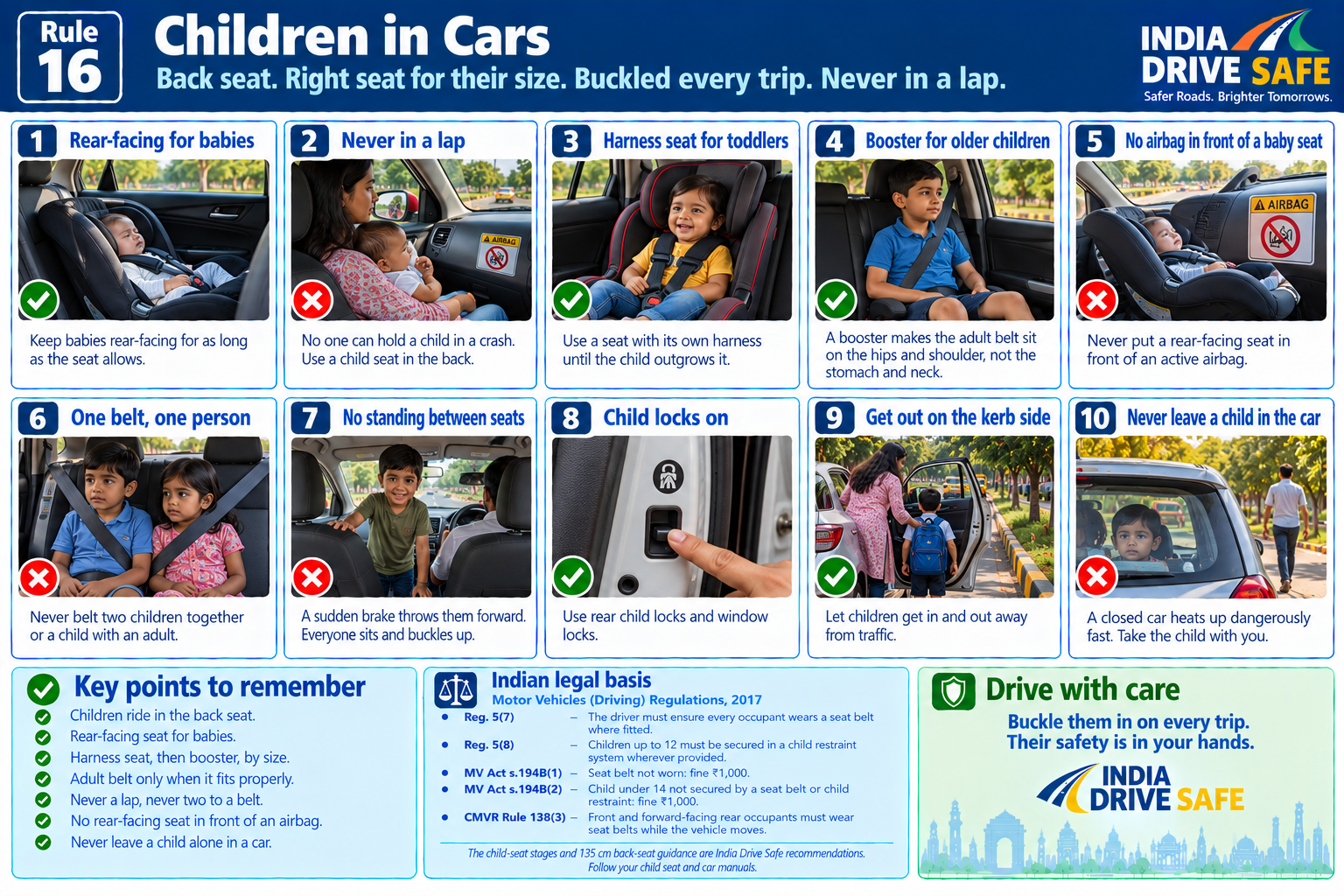
In India it is still common to see a baby in a parent's lap in the front seat, children standing between the front seats, or three children sharing one seat belt. In a crash or even a hard brake, an unrestrained child is thrown forward with enormous force, and no adult's arms can hold them. A child seat or a properly fitted seat belt is the only thing that keeps a child in place.
Every child, on every trip: in the back seat, in a child seat or booster that suits their size, until an adult seat belt fits them properly. Never in a lap, never in front of an airbag, never sharing a belt.
What Indian law clearly requires
- Regulation 5(7) of the Motor Vehicles (Driving) Regulations, 2017: the driver must make sure that they and all other occupants wear seat belts where the vehicle has them.
- Regulation 5(8): the driver must make sure that children up to the age of 12 are secured in a child restraint system wherever one is provided.
- Section 194B(1) of the Motor Vehicles Act, 1988: driving without a seat belt, or carrying passengers who are not wearing one: fine of ₹1,000.
- Section 194B(2): driving with a child under 14 who is not secured by a seat belt or a child restraint system: fine of ₹1,000.
- Rule 138(3) of the Central Motor Vehicles Rules, 1989: the driver, the front passenger and passengers in forward-facing rear seats must wear seat belts while the vehicle is moving.
States are enforcing these rules more actively. In 2024, for example, the Kerala Motor Vehicles Department announced that children under four must use a car seat, children aged 4 to 14 who are 135 cm or shorter must use a booster cushion with a seat belt, and children under 135 cm must not travel in the front seat.
Why a lap is not safe
In a crash at ordinary city speeds, a child's body is thrown forward with a force many times its own weight. No one can hold on to a child against that force. A child on an unbelted adult's lap can also be crushed between the adult and the dashboard, or hit by an opening airbag. Holding a baby in your arms is never a substitute for a child seat.
The right restraint at each stage
Choose by your child's height and weight, following the seat maker's limits, rather than by age alone. A widely used sequence, based on UK and Australian rules, is:
| Stage | Restraint | Notes |
|---|---|---|
| Babies | Rear-facing infant seat | Keep the child rear-facing for as long as the seat allows, at least until about 15 months. Rear-facing seats protect a baby's head and neck best. |
| Toddlers and young children | Rear- or forward-facing seat with its own harness | Move to forward-facing only when the child has outgrown the rear-facing seat. |
| Older children | Booster seat used with the adult seat belt | Lifts the child so the belt sits across the hips and shoulder, not the stomach and neck. |
| About 135–145 cm tall and over | Adult seat belt | Only when the belt fits properly (see the five-step test below). |
Buy a child seat approved to a recognised safety standard, such as India's AIS-072 or the European ECE R44 or R129 approval. Never use a second-hand seat that has been in a crash or has no label.
Is your child ready for an adult seat belt? The five-step test
- Can the child sit with their back flat against the seat back?
- Do their knees bend comfortably at the edge of the seat?
- Does the lap part of the belt sit low across the hips and upper thighs, not the stomach?
- Does the shoulder part of the belt cross the middle of the shoulder and chest, not the neck or face?
- Can the child stay seated like this for the whole trip?
If the answer to any question is "no", the child still needs a booster seat.
Children belong in the back seat
- the back seat is the safest place for any child;
- never put a rear-facing baby seat in front of an active airbag. An opening airbag strikes the back of the seat close to the baby's head. If you must use the front seat, the airbag must be switched off as the car's manual explains;
- keep children in the back until they are tall enough for the adult belt to fit properly; India Drive Safe recommends at least 135 cm, and ideally 12 years of age; and
- never seat a child where they could be hit by a side airbag while leaning against the door.
Fit it right
- follow both the child-seat manual and the car manual;
- use the car's ISOFIX anchor points if the car and seat have them; they make correct fitting much easier;
- a fitted seat should move no more than a few centimetres when you push it side to side at the belt path;
- the harness should be snug: you should not be able to pinch a fold of strap at the child's shoulder;
- never put the shoulder belt behind the child's back or under the arm; and
- never belt two children, or a child and an adult, with one seat belt.
Every trip, every time
- short trips to school, tuition or the market are where most children travel. Use the seat on these too;
- in taxis and cabs, carry a portable booster or travel seat, and use the rear seat belts;
- set the example: if every adult in the car wears a seat belt, children accept theirs; and
- a child asleep must stay buckled in.
Safety around the car
- use the child locks on the rear doors, and window locks if the car has them;
- let children get in and out on the kerb side, away from traffic;
- walk around the vehicle before reversing (Rule 10); and
- never leave a child alone in a parked car, even for a few minutes. A closed car in the Indian sun becomes dangerously hot very quickly.
Pregnancy
Pregnant women must still wear a seat belt. Place the lap belt low, under the bump and across the hips, and the shoulder belt between the breasts and to the side of the bump. Never place the belt across the bump itself.
Choosing a car
Bharat NCAP, India's car crash-test programme, gives every tested car a separate star rating for child occupant protection. Check it when you choose a family car, and look for ISOFIX anchors and rear three-point seat belts in every seat.
Common mistakes
No one can hold a child in a crash, and the airbag can strike them. Use a rear-facing seat in the back.
Keep babies rear-facing as long as the seat allows.
Use a booster until the five-step test is passed.
One person, one belt, always.
A sudden brake throws them into the windscreen. Everyone sits and buckles up.
Heat builds fast. Take the child with you.