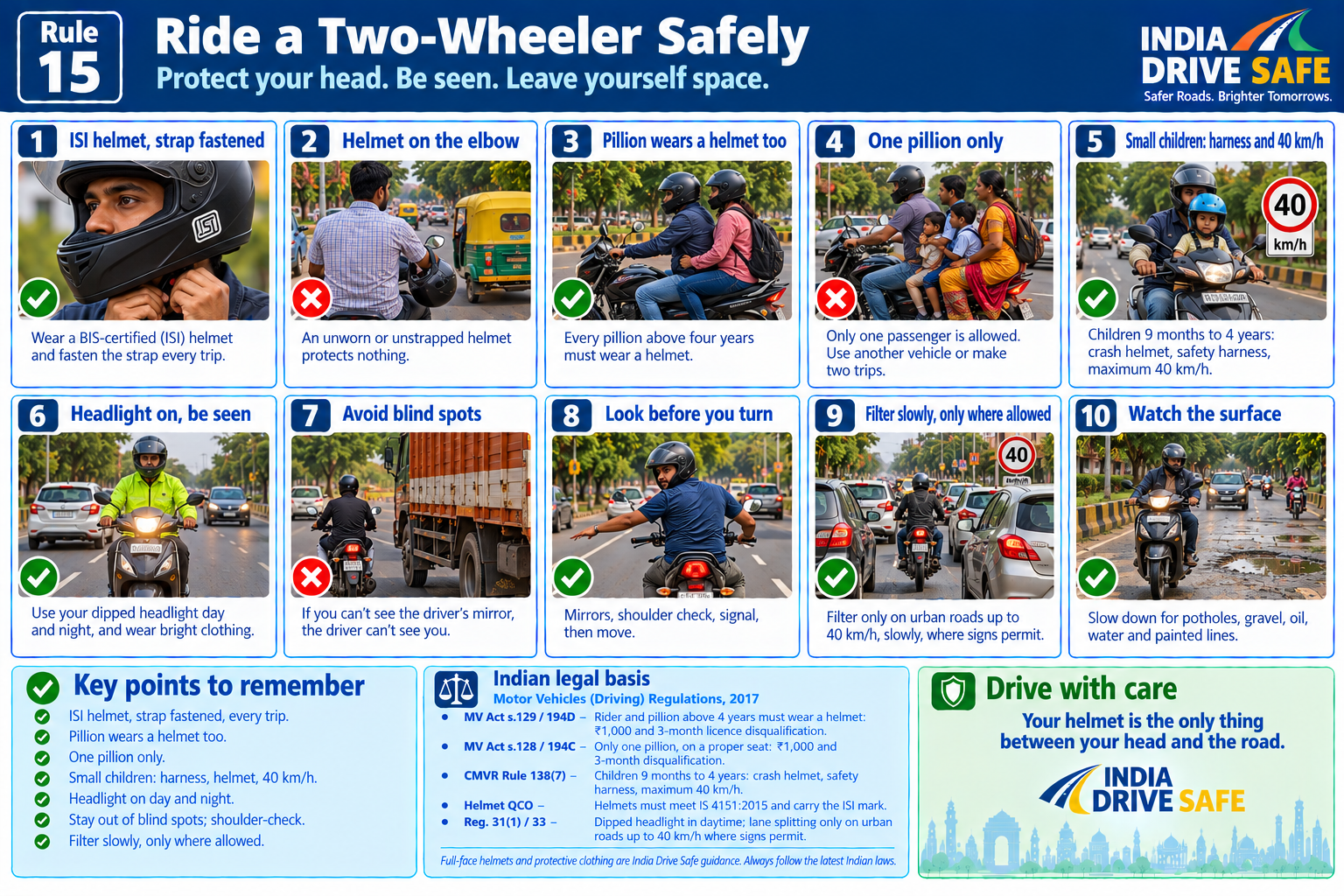
Motorcycles and scooters carry millions of Indian families to work, school and market every day. They are also the most dangerous way to travel on the road: a rider has no roof, no seat belt and no airbag, and in a crash the rider's body takes the impact. Riding safely is about three things above all: protect your head, be seen, and leave yourself space.
Every rider and every pillion wears a BIS-certified helmet with the strap fastened, on every trip, however short. Carry only one pillion, ride where others can see you, and never squeeze into a gap that is not there.
What Indian law clearly requires
- Helmets (Section 129 of the Motor Vehicles Act, 1988, and Regulation 5): every person driving or riding on a motorcycle, including the pillion and any child above four years of age, must wear protective headgear meeting the prescribed standard. Turban-wearing Sikhs are exempt.
- Helmet penalty (Section 194D): a fine of ₹1,000 and disqualification from holding a driving licence for three months.
- Certified helmets only: since 1 June 2021, helmets for two-wheeler riders must meet IS 4151:2015 and carry the BIS ISI mark. Making or selling uncertified helmets is an offence.
- One pillion only (Section 128): a motorcycle may carry no more than one person besides the rider, sitting on a proper seat fixed behind the rider, with safety measures such as footrests. Breaking this rule carries a ₹1,000 fine and a three-month licence disqualification (Section 194C).
- Children aged 9 months to 4 years (Rule 138(7) of the Central Motor Vehicles Rules, in force since 15 February 2023): the child must wear a crash helmet that fits and a safety harness attaching them to the rider, and the motorcycle must not go faster than 40 km/h.
- Regulation 5: hold the handlebar with both hands except when signalling; keep your feet on the footrests unless the road requires otherwise; never hold on to or push another vehicle while riding.
- Regulation 31(1): two-wheeler riders must use dipped headlights in the daytime as well as at night.
- Regulation 33: riding between lanes of slower cars (lane splitting) is allowed only in urban areas on roads with a speed limit of 40 km/h or less, where signs permit it, and when you are no more than 15 km/h faster than the traffic you pass.
- Regulations 37 and 39: no hand-held phone while riding, and never ride on footpaths or cycle tracks.
Your helmet: the most important thing you wear
- Buy an ISI-marked helmet to IS 4151:2015 from a proper shop. Cheap "construction" caps and uncertified helmets give almost no protection.
- Fasten the chin strap every time. An unfastened helmet flies off in a crash before your head hits the road.
- Choose the right size. It should sit level and snug, and should not move when you shake your head.
- A full-face helmet protects your jaw and face as well; India Drive Safe recommends it wherever possible.
- keep the visor clean and unscratched, and replace a helmet that has been in a crash or dropped hard, even if it looks fine; and
- the pillion needs a helmet too. Carry a second helmet whenever you may carry a passenger.
Dress to survive a fall
Gloves, closed shoes and a jacket that covers your arms reduce injuries in a fall. Slippers and sandals give no protection and slip off the footrests. A bright jacket or reflective strips help other road users see you.
Be seen
The most common crash for riders is a driver who says "I didn't see the motorcycle". Make yourself as easy to see as possible.
- keep your dipped headlight on, day and night (Regulation 31);
- wear bright or reflective clothing, and a light-coloured helmet if you can;
- ride where drivers ahead can see you in their mirrors, not in their blind spots;
- stay out of the blind spots beside and behind trucks and buses. If you cannot see the driver's mirror, the driver cannot see you; and
- at junctions, assume drivers waiting to pull out have not seen you. Slow down and be ready to brake.
Road position and filtering
- keep to the left part of your lane in normal traffic, with space from the edge for potholes and gravel;
- use the whole lane width when needed to stop cars squeezing past you dangerously, for example on narrow bends;
- do not weave between lanes at speed. Filter between slow or stopped traffic only where Regulation 33 allows it, slowly, and watch for doors opening, pedestrians crossing and cars changing lanes; and
- never undertake a vehicle that is turning left, or ride up the left side of a bus or truck at a junction.
Turning, braking and road surfaces
- before every turn or lane change, check your mirrors and look over your shoulder, then signal (Rule 02);
- use both brakes together, smoothly and progressively, and brake mostly while upright rather than leaning in a bend;
- slow down before bends, not in them;
- watch for potholes, gravel, sand, oil, wet manhole covers, painted lines and speed breakers, which are much more dangerous on two wheels; and
- in the rain, slow down, brake earlier and gentler, and avoid painted markings and metal covers.
Carrying a pillion
- carry only one passenger (Section 128), wearing a fastened helmet;
- the pillion should sit astride the seat where possible, facing forward, feet on the footrests and holding on to you or the grab rail;
- a passenger sitting side-saddle should hold on firmly, and loose clothing such as a saree or dupatta must be kept clear of the wheel and chain; the saree guard must be fitted;
- a passenger changes how the motorcycle brakes and handles. Ride more gently and leave more distance; and
- the pillion should not lean against you in bends or wave and gesture to others.
Children on two-wheelers
- for children from 9 months to 4 years: a fitted crash helmet, a safety harness attaching the child to the rider, and a maximum speed of 40 km/h (Central Motor Vehicles Rules, Rule 138(7));
- children above four must wear a helmet like any other rider (Section 129);
- never let a child stand in front of you or sit on the fuel tank, where they block the handlebar and are thrown first in any crash; and
- a family of three, four or five on one motorcycle is illegal and extremely dangerous. Use another vehicle or make two trips.
Loads
Do not carry loads that stick out sideways, block your view, hide your lights or make the motorcycle unstable. Never carry gas cylinders, glass sheets or long rods on a two-wheeler. Never hold on to or tow another vehicle, and never let your motorcycle be towed by a rope (Regulations 5 and 30).
Check your machine
- tyres: correct pressure and enough tread;
- brakes: both working and firm;
- lights, indicators and horn working;
- chain correctly adjusted and lubricated; and
- both mirrors fitted and adjusted. Riding with mirrors removed or turned inwards takes away your view behind.
Common mistakes
It protects nothing there. Head on, strap fastened, every trip.
The law requires it, and the passenger's head hits the road just as hard.
One pillion only. Extra people make the motorcycle unstable.
Filtering is allowed only slowly, on urban roads up to 40 km/h, where signs permit.
If you cannot see the driver's mirror, the driver cannot see you.
Hand-held phone use is prohibited and takes your attention off the road.