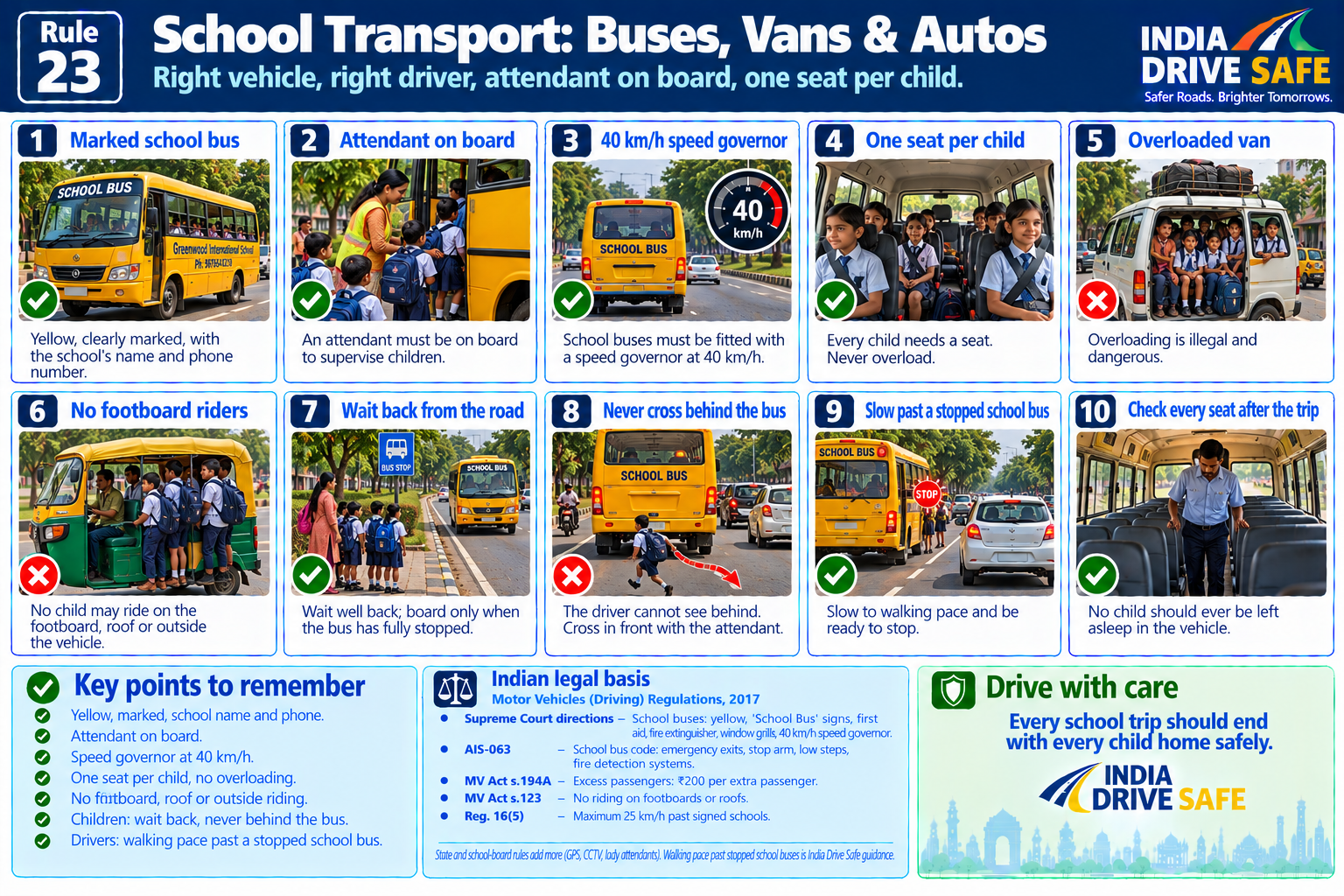
Every school day, millions of Indian children travel in school buses, vans, autos and cycle-rickshaws. Courts, the Central Government, school boards and States have all set rules to make these journeys safe, but the rules work only when schools, transport operators, drivers and parents check that they are being followed. This article explains what to look for and what every road user should do around school transport.
Children's transport must never be overloaded, rushed or unsupervised. Parents should check the vehicle and driver, children should learn safe boarding habits, and every driver should slow right down near school buses and vans.
What the rules require for school buses
The Supreme Court has issued directions for school buses, which are widely applied by State transport departments and schools. Key requirements include:
- the bus painted yellow, with "SCHOOL BUS" written on the front and back; a hired bus must show "ON SCHOOL DUTY";
- a first-aid box and a fire extinguisher;
- horizontal grills on the windows;
- the school's name and telephone number written on the bus;
- doors fitted with reliable locks;
- an attendant from the school on board;
- a speed governor limiting the bus to 40 km/h;
- a driver holding a valid transport-vehicle licence with several years of experience; and
- enough space inside for school bags, which must not hang outside.
The school bus body code (AIS-063)
Buses built as school buses must also meet the Automotive Indian Standard AIS-063, which requires among other things:
- golden-yellow colour with a golden-brown band and the school bus symbol front and rear;
- emergency exits, with a buzzer alerting the driver if a door opens;
- a low first step (no more than 300 mm from the ground) and handholds for small children;
- forward-facing seats of a minimum size for each child, and racks under the seats for bags;
- a stop arm that swings out with the word "STOP" and switches on the hazard lights automatically when the door opens; and
- fire detection and alarm systems (and, from 2020, fire suppression systems).
School board and State rules
- CBSE (2017) requires affiliated schools to fit GPS and CCTV, keep speed governors at 40 km/h, provide a trained lady attendant, appoint a transport manager and encourage a parent to travel on each bus.
- States add their own rules. For example, Maharashtra's 2026 amendment requires CCTV, GPS tracking with a panic button and parent app, seat belts on every seat, police verification and medical checks for drivers and attendants, lady attendants for children up to Class V, and regulated fares.
Check the rules of your State and your child's school board.
School vans, autos and cabs
- vans, autos and cabs carrying schoolchildren must be registered and permitted for that use, insured and fit, and driven by a licensed driver;
- overloading is illegal and dangerous. Carrying more passengers than permitted is an offence (Section 194A of the Motor Vehicles Act, ₹200 per extra passenger), and children count as passengers;
- children must sit inside, never on laps in the front, on the driver's seat, on the footboard or hanging outside (Section 123);
- use seat belts where fitted (Section 194B covers children under 14); and
- bags should be inside the vehicle, not tied to the outside or roof.
A checklist for parents
- Is the vehicle clearly marked as school transport, in good condition, with working lights and doors?
- Is there an attendant on board, and for young children a lady attendant where required?
- Does every child have a seat, without squeezing?
- Are first-aid, a fire extinguisher, emergency exits and (where required) GPS and CCTV in place?
- Has the school verified the driver's licence, experience and background? Ask the school's transport manager.
- Does the driver drive calmly and within the speed limit? Ask your child, and watch at pick-up.
- Do you have the driver's, attendant's and school transport manager's phone numbers?
If something is wrong, raise it with the school in writing. Schools are responsible for the transport they provide or arrange.
Teach your child
- wait for the bus well back from the road edge, not on the road;
- board and get off only when the vehicle has stopped completely and the attendant says so;
- never walk or run behind the bus. If you must cross, do it with the attendant, well in front where the driver can see you, and only after looking both ways;
- never go back for a dropped item near the bus. Tell the driver or attendant first;
- stay seated, keep hands and head inside, keep the gangway clear; and
- tell your parents if the driver drives fast, uses a phone, or anyone makes you feel unsafe.
For all drivers: around school buses and vans
- when a school bus or van is stopped with its hazard lights or stop arm out, slow down to walking pace and be ready to stop, whichever direction you are coming from. A child may run across;
- never overtake a school bus that is stopping or moving off near a school;
- near schools, obey the 25 km/h limit where signed (Regulation 16(5)) and keep well below it at opening and closing times (Rule 08); and
- do not park on the approach to the school gate or in a way that hides children from traffic (Regulation 22; Rule 10).
New Zealand sets a legal limit of 20 km/h when passing a stationary school bus in either direction. India Drive Safe recommends the same behaviour on Indian roads.
For school transport drivers
- keep within the speed governor and the speed limit, and never race to make up time;
- never carry more children than seats;
- never use a phone while driving (Regulation 37), and never drink before driving (Rule 14);
- wait until every child is seated before moving, and until children are clear of the vehicle before pulling away;
- check all round the bus, including in front and behind, before every move; and
- at the end of every trip, walk through the vehicle to make sure no child has been left behind asleep.
Common mistakes
Overloading is illegal. Every child needs a seat.
Prohibited by Section 123, and deadly in a sudden stop.
The driver cannot see them. Cross in front with the attendant.
Slow to walking pace. A child may run out.
Required by the Supreme Court's directions. Ask the school.
Drivers and attendants must check every seat after each trip.