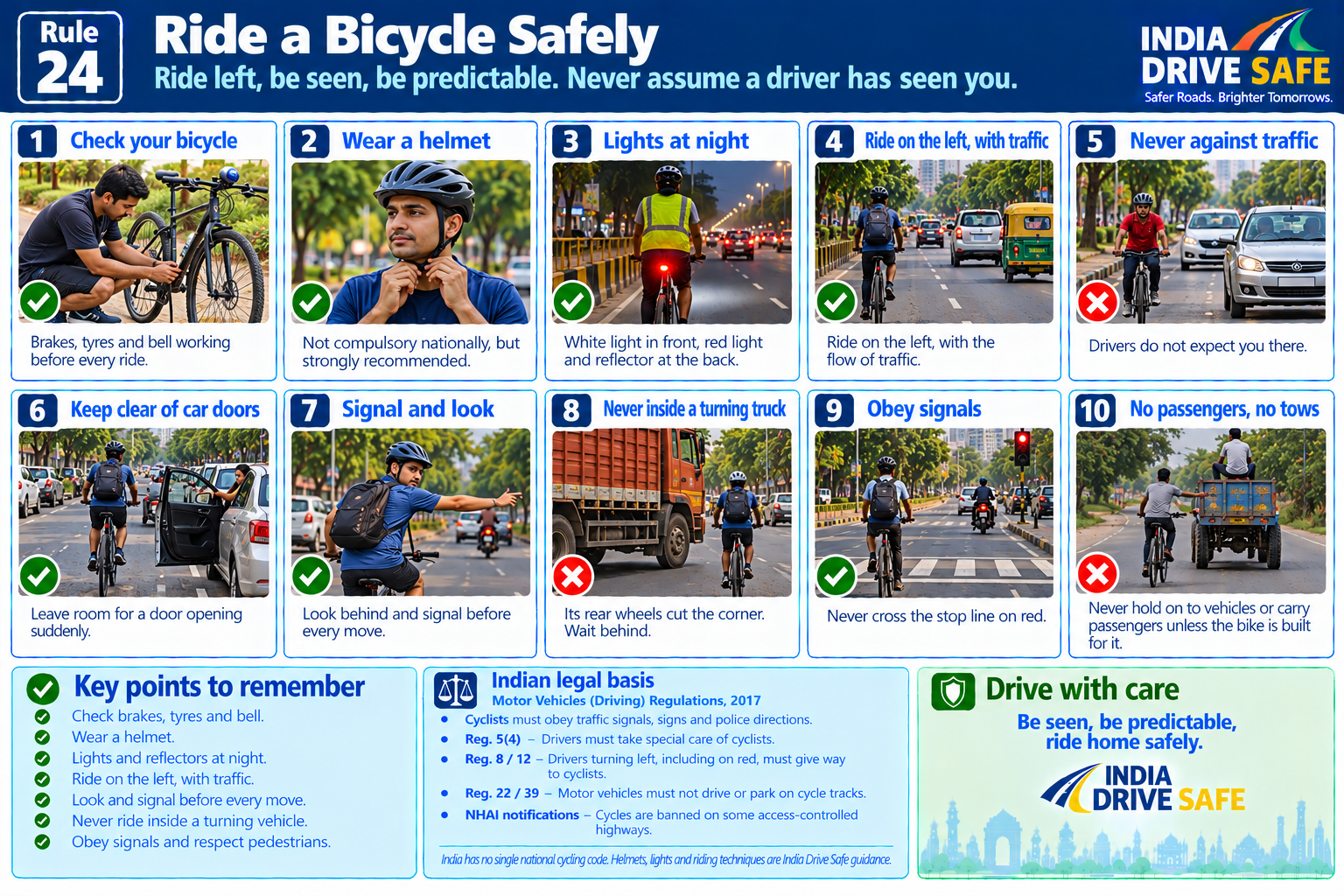
Bicycles carry schoolchildren, workers, delivery riders and fitness riders across India every day. Cyclists are among the most vulnerable road users: they are small, slow compared with traffic, and have no protection in a crash. Rule 08 explains how drivers must protect cyclists. This article is for the person on the bicycle.
Ride on the left, be seen, be predictable, and obey the same signals and signs as other traffic. Wear a helmet, use lights at night, and never assume a driver has seen you.
What Indian law says about cycling
India has no single national code for cyclists. The Motor Vehicles Act, 1988 and the Motor Vehicles (Driving) Regulations, 2017 mainly govern motor vehicles. Cycling is also covered by State and city traffic rules and police directions, so details vary from place to place. In practice:
- cyclists must obey traffic signals, signs and the directions of traffic police, like everyone else on the road;
- cycles are prohibited on some roads. NHAI has banned cycles, along with two- and three-wheelers and other slow vehicles, from several access-controlled highways by notification under the Control of National Highways (Land and Traffic) Act, 2002. Some cities also bar cycles from particular flyovers and sea links. Read the signs at every entry (Rule 09);
- a bicycle helmet is not compulsory under national law, but India Drive Safe strongly recommends one; and
- the law protects cyclists mainly by placing duties on drivers: special care for cyclists (Regulation 5(4)), giving way to cyclists when turning left (Regulation 8), no driving or parking on cycle tracks (Regulations 22 and 39), and letting cyclists cross at red-light left turns (Regulation 12).
Because the detailed rules vary, India Drive Safe recommends that cyclists follow the same rules of the road taught in this guide: keep left, obey signals and signs, and give way where a driver would have to.
Your bicycle
- Brakes: both must stop you firmly. Check them before every ride, and more carefully in the rain;
- tyres: correctly inflated and not worn;
- bell: fitted and working, to warn pedestrians and other riders;
- lights at night: a white light at the front and a red light at the back, plus a red rear reflector and pedal reflectors (this is the UK legal standard and India Drive Safe's recommendation); and
- size: you should be able to put a foot on the ground when stopped. Children often ride bikes that are too big.
Be seen
- wear light or bright clothing by day and reflective items at night;
- switch on your lights from dusk to dawn and in rain, fog or dust;
- ride where drivers can see you, not in the blind spots of trucks and buses (Rule 17); and
- make eye contact with drivers at junctions, but do not rely on it.
Where to ride
- ride on the left, with the flow of traffic, never against it;
- keep about a door's width away from parked cars, so that an opening door does not hit you;
- use cycle tracks and lanes where they exist and are usable (Regulation 39 keeps motor vehicles out of them);
- do not ride on footpaths, which belong to pedestrians;
- ride in single file on narrow or busy roads; and
- avoid highways where traffic is fast and cycles are banned or unsafe.
Signal, look and be predictable
- keep both hands on the handlebar except when signalling, and both feet on the pedals;
- look behind before you move off, turn, change position or pass a parked vehicle;
- give clear arm signals: left arm out to turn left, right arm out to turn right; and
- ride in a straight line. Weaving between vehicles surprises drivers.
Junctions and turns
- Left-turning vehicles are the biggest danger. Never ride up the left side of a bus, truck or car that is turning left or about to. Stay behind it;
- to turn right on a busy road, check behind, signal, and move to the right side of your lane when safe. If that feels unsafe, stop at the left edge and cross like a pedestrian when the road is clear;
- obey traffic lights. Never cross a stop line on red; and
- at roundabouts, keep left and watch for vehicles leaving across your path. You may get off and walk across if that is safer (Rule 07).
Respect pedestrians
- give way to pedestrians at crossings, and get off and walk across zebra crossings;
- use your bell early and gently, and slow down near people, especially children, older people and anyone with a white cane; and
- never ride on the footpath to escape traffic.
Things never to do
- carry a passenger unless the bicycle is built for one, with a proper seat;
- hold on to a moving truck, tractor or auto to get a tow;
- use a phone or wear earphones while riding;
- carry loads that block your view, unbalance you or catch in the wheels; or
- ride after drinking alcohol.
Children on bicycles
- young children should ride with an adult until they can control the bike, look behind, signal and judge traffic;
- start in parks and quiet lanes, not on main roads;
- a helmet, a bell, working brakes and lights are essential; and
- plan a school route with the least traffic, and practise it together first.
Common mistakes
Drivers do not expect you there. Always ride on the left.
You are invisible to drivers. White front, red rear.
Its rear wheels cut the corner. Wait behind.
Cyclists must obey signals too.
Leave a door's width to avoid opening doors.
A sudden brake or turn throws you under its wheels.