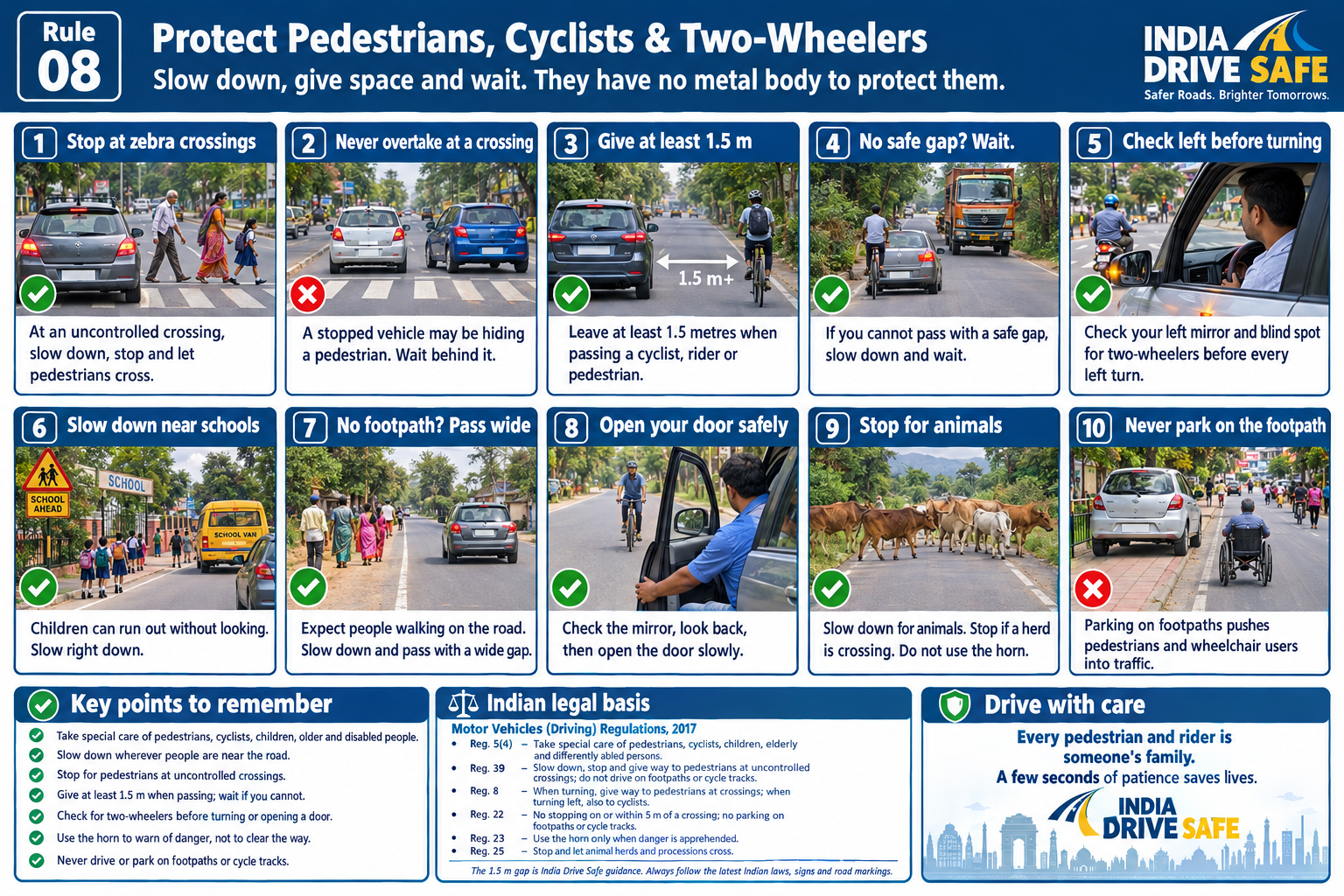
Pedestrians, cyclists, two-wheeler riders, children, older people and people with disabilities have no metal body, seat belt or airbag to protect them. A mistake that would only dent a car can kill one of them. Indian roads are shared by all of these users at once, often on the same strip of road, so every driver needs a habit of looking for them and giving them room.
If a person outside a vehicle could be hurt by your next move, slow down and give them space. If you cannot pass with a safe gap, wait.
Who are vulnerable road users?
Anyone who would be badly hurt in a collision with your vehicle. On Indian roads that includes:
- pedestrians, including people walking on the carriageway where there is no usable footpath;
- children, who are small, quick and hard to see;
- older people, who may need more time to cross;
- people with disabilities, including wheelchair users and people who are blind, partially sighted or hard of hearing;
- cyclists and cycle-rickshaw riders;
- motorcycle and scooter riders and their pillion passengers;
- hand-cart pushers, street vendors and people loading or unloading at the roadside; and
- animals on the road and the people herding them.
What Indian law clearly requires
The Motor Vehicles (Driving) Regulations, 2017 place clear duties on drivers:
- Regulation 5(4): drivers and riders must take special care to protect the most vulnerable road users, namely pedestrians, cyclists, children, elderly persons and differently abled persons.
- Regulation 3: you must not drive, stop or park in a way that endangers or inconveniences other road users.
- Regulation 39: at an uncontrolled pedestrian crossing you must slow down, stop and let pedestrians and wheelchair users cross. You must not enter a crossing if you might get stuck on it, and you must not drive on a footpath or cycle track unless a police officer or a sign permits it.
- Regulation 8: when turning, give way to pedestrians at uncontrolled crossings. When turning left, also give way to cyclists and slow traffic.
- Regulation 22: do not stop on a pedestrian crossing or within 5 metres before it. Do not park on a footpath, cycle track or pedestrian crossing.
- Regulation 23: use the horn only when you apprehend danger (or where a sign requires it), never continuously, and not in silence zones.
- Regulation 25: slow down and pass processions and herds of animals with care. If they are crossing the road, stop and let them cross.
Speed decides who survives
A pedestrian hit at walking-pace speeds usually survives. The same pedestrian hit at highway speeds usually does not. The UK Highway Code notes that a pedestrian hit at 40 mph (about 64 km/h) will probably be killed, while at 20 mph (about 32 km/h) the risk is about one in twenty.
Wherever people are walking close to traffic, such as markets, school gates, bus stops, temple and hospital entrances, village roads and residential lanes, slow to a speed at which you could stop for someone who steps out without warning. Obey every posted speed limit. Where no lower limit is posted, India Drive Safe recommends no more than 20–25 km/h in crowded streets and when children are near the road.
Pedestrian crossings
- Look well ahead for crossings and people waiting at them.
- Slow down early enough to stop smoothly before the stop line or crossing.
- Stop and let people cross. Wait until they have crossed your path completely, not just your lane.
- Do not rev your engine, edge forward or sound the horn to hurry them.
- Do not stop on the crossing in slow traffic. Wait behind it until there is room on the other side.
Never overtake a vehicle that is slowing or stopped at a crossing
The vehicle may be stopping for a pedestrian you cannot see. Overtaking it can put you straight into that person. UK law prohibits this at crossings (Highway Code rule 191). Indian regulations do not spell it out, but India Drive Safe teaches it as a firm safe-driving rule.
Where there is no footpath
On many Indian roads people have no choice but to walk on the carriageway, often with their backs to traffic, sometimes in dark clothing and at night. Treat every roadside edge as a place where a person may be walking.
- reduce speed when you see people walking along the road;
- move out and pass them with a wide gap, as you would a cyclist;
- if oncoming traffic stops you moving out, slow down and wait behind; and
- never sound a long horn blast behind a walker. A short tap, if needed at all, is enough.
Give space when you pass
Cyclists, two-wheelers, cycle-rickshaws, hand-carts and pedestrians can wobble, swerve around a pothole or be pushed sideways by the air from a passing vehicle.
Indian law does not set a fixed passing distance. The 1.5-metre figure is an India Drive Safe recommendation drawn from other left-driving countries:
- United Kingdom: the Highway Code advises at least 1.5 metres when overtaking cyclists at speeds up to 30 mph, and more at higher speeds.
- New South Wales: the law requires at least 1 metre at speed limits up to 60 km/h and 1.5 metres above 60 km/h.
- New Zealand: since 1 October 2026, the law requires a 1.5-metre gap when passing cyclists, horse riders and other unprotected road users.
Overtake only where it is legal and safe to do so (see Rule 04). Do not squeeze past in the same lane.
Turning: the most common danger point
Turning left
Cyclists, scooters and motorcycles often travel along your left side, in exactly the place you are about to turn across.
- check your left mirror and look over your left shoulder before you turn;
- do not overtake a cyclist and then immediately turn left across their path; stay behind them instead;
- give way to pedestrians crossing the road you are turning into; and
- turn slowly so that you can still stop if someone appears.
Turning right
Oncoming motorcycles are small and their speed is easy to misjudge. Look twice, and if you are unsure how fast a two-wheeler is approaching, wait for it to pass.
Motorcycles and scooters
- check mirrors and blind spots before every lane change, turn or pull-out, because two-wheelers move into gaps quickly;
- expect riders to swerve around potholes, manholes, gravel, water and oil;
- leave a longer following distance, because a rider may brake or swerve suddenly for a pothole; and
- remember that a rider may be carrying a pillion passenger, including a child.
Regulation 33 allows motorcyclists to filter between slower vehicles only in limited urban conditions. Whether or not a rider is filtering legally, check for them before you change position.
Children
Children cannot judge speed and distance well. They may run out from behind a parked vehicle, a bus or a vendor's cart without looking.
- slow right down near schools, playgrounds, tuition centres and residential lanes, especially at opening and closing times;
- pass a stopped school bus or van very slowly and be ready to stop, whichever direction you are travelling (New Zealand sets a legal limit of 20 km/h for this);
- a ball, a bicycle or an adult waving near the road often means a child is close by; and
- before reversing, walk around your vehicle and check behind it. Small children cannot be seen in mirrors. Regulation 18 restricts reversing on public roads for good reason.
Older people and people with disabilities
- allow more time for older pedestrians to cross, and do not hurry them;
- a person with a white cane or guide dog may not see you; a white cane with a red band means the person may also be unable to hear you;
- a person who is hard of hearing may not react to your horn;
- wheelchair users may have to use the road where a footpath is blocked or has no ramp; give them the same wide gap as a cyclist; and
- never park on footpaths, kerb ramps or crossings. Doing so forces wheelchair users and parents with prams into traffic.
Opening your door
Regulation 5 requires care when getting in or out of a vehicle. An opening door is one of the most common causes of serious injury to cyclists and two-wheeler riders.
- check your mirror and look back over your shoulder before opening any door on the traffic side;
- open the door with your far hand (the left hand for the driver's door); this turns your body so you naturally look back. This is called the "Dutch reach";
- open the door slowly and only a little at first; and
- ask passengers in taxis, cabs and autos to get out on the kerb side.
Use the horn as a warning, not a weapon
Under Regulation 23, the horn is for warning of danger. A loud or continuous horn startles pedestrians, older people, children and animals, and can make them move unpredictably into your path. Slowing down is almost always safer than sounding the horn.
Animals on the road
- slow down when you see cattle, dogs, goats or other animals near the road; they can move without warning;
- pass herds slowly with plenty of room, and stop if they are crossing (Regulation 25);
- do not sound the horn or rev the engine close to animals; and
- at night, look for eyes reflecting your headlights, and reduce speed on unfenced roads.
If an animal suddenly appears, brake firmly in a straight line. A violent swerve into oncoming traffic or off the road can cause a far worse crash.
At night and in poor visibility
Pedestrians, cyclists, cycle-rickshaws and hand-carts are often unlit and wearing dark clothing. Drive at a speed that lets you stop within the distance you can see, and expect people at the road edge. Dip your headlights for oncoming traffic, including two-wheelers and pedestrians, so you do not dazzle them (Regulation 31).
If you drive a bus, truck or other large vehicle
Large vehicles have deep blind spots beside the cab, directly in front and behind. A cyclist or pedestrian can be completely hidden.
- check every mirror before moving off, turning or changing lanes, especially the left side;
- at a bus stop, check for passengers walking in front of the bus or running to catch it before you move; and
- when turning left, remember that your rear wheels cut a tighter path than the cab and can crush someone standing at the corner.
Common mistakes
The horn is a danger warning, not a right of way. Slow down and wait.
Leave at least 1.5 metres, or wait behind until you can.
Check the left mirror and over your shoulder before every left turn.
It may be stopping for a pedestrian you cannot see.
It is prohibited and pushes pedestrians and wheelchair users into traffic.
Check the mirror, look back, and use the far-hand reach.
A simple routine around vulnerable road users
Every pedestrian, cyclist and rider is someone's child, parent or grandparent. A few seconds of patience costs you almost nothing.